




I have been asked, more than once: "Are you obsessed with the 'Spiral Jetty?' "
If so, I'm not alone.
This may be quibbling, but actually I see the lure of artist Robert Smithson's world-famous (if not Utah-famous) earthwork swirl of salt-sprayed basalt boulders in the northern reaches of the Great Salt Lake as more the photogenic subject of a "chronicling impulse" than an obsession.
How often is a lifelong, camera-toting journalist and wanderer presented an opportunity to witness hour-to-hour and season-to-season, let alone year-to-year, changes occurring so visibly at one geographic location?
And that at a spot selected by a (literally) groundbreaking artist for a one-of-a-kind artwork precisely for its natural characteristics — to purposely expose his creation to "entropy," the gradual alterations wrought by erosive time upon matter: say, a simple, 1,500-foot-long rock jetty coiling into a salty inland sea.
Smithson was a New Jersey-born, New York-based conceptual artist and intellectual fascinated (obsessed?) by entropy, by spirals — an ancient design with many meanings — and by the idea of large-scale "earth art" away from the confines of traditional museums and exhibit rooms. He also kept in mind what his outdoor artwork might look like from the air — which was the only way to really see it for many years.
In 1970 Smithson envisioned an "immobile cyclone" in the pink water tinted by algae and bacteria off the Great Salt Lake's Rozel Point. It would be an artifact of what he described as our "Carboniferous Period," marooned in a zone of "modern prehistory" along with nearby castoff industrial debris.
Smithson outlined his jetty with poles and string in the then shallow water; hired a couple of dump trucks, an earthmover, a tractor and a perplexed crew; and built the "Spiral Jetty" with black boulders and earth from the site, leased from the state of Utah.
Tragically, he died three years later at age 35 in a plane crash while surveying another of his remote projects, "Amarillo Ramp," in Texas.
His notebooks are filled with fanciful sketches and diagrams. He wrote an essay about his jetty project and filmed the work as it was being done. He called all — the earthwork, the essay and the film — "Spiral Jetty," or "The Spiral Jetty."
Almost two dozen times in the film's narration, conjuring the view in every direction from the jetty's center, he intones:
"Mud, salt crystals, rocks, water."
The mantra is also found in Smithson's writings.
Thirty-five years later, New York Times critic Michael Kimmelman called Smithson's multimedia vision "cunning and prescient."
"He grasped that in the modern age a sculpture in the middle of nowhere could have a life separate from itself, through reproductions and other simulacra, which is how most people would see the work. …"
In other words, there is the Real Thing — the "Spiral Jetty" in the outback of northern Utah — and there are photographs and videos and illustrations and such.
Or one can go there and take photographs of one's own, which is what a remarkable number of pilgrims (and obsessives?) have chosen to do in the past decade. Handy evidence can be found on the Web, as well as in such books as the 2005 tribute "Robert Smithson: Spiral Jetty," published by the University of California Press and New York's Dia Art Foundation, which now owns the jetty, a gift from Smithson's estate.
It is said Smithson understood that the slowly rising waters of the Great Salt Lake might occasionally swamp his jetty. He surely did not know, however, that the lake level would rise so dramatically during Utah's soggy early 1980s. Who did?
As a result, "Spiral Jetty" has been in a soupy hibernation for most of the past four decades, its topmost boulders and outline only occasionally surfacing like a hint of lost Atlantis.
That is, until 2002. Although it still dips beneath the waves on occasion, the jetty has been exposed — to the desert air and to visitors' eyes — since then more than at any time in its history
I've visited and photographed the "Spiral Jetty," 100 miles northwest of Salt Lake City, more than 20 times this decade — three times so far this year. And that was after fruitlessly and erratically hunting for it along the Promontory shorelines for years before that.
Yes, I enjoy the journey, and sharing the adventure — the experience, for that is what the "Spiral Jetty" has become — with friends and family who want to see it, too.
After the road trip, and progressing on steadily worsening desert dirt tracks to the "Spiral Jetty" (encountering beach-ball-size boulder domes near the middle of the last, much-squished section), I delight in the vast spaces and enveloping sky at Rozel Point, about 15 miles from the Golden Spike National Historic Site at Promontory Summit.
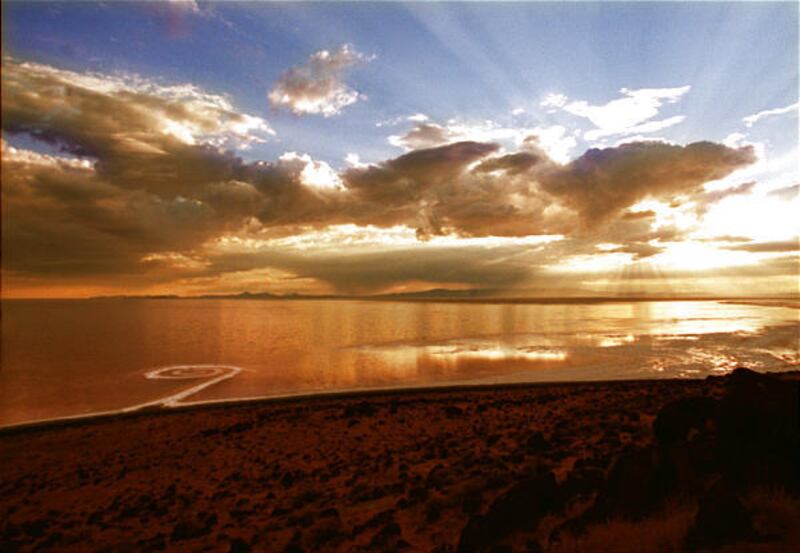
And only if you venture to places like this do you realize how beautiful the Great Salt Lake can be: an ever-shfiting shallow, briny sea wrapped in pastel visions of blue and pink and purple bordered by the creamy lakebed and the occasional cloud.
Color. Pattern. Texture. Beauty at once scenic and abstract. All can be glimpsed on these shores.
In the mid-1800s, explorer/surveyor Capt. Howard Stansbury, too, had noted, upon rising one morning, the lake's "great and peculiar beauty."
I first "saw" the "Spiral Jetty" in 2001 with my friend Ravell Call. I understood the Great Salt Lake had been shrinking, and because of a chat with personnel at Golden Spike, knew generally where it was to be found.
But on that beautiful and mild early November day, the jetty was simply a long, dim ghost somewhat visible beneath the lake's surface.
And I realized that I had been there years before during my haphazard search. The "Spiral Jetty" had been too submerged then to be viewed from the shore, so I would not have seen it anyway, though there is a tricky, mostly straight oil-drilling jetty a quarter-mile away that has fooled visitors now and then.
A tarlike oil is known to lie and seep from beneath the Great Salt Lake nearby. Drilling for it pre-dated the jetty — Smithson was aware of and accepted the industrial debris and the "Silurian technology," as he called it.
Oil exploration and mineral extraction proposals continue to stir controversy, regarding both the viability of such projects and their proximity to the famous artwork and possible impact on it. ("Spiral Jetty vs. Oilzilla," one international Web site trumpets.)
In July 2002 I returned with Call and two other friends from the Deseret News, Joe Bauman and Steve Speckman — and Speckman wisely brought along a kayak.
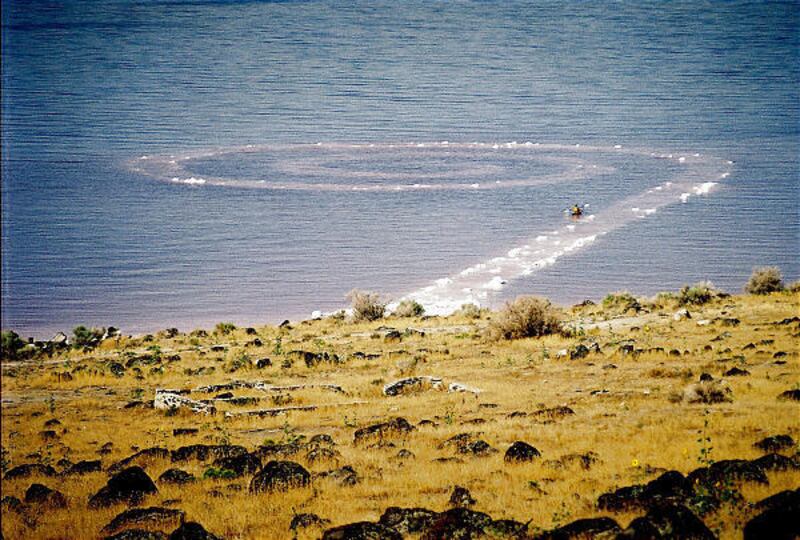
The lake's level had lowered enough that the "Spiral Jetty" was clearly visible, the highest salt-encrusted boulders poking above the murky pink water. A group of tourists from England arrived just after we did that day, and one — a pilgrim-artist — was brave enough to immediately clamber and splash along the swamped curls all the way to the spiral's inner tip.
We wrote a news story about the re-emerging "Spiral Jetty," perhaps the first in the world to hail the 21st century return of a renowned artwork — famous at least to some artists, art students, scholars and aficionados.
Then began a cycle of submergence, emergence, drought, high-and-dry exposure — and entropy — that Smithson's jetty had never before endured in so short a span.
In the summer of 2003, the retreating lake revealed the full jetty, bright-salt white and surrounded by that pink-to-ruby water.
It was lovely, probably more beautiful than Smithson had intended or expected.
A thick layer of salt coated the basalt boulders. Delicate saline stalactites hung in tiny curtains from receptive rocks. Briny, breeze-blown foam accumulated on the spiral's outer coils.
In 1970, Smithson and photographer Gianfranco Gorgoni captured early "Spiral Jetty" images from a helicopter, high above and looking from the lake toward Rozel Point. The jetty had already received its first slight coating of salt, probably bestowed by wind-blown foam and wave action. But it wasn't as blazingly crystalline as the long-marinated jetty of 2003.
So alluring was the evolving jetty that year that I dropped by eight times between February, before the earthwork had re-emerged, and December.
I wrote an essay that summer for the newspaper, and that turned me into a tour guide for many friends and members of my family. I took scores of photographs, including sequences that have been turned into panoramas of Rozel Bay by my friend Robert Noyce. In these, the "Spiral Jetty" seems but a small, curious twist in a Cinerama-like vista.
And in the years since, I've visited the jetty at least once each year, if not more — in every season, at dawn and at sunset, in daylight and at night with a rising full moon.
I've been there when Rozel Point has had patches of snow … but the muddy road and broad potholes make for a sobering journey.
Spring and summer warming encourages the algae and bacteria to pink-ify the lake's northern bays. I watch for telltale shadows that hint that white pelicans are flying in the blue sky overhead, possibly in majestic V formations or circling in sunlight that makes them seem to disappear then reappear, then disappear again.
And I've driven north to see Rozel Point in autumn, when the yellowing rabbit brush and sagebrush can set a spectacular scene.
I'm always looking for a new angle, a fresh way of seeing the "Spiral Jetty" in its special setting, one in which the gently alien earthwork has blended naturally into the landscape.
Somehow — and Smithson noted this as well — the jetty's size appears to vary in our perceptions of it. In its expansive surroundings, it seems smaller than you might expect. When you walk upon the jetty, it feels larger, though the next coil is just across a shallow pond … or beyond muck or grainy mud-gravel in drier times.
The jetty has been slightly submerged several times in winter or during the spring runoff. Lake currents and erosion have added earthen "spurs," visible at times on its rims.
But "Spiral Jetty" also has been entirely stranded, a mostly-black swirl of boulders on a plain of squishy or parched lakebed mud. Often that is the case late in a particular year, but recently it has generally been so year-round.
As always, 2009 has presented new perspectives.
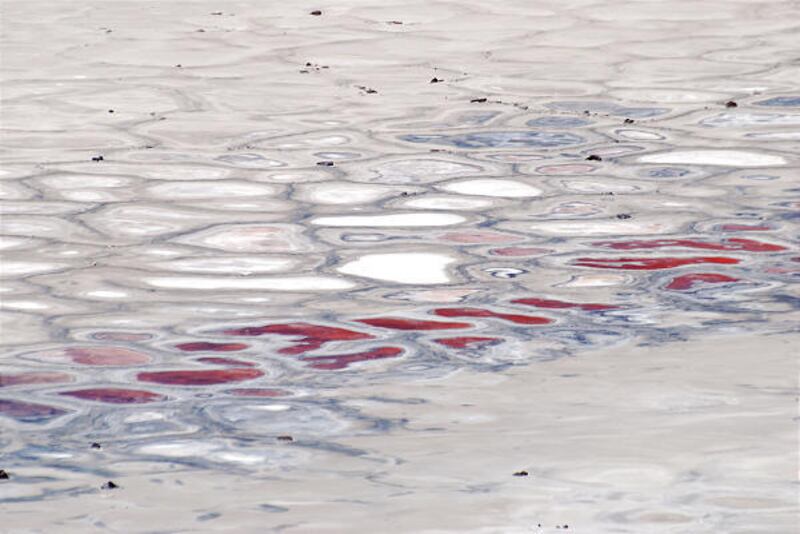
In March, the blue lake waters were far away from even the jetty's outer edge, but a new phenomenon began appearing on the exposed lakebed: a pocked pattern of dry, ridged basins that remind me of lily pads in a Monet painting. From a distance, boulders seem sprinkled in the design like flecks of pepper.
By May, the lake water had crept closer to the "Spiral Jetty," and some of the basins, or potholes, had colored water in them. After our unusually wet June in Utah, the magnetic attraction of the jetty, and the interest of friends, again drew me to Rozel Point in July.
Purple-blue water lapped at the jetty's southern border. A shallow, flamingo-pink broth pooled within some of the coils. And even more of the "Monet pads" to the west had water in them, some colored a deep blood-rose or burgundy.
Smithson's Rozel Point jetty has clearly transcended the idea that art belongs only in or around a museum. He had a concept of art "sites" and "nonsites" for which the back-of-beyond "Spiral Jetty" has become an exemplar.
And because of its grand setting, and because it has inspired a form of rough pilgrimage, the remote sculpture also has become everyone's "Spiral Jetty," an alluring artifact for some among us that is now one with nature, and a plaything of one of nature's most capricious lakes.
In 2005, Robert Smithson's wife, artist Nancy Holt — who created another desert Utah artwork, "Sun Tunnels" — was asked in a PBS interview what her husband might have thought of the changes his "Spiral Jetty" has undergone.
"I think Bob had the feeling that he wanted to make a work that was strong enough and would last long enough so that it would go through whatever changes might occur." And, she said, "I think he would have been awed just like we are. …"
If you go...
What: "Of Salt and Earth," a "Spiral Jetty" photo exhibit by Ray Boren
Where: UTah Artist Hands, 61 W. 100 South
When: Through Sept. 15, Monday-Friday, 12-7 p.m.; Saturday, 12-5 p.m.
Also: Photographer Ray Boren will be on hand during the monthly Gallery Stroll Aug. 21, 6-9 p.m.
e-mail: features@desnews.com