

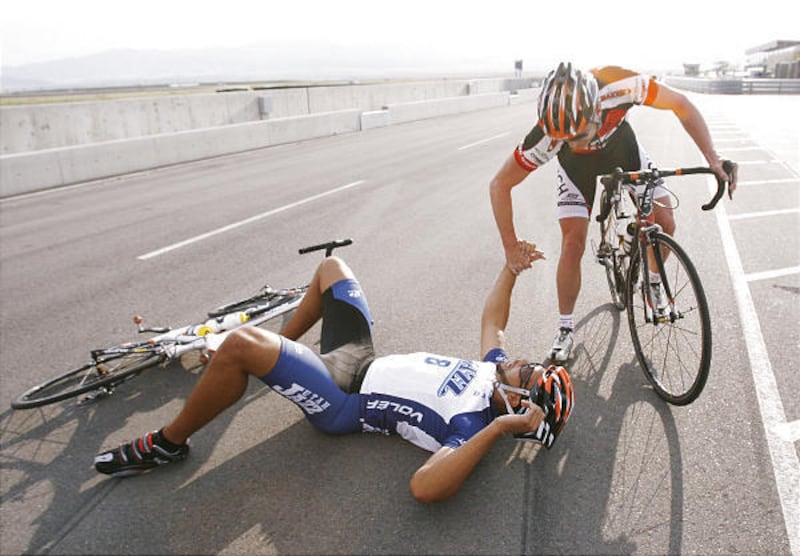

Thanks to revolutionary hip surgery, Floyd Landis is setting the stage for a return to the top of the cycling world.
The world-class rider and Olympian is back in the saddle after recent injury and testing positive for doping derailed his professional cycling career.
In 2003, Landis fell off his bicycle while training and broke the femoral neck of his hip. Orthopedic surgeons put three screws into his hip to help heal the fracture correctly. His initial recovery lasted more than six weeks. When he began training again he could barely walk, and he was having issues with the pins in his leg. Surgeons put three more screws in his hip to further secure the bones. He experienced constant arthritic pain — some night so intense he couldn't sleep — while training and racing at the 2006 Tour de France.
In October 2006, Landis decided to have an innovative surgical procedure known as Birmingham hip resurfacing. He says since having a state-of-the-art ball joint inserted into his hip, the pain has left.
"When I am training in normal life, I forget it is there," the 33-year-old Landis said, adding he hardly notices his new hip "unless someone asks about it or I am doing something I'm not used to doing."
Many individuals will outlive a traditional hip replacement and be required to undergo more difficult surgeries in the future. The new technology that was recently approved for use in the United States. Hip resurfacing conserves, rather than removes the thighbone as is done in traditional hip replacement surgery.
"It has been a whole three years now, and that recovery (from the 2006 operation) was probably easier than the first recovery," Landis said in an interview with the Deseret News. "I had a bit of rehab, and took a few months off, but the pain itself is gone."
Landis trained a minimal amount during that time, but less compared to previous years due to a suspension from competition due to blood doping in the 2006 Tour de France. He tested positive for a particularly high ratio of testosterone to epitestosterone. Landis fought to prove his innocence to the tune of about $2 million. In the end, he was banned from the sport for two years and stripped of his Tour title and yellow jersey.
Now Landis is riding in the Tour of Utah, which begins today.
"I have done about 15,000 miles so far this year in training," he said. "I'm in good shape. My goal is to win the race."
Landis prefers big mountain courses and said Utah "isn't afraid to put some big mountains." The six-stage race will take riders to Mount Nebo, the Alpine Loop and Snowbird.
Local orthopedic surgeon Dr. Joshua Hickman of Mountain Orthopedics specializes in hip and knee replacement and hip resurfacing. He didn't work on Landis, but he said the resurfacing technology is gaining in popularity since its approval in 2002. "The surgery is thought to preserve more femoral bone than during (a traditional) hip replacement," he said.
While recovery time seems to be similar to a traditional hip replacement, Hickman said two of the main advantages to the type of surgery are preservation of bone and fewer rates dislocations.
"If patients need a second surgery down the road, you have more (bone) to work with," he said.
The surgery is most popular for younger, more active individuals because a cap is placed on the end of bone which needs to be more dense. Those with hip problems under the age of 60 are usually encouraged to do the surgery.
Landis said plenty of things now make him sore that didn't used to, but he's no longer in constant pain.
"You can deal with (the pain) forever if you have to, (but there is) no reason to wait if it is affecting you everyday life."
e-mail: cneugebauer@desnews.com