




If life is in the details, so is art.
That's exactly what makes the wood sculpture done by St. George artist Darwin Dower so extraordinary. "I try to make it authentic down to the smallest detail," he says. "For every hour I spend sculpting, I've spent at least an hour on research."
The other thing that makes his art unique is its ability to evoke images of yesteryear. "So many times when people look at my art, I hear them say, 'that reminds me of …' or 'I remember when …' That's my true purpose in doing this. I want to pay tribute to our ancestors and the hard work they did for us."
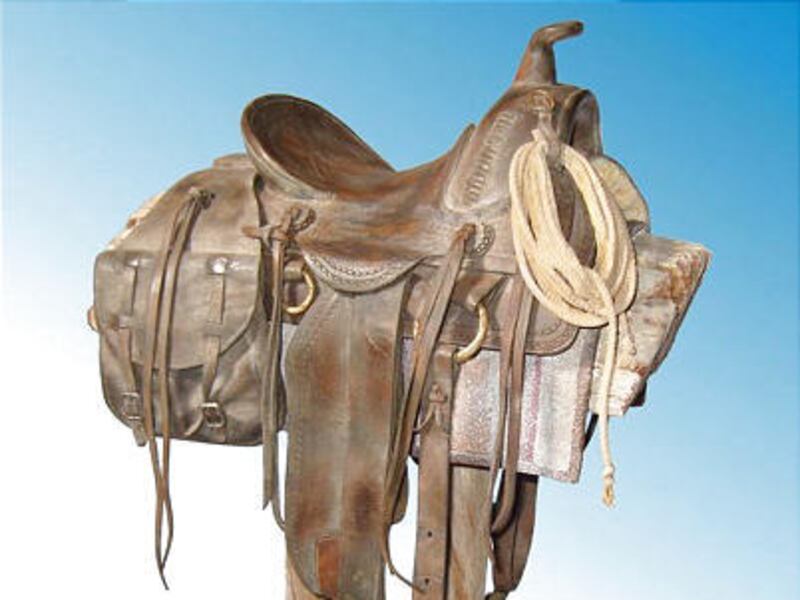
Dower's work has been recognized throughout the country. His saddles, plows and shoes now sell from anywhere from $400-$500 on up to $15,000-$18,000. He has won numerous awards and been invited to participate in prestigious shows.
It's not exactly what he set out to do. "I've always liked art, but I spent 40 years in the business world to feed my family," he says.
He first became interested in wood carving about 30 years ago when a rather rough-looking guy brought a burlap sack into the store and started pulling out duck decoys that he wanted to sell. "I gained a new respect for what could be done with wood. It also taught me a valuable lesson about not judging people."
As he thought about it, Dower decided he might like to try some carving, too. So, he carved a few decoys and took then to a symposium at BYU being held by one of the country's foremost bird carvers. "I took one to get it critiqued and the man asked me if I was thin-skinned. He then proceeded to tell me everything that was wrong with it. That almost made me quit. But I set it aside and thought about it, and I realized that everything he told me was right. I didn't know anything about the anatomy of birds and ducks. But I grew up around the Old West, and I did know that stuff. So that's what I decided to carve."
After he did his first piece and it sold almost immediately, he figured he was on to something.
Dower was born and raised in Emery County. "I was fortunate enough to be raised on a farm by my grandparents. My grandfather did almost everything with a team of horses. So, I was able to experience everything the generation older than me did."
Did he appreciate it at the time? Not at all. "I hated every minute. I honked my horn on my way out of the valley and thought I'd never go back."
But time has a way of tempering feelings, he says. "I know have a deep respect for my ancestors and the work they did in settling the West. I have an absolute love for the Old West. I really think I would have been happy living 150 years ago. I can see myself riding up to a saloon — and ordering a sarsaparilla."
It's that love that he pours into his work.
Creating art out of wood is one of the oldest of arts, he says, dating back to Biblical times. But because wood didn't last as well, it's often overlooked. "Wood art sometimes struggles to be accepted as fine art," he says. "People don't realize it should have the same value as bronze or stone."
In many ways it is harder than bronze work. "Wood is very unforgiving, compared to clay." There's also the fact that his pieces are one-of-a-kind. "If you buy a bronze, you may buy one of 25 or one of 2,500. I once asked a friend who does bronze how much he would charge if he only made one piece. Ten to 15 times as much, he said."
With clay, he says, "you start and add mass. But with wood, you start with a block and remove. So you have to spend hours measuring, checking, taking photos."
But there's something about the wood that touches his soul: the texture, the colors, the grains. "I love to get a block and see what's inside trying to come out."
But the difficulty is why you don't find many wood sculptors around, he says. "There are lots of carvers, lots of whittlers, but few good sculptors. The thing that makes the difference is the amount of time you are willing to spend. To turn a craft into a fine art comes with experience, education."
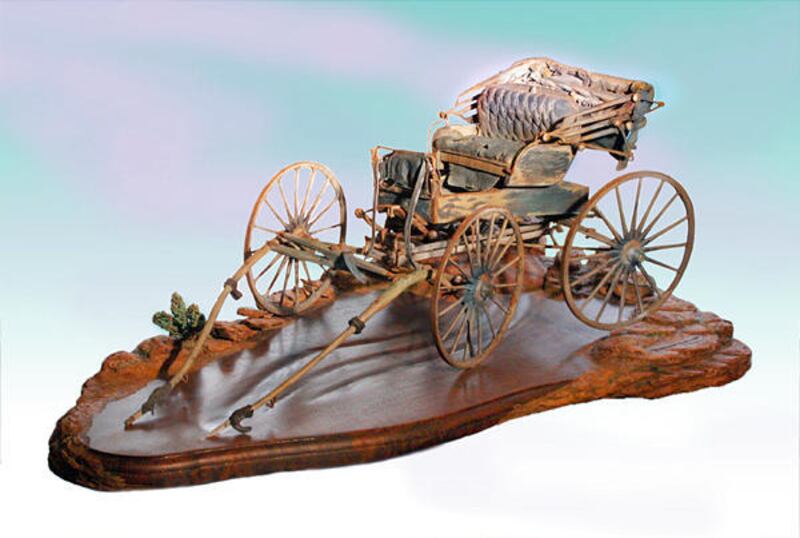
He is always challenging himself to "do something I don't think I can do," says Dower. Creating a saddle can take as long as four months, but when he is finished it's hard to tell the wood from the original — except, perhaps, for the size.
His favorite wood is tupelo, a swamp wood from the South because "it has a tight grain, and it holds the paint well."
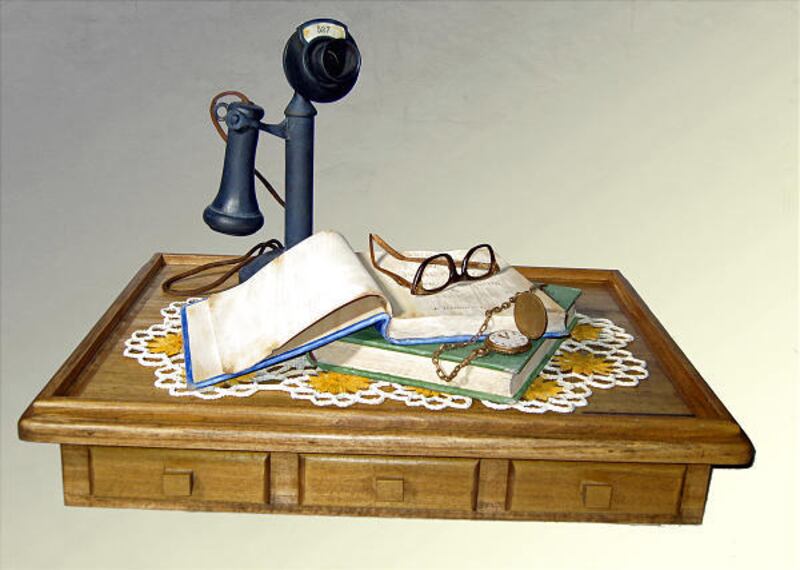
Dower likes to think of his work as being in the "Trompe L'Oeil" (French for "fool the eye") style.
He remembers the time he entered a buggy in the fine arts division of the Utah State Fair. "They moved it to the metal division because, as the guy in charge told me, 'I know metal when I see it.' I had to prove to him that it was all made of wood. The next year, I entered another piece and it won Best of Show."
Trompe L'Oeil is usually done in two-dimensions. "So to do it in three-dimension is fun. But I find you have to think differently. You have to create lines that will guide the eye through the piece. You use S-shapes and circles, but it also has to be subtle."
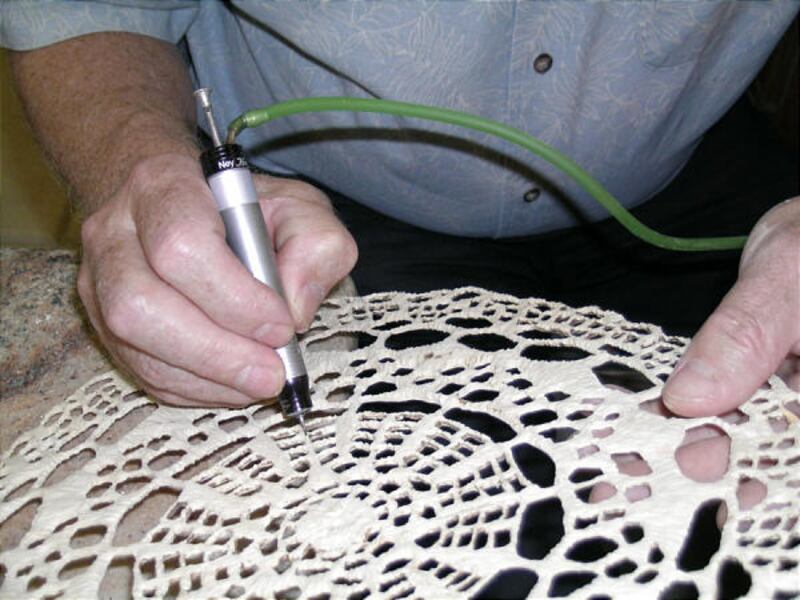
About 20 years ago, Dower came up with another innovation to help his work. "I stumbled on a re-designed, high-speed dental drill. It lets me get detail at 400,000 rpm that I could never get any other way."
And whether it is carving wood to make it look like a lace doily, or creating books, eyeglasses and an old-fashioned telephone, it's all about detail, he says.
Art is best, he says, when it tugs at the heartstrings. For his work, he hopes that tug will take you to a bit of the past. "It's just my way of honoring our pioneer forebears who worked so hard to settle the West. It's my way of preserving and honoring those individuals who paved the way for all the luxuries of life we have."
e-mail: carma@desnews.com