

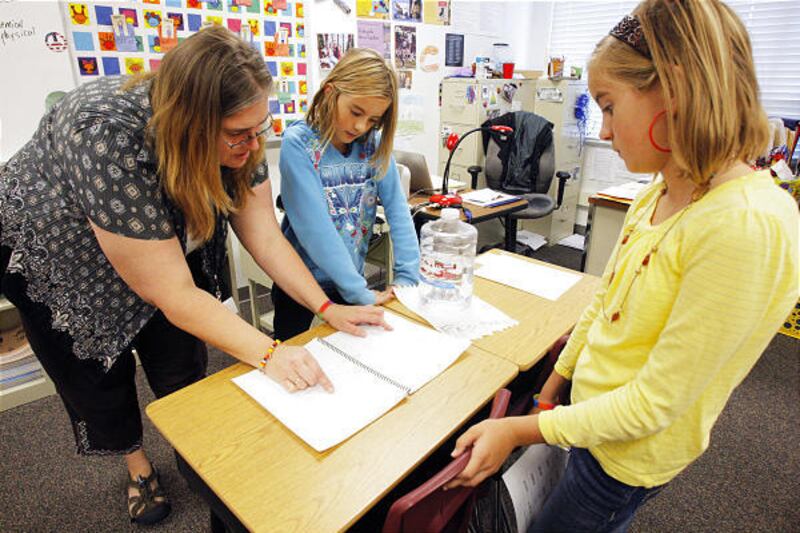
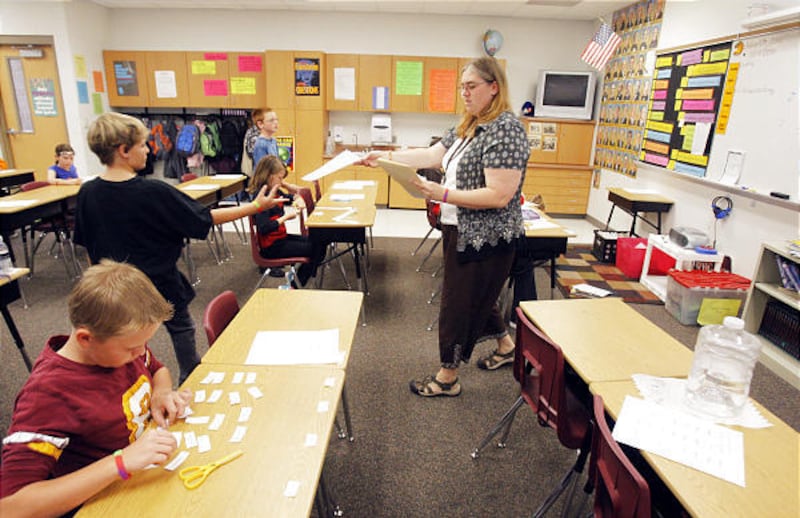
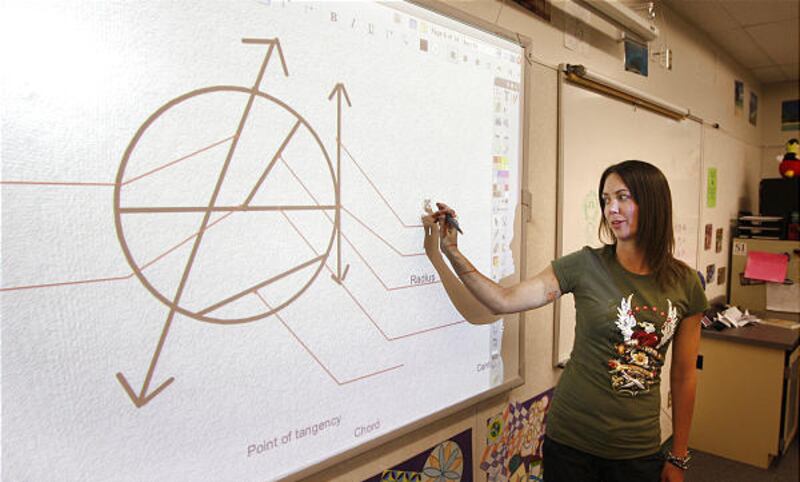

PARK CITY — Lori Hall flicks back her hair and plunks her stylus down on her brand-new Promethean Interactive Whiteboard. The board, the middle school teacher explains, sounding much like a small child eager to show off a favorite toy, combines the perks of a projector, the capabilities of a touch-screen computer and the delights of an Etch A Sketch. Old-fashioned chalkboard action? Check. Video? Check. Interactive Web-based tools? Check.
"This is pretty much my dream classroom," said Hall, 33, a math teacher at Treasure Mountain Middle School in Park City. She recently returned from an out-of-state training where, she said, "I got some great ideas about how to use technology to jazz up my lesson plans."
Not all of Utah's teachers are so lucky, though. Elsewhere in the state, in an effort to make ends meet in a tight economy, administrators have all but slashed professional development from the budget. At some schools, teachers have yet to trade antiquated tape recorders for CD players. Said one Tooele School District principal, with a sigh, "There's a lot of things I'd wish for."
The argument about "haves" and "have-nots" in Utah's education system has been a hot topic since the creation of Canyons School District last year, which left Jordan School District with $400 less per student in annual funding. The dust from the much-debated divorce has all but settled; after a harrowing summer trimming programs, Jordan School District has a budget that will sustain the district into the future. The bigger issue behind the firestorm still remains, however: When it comes to funding, not all Utah children are treated equally.
Education spending varies from district to district, ranging from less than $6,000 per student to more than $20,000. Legislators have struggled to pound out a solution for years. With several bills aimed at spreading the wealth in the works, this next legislative session promises to be no exception. But not everyone's on board. Compared to the rest of the nation, Utah gets high marks for equity in education spending — a fact the more affluent school districts are quick to point out. The trouble with education funding in Utah, they say, is not inequity, but inadequacy.
Money for schools comes from three sources: local income taxes, local property taxes and the federal government. The Legislature spreads about 70 percent of the money equally among students across the state. The rest, much of which is dependent on local property taxes, varies by location.
At the discretion of their individual boards, school districts levy property taxes to meet needs varying from new buildings to computers to literacy programs. How much money a district can collect in this way, however, is dependent on several factors. Properties in wealthier areas bring in more tax revenue because they are worth more. Different areas also have a different mix of commercial, residential and agricultural property — some of which can be taxed at higher rates than others. Homes, for example, can only be taxed at 55 percent of fair market value while farmland can be taxed at 100 percent.
"It boils down to this: some districts have a greater capability to raise money than others," said Sen. Howard Stephenson, R-Draper, chairman of the education interim committee.
As a result, residents in poorer school districts often end up paying higher tax rates than their wealthy neighbors. Their children, however, still receive considerably less. Tooele School District, for example, has the third-highest tax rate in Utah. Because district boundaries include a lot of untaxable federal land, however, Tooele collects less money than most other Utah schools. On the other hand, Park City School District, where property values are high, brings in more money for children with half the tax rate.
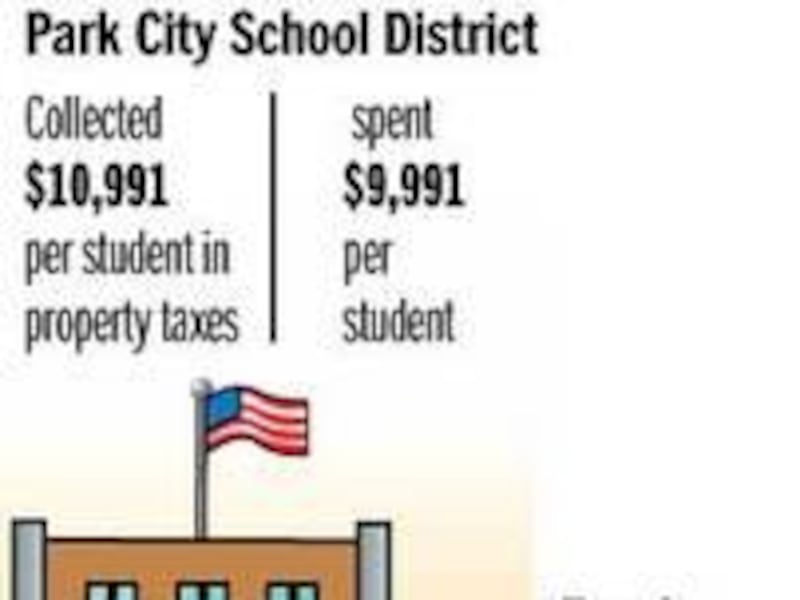
On paper, this translates into what Stephenson described as a "shocking" disparity in funding. In 2009, Tooele School District, brought in about $1,000 per student in property taxes. In Park City, the school district raked in close to $11,000 per student.
In day-to-day life, these financial details mean the difference between a state-of-the-art, energy-saving facility and an old — but clean — building that could use a remodel. Some schools in Tooele School District haven't updated their computer labs for 10 years. Park City School District elementary schools boast a 2-1 ratio of students to computers. Next year, the principal at Treasure Mountain Middle School plans to outfit every one of his students with a laptop.
"I'd never complain for heaven's sake," said Diane Quist, a kindergarten teacher from Tooele School District. But, she admitted, "We could use a little more money."
On a recent day this summer, Quist hurried around her classroom at Stansbury Elementary, stacking chairs and sweeping bits of paper off her colorful alphabet rug. Though the school is considered one of the best buildings in the district, Tooele's financial situation is still readily apparent within its halls. Concerned about saving money on the energy bill, Quist worked in the dark. The bathroom is plastered with signs reminding children to "please help us save on toilet paper and towels."
"Reading is the hardest to tackle," said Quist, who juggles close to 25 5-year-olds at a time. "I share a part-time aide with three other classes and we only have one reading specialist. She's so busy with the first-graders, I hardly get a minute."
District-wide, Tooele teachers lost the majority of their "quality teaching" days (time devoted to professional development) this year and everyone took a three-day furlough. The district tweaked their teacher compensation packages to the point where Superintendent Terry Linares admits she's concerned about the district's ability to attract and retain quality teachers. There's no money for new textbooks, she said.
"You have to ask yourself: What did a student in one district do differently than a student in another to deserve this kind of treatment?" said Stephenson, who is the chair of the Legislature's education interim committee. "The answer is: Nothing."
Stephenson pointed out that, in accordance with the constitution, the state Legislature controls Utah's school system. Years ago, in an attempt to split up administrative tasks into manageable pieces, the legislature separated the state into school districts. In doing so, Stephenson said, the state inadvertently "picked winners and losers." As Utah grew, the differences between schools in different parts of the state became more pronounced. Now, he said, "It's time to fund the state-wide system on a state-wide basis."
Since formal educational systems were first established in the United States, states have struggled to equalize funding from school to school. During the 1960s, affluent districts across the nation routinely spent twice what nearby poorer ones did, and sometimes four or five times as much. Since 1971, 45 states have taken the issue to the federal courts, successfully overturning their local funding systems. Still, disparities remain high. In some parts of the United States, the funding gap between rich schools and poor is more than $10,000 per student.
Stephenson argues that Utah must figure out a more equitable way to distribute property tax revenue among schools to avoid legal action.
"This is a significant problem," he said. "If things don't change, it could be devastating to the economic viability of multiple municipalities."
Those on the other side of the issue, though, point out that, in comparison to the nation, Utah's educational system is one of the fairest.
"We are a model of equalization for this country," said Dave Thomas, a member of the Utah State Board of Education, during a meeting with lawmakers Wednesday. At the request of the Legislature, the board put together a recommendation to level the playing field for Utah schools. Thomas said, though, "if we put it to a vote, I'm not sure the state board would agree that we need to equalize more."
The difference between per-pupil spending at Utah's richest and poorest schools — about $1,979 — is the lowest in the county, according to a recent report by Education Week. The national average is a difference of about $3,924 per student.
Utah's education funding formula has several mechanisms built in to help spread the wealth. Each year the Legislature allocates a certain amount of money for each child, which is paid with income taxes. The state also guarantees each district a minimum amount of money from property taxes. If a district can't raise the cash, the state fills in the gap with income tax money. Because Utah's education budget is so small, though, the guarantee is low. While it brings the state's most-struggling districts closer to average, it does little to close the gap between the richest and the poorest.
Regardless of its weaknesses, State Superintendent Larry Shumway said he believes the system is well-equipped to address the financial disparities among Utah school districts.
"The vast majority of funding is equalized," he said. "We have one of the strongest equalization programs in the U.S."
The real problem, he said, is inadequate resources.
"To spread a small meal among many people may be fair, but everyone starves in the end," he said.
A report published in September by the Education Law Center, a public interest law firm specializing in education reform, supports this argument. In the study, "Is School Funding Fair? A National Report Card," Utah earned an "A" grade for distributing money fairly between areas of high and low poverty. It got an "F," however, for overall funding effort.
For the most part, Utah allocated more resources to high-poverty districts and fewer resources to more affluent districts, said study author, Bruce Baker, an associate professor in the graduate school of education at Rutgers University. Park City School District, which pulls in considerably more than any other district in the state, is an exception to the overall trend.
The statistics are slightly deceiving, though, Baker said. Because Utah spends so little on education, its fairness score is higher by nature of the law of ratios. In comparison to the nation, Utah devotes a low percentage of its overall budget to education.
"The funding is so low it's like you guys get nothing, and you guys get a multiple of nothing," he said. "I guess you could say it's fair when everyone gets nothing, but that's a really twisted view of fair."
During a showdown about the issue at a recent legislative meeting, board members from Park City School District joked about needing a bulletproof vest.
"We feel like we have a target on our back," said district spokesman Patrick Ogden, with a scoff. Park City, he pointed out, already donates more than $2.5 million of the money they collect in property taxes to other districts. In 2009, they were the only district to contribute any cash to the equalization effort.
Even as one of Utah's wealthiest districts, compared to schools in other parts of the country, Park City is practically broke, said Patty Murphy, the district's business administrator. Like most in Utah, the economy has forced Park City schools to cut back. The district, which is running at a $2.3 million deficit, slashed seven teaching positions and seven aides this year. The travel budget took a hit and professional development, though still alive and well, is not as robust as in past years.
"Looking at what we have and tell me what we should live without," Ogden said. "Should we raise our class sizes? Should we decrease teacher pay? Should we use less technology?"
Buildings and computers aside, a day at Park City's McPolin Elementary plays out just like a day in Tooele School District. Teachers call class to order. Books open and pencils hit paper.
Gazing over his squirming wards one afternoon this summer, Principal Bob Edmiston wiped sweat off his forehead with the back of his hand. It had been a long morning. The water line was broken and there was a growing line of children clamoring for the use of the facilities. He wasn't sure what it was, but there was a bad smell coming from the hallway.
"Am I grateful for what I have? Yeah," he said. "But that doesn't mean I don't have a care in the world."
The worries — worries no different from those in other parts of the state — spilled out: Can he better meet the needs of his minority students with another specialist to help teach English as a second language? How can he provide teachers with ongoing opportunities to improve their craft? Can he continue to keep class sizes down?
"I love having computers," said Bob Edmiston, principal of Park City's McPolin Elementary. "I love having smart boards. But when it comes down to it, all the gadgets in the world aren't going to make a good school."
Whether they're for equalization or just for pumping more money into the budget, the state's leaders agree, for the most part, that education funding in Utah is an issue that needs to be addressed. They have different ideas, however, about how to tackle the problem.
In its recommendation to legislature, the Utah State Board of Education stressed a commitment to giving children access to equal educational opportunities. They are not concerned, however, about whether tax payers in one district pay more than tax payers in another, Thomas said.
"Equalization is about the students," he said. "All children of the state are entitled to a reasonably equal educational opportunity regardless of their place of residence and economic situation."
Thomas said the school board supports "floating up" struggling districts rather than taking money from more prosperous districts and redistributing money. Districts should be "empowered" to provide educational facilities and opportunities above and beyond what the state provides.
"Our principle tax is to make sure there are no losers," he said. "Everybody can be a winner."
To accomplish these goals, the State Board suggested tweaking the way property taxes are collected. If local voters wanted to raise local taxes they would be required to donate a percentage of the money to the state, which would then redistribute the money to struggling districts. Districts would also be given more flexibility in how they can spend the money collected through property taxes.
Though most legislators profess a similar commitment to achieving equality from a student perspective, they would also like to level the playing field for taxpayers.
"We're facing two challenges here," said Sen. Stuart Adams, R-Layton. "Children in different districts are being funded differently and taxpayers in different areas of the state are being treated differently."
Adams plans to tackle the problem head on. Instead of funding schools with property taxes, which vary by location, the state should use sales tax money. The Legislature did away with sales tax on food in 2006. He hopes to reinstitute it. To compensate, property taxes would be lowered. The state would pass out the money child by child.
"The beauty is, everyone gets a property tax reduction plus money is distributed more fairly," he said.
Though she has not yet finalized her equalization battle plan, Rep. Merlynn Newbold, R-South Jordan, said she hopes to tweak the way property tax is collected to funnel more money into state coffers. It will then be distributed equally among all students.
"Education is a statewide system," she said. "I can't think of any other statewide service we provide — police, fire, anything — where some get so much and others get less."
While state leaders prepare to battle it out, educators carry on.
"The financial constraints are difficult," said Terry Linares, superintendent of Tooele School District.
But for the most part, she seems to have made peace with the facts: money is tight, it has always been tight and it will likely continue to be tight.
"You know, this is what we have," she said. "I can't control what the Legislature does or doesn't do. All I can do is ask myself, 'How are we going to make it work?'"
In Park City, Hall admits (with a cheerful shrug) that she's happy to have a job in one of the state's more prosperous school districts.
She's got her hands on the latest and greatest in educational technology and her imagination is running wild. Not every school district is afforded the same opportunities, but, she said, that's no excuse to punish Treasure Mountain Middle School.
"I would love it," she said, "if everyone could have what we have."
e-mail: estuart@desnews.com