

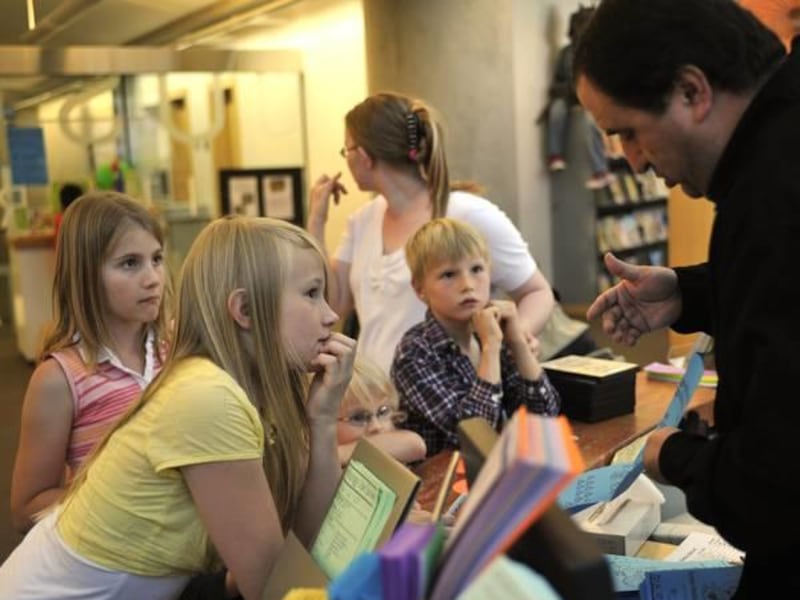

SALT LAKE CITY — For Tomas Flores, 8, reading is a family affair.
The third-grader and his mom benefited from a partnership designed to help keep students reading over the summer. That's a time researchers say can be detrimental to students' education — a fact confirmed by a recent study for the Salt Lake City School District and Deseret Media Companies, including the Deseret News. Hundreds of students going into the third and fourth grades in three Title One schools participated. They were broken up into groups. Tomas' school was given free books, and the students' parents were given summer reading instructions. The next school was just given free books. The third school was the control group.
The study showed that perhaps a strong parental involvement program during the spring for the coming summer would give parents tools to support their students' reading over the break.
When Tomas read at home over the summer and didn't know what a word in a book meant, his mom would help him out. First she had him try to read the word by himself. Then she would help him sound it out.
The school, Sylvia Flores said, "taught us how to explain to them, how to teach them."
Research shows it usually takes a child up to four months to return to the same reading level achieved by the end of the previous school year.
"Often children will lose the gains they've made (during the school year) if they don't read in the summer," said Sharon Adamson, with the Salt Lake City School District. "And then it takes until midyear to get them back to where they were at the end of the year before."
Year-round school doesn't eradicate the problem because students regress over the shorter breaks as well, said Janice Dole, one of the researchers.
She and Douglas Hacker, with the Utah Center for Reading and Literacy at the University of Utah, conducted the three-month study.
This is what they found:
In the school where students received the fewest number of books, the spring to fall reading level drop was the greatest.
More parental support was positively associated with more books read.
There was a significant negative association between time spent reading and students reporting watching TV and playing video games.
Student reading scores dropped between 14 and 18 words per minute from the end of the school year to the next.
The control school that did not receive books from KSL and the Salt Lake City School District (but did inadvertently receive a small amount of free books from another source) dropped an average of 18.5 points in DIBELS (dynamic indicators of basic early literacy skills) scores from the spring to the fall. DIBELS tests are given frequently to K-6 students to help teachers understand at what level their students are reading.
In the school where parental involvement was encouraged and free books were given out by Deseret Media Companies and the Salt Lake City School District, students dropped the least in their DIBELS scores. But their drop was not significantly different than the school where parental involvement was not encouraged.
Dole said the summer slide is more complex than they thought at the outset of the study and additional studies will have to be conducted to see what schools, parents and teachers can do to prevent the summer slide.
She said the study does indicate that instruction makes a big difference, especially with students who struggle in reading. Some children, Dole said, need to have instruction to keep up with trajectory growth, and more research needs to be conducted on giving parents better instruction before the summer starts.
She said research in the past has shown that parental involvement is vital for a child's growth in reading skills. She said parents can encourage their children to read books that interest them and that parents should read out loud to their kids.
"We know parents make a difference — a really important difference," Dole said.
One parent from the control group already understands the significance of summer reading.
"It's important because I believe that education is 50/50," said Mele Tausinga, a mother of seven. "We shouldn't leave it all up to the teachers. When we push them at home, it kind of gives them an extra boost to be a little bit ahead of the game when they come to school, so that they are ready to go instead of starting over."
She said she has her kids read to each other because they listen more intently when a sibling reads to them then when she reads to them. Tausinga also said it helps the younger ones learn to read better.
Another mom, Maria White, who has five children, said she went to the library twice a week with her children over the summer and each of her five children has his own bookshelf in the house. She said her eight-year-old son reads to his younger brothers and even to the dog. White said when he wasn't playing outside this summer he was reading and said all of the family members are "voracious readers."
"I've gotten to the point that I take the light bulb out in the hallway because I will get up to go to bed and he will still be up reading," White said.
Along with getting a varying number of books, students involved in the study also took a survey at the end of the break. The survey not only showed a positive correlation between parental involvement and the number of books read, it also showed how certain activities positively or negatively correlated to reading time.
Watching TV and playing video games was more often negatively correlated with choosing to read, the study found. So, the students who read more during the summer tended to watch TV or play video games less.
Something more surprising was that students who said they went to the mall more also seemed to read more.
But Dole said the biggest thing the study showed is that something more needs to be done to keep all students reading over the summer.
"If you want to get good at basketball or football, you have to practice every day," Dole said. "If you want to get good at reading, you have to practice every day."
e-mail: slenz@desnews.com