

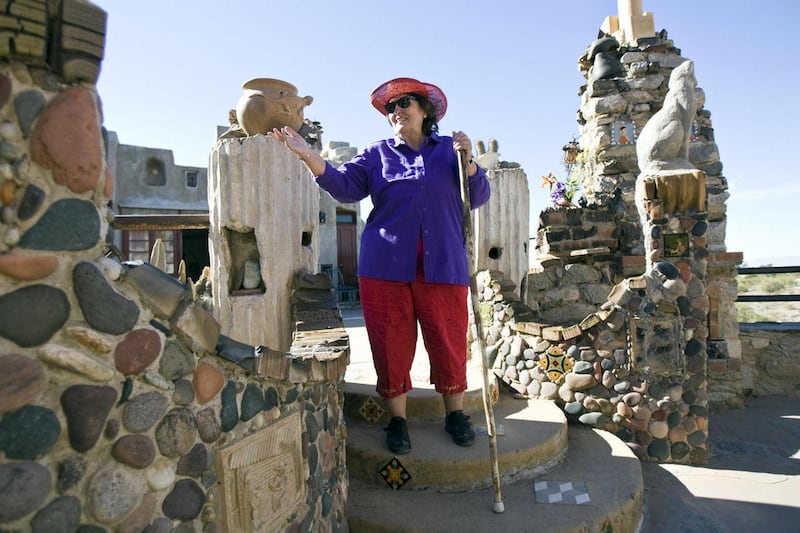
PHOENIX — On a moonlit night in 1945, Mary Lou Gulley took a taxi to the base of South Mountain and discovered the secret her father had been keeping for 16 years.
There, amid the rocks and crevices, rose a five-story castle, the fulfillment of a promise her father, Boyce Luther Gulley, finished not long before he died.
Mary Lou marveled at the whimsy of the 18-room creation, a composite of desert boulders and misshapen brick, telegraph poles and refrigerator glass, a bar made from half of a covered wagon and a wall studded with the wheels of a Stutz Bearcat.
Mary Lou, then about 22, moved in and made the strange abode her own. For 65 years, until her death on Nov. 3, she cherished the castle, remaining in awe of the gift that would forever haunt and dominate her life.
Her tale of the castle traces to the late 1920s. She was living with her parents in Seattle when her father suddenly deserted his wife and 5-year-old Mary Lou.
"He said he wanted to pursue his dream of being an artist," Mary Lou once recalled. "It broke my heart that he left us."
A few years after his disappearance, letters began to trickle in, postmarked from Arizona.
Mary Lou hoped he would return someday, but it wasn't to be. In 1945, a telegram brought news of her father's death. Then, as if from the grave, a final letter arrived: "Dearest Mary Lou: Can you forgive me? It wasn't art I wanted, it was you. I left home not because I wanted freedom but because I had tuberculosis."
He shared his secret that he had been building a home in Phoenix. Curious, Mary Lou and her mother set out to see for themselves. It was almost 10 p.m. when they arrived. After checking into a downtown hotel, they decided not to wait for morning. They took a taxi and headed south, knowing only that the house was near Seventh Street at South Mountain.
As the cab drew closer, the castle's form took shape. Mary Lou suddenly understood. When she was about 3 years old, she loved to watch her father build sand castles. She asked if he would someday make her one big enough to live in. As she gazed that night at her new home, she realized he had kept his promise.
Mary Lou and her mother struggled financially. But an idea was born after a reporter from Life magazine wrote a story about the house. When it was published on Jan. 26, 1948, the headline read: "Life Visits a Mystery Castle."
The name stuck and Mary Lou decided to share its mysterious past and decor by giving tours. She was a natural, eagerly engaging visitors with anecdotes of her father and her home. Her mother gave tours, too, until her death in 1970.
Mary Lou never let on to strangers whether she was bitter about being abandoned by her father. But she shared her sorrow with close friends. She believed her legacy was to be the castle princess. She grew to feel his presence as she explored the intricacies of the castle.
She would share with visitors how Boyce staked out an old copper-mining claim for the place, only to work odd jobs to have money to buy materials to build the castle.
Mary Lou admired his ingenuity and how he squeezed all he could from only two years of architectural-engineering experience.
One day, when a loose stone was pulled from a wall, a shower of nickels and dimes fell out. Her father had several discoveries in wait, said Rita Spears, Mary Lou's attorney. One of the letters he left said not to open the trap door in the castle until Jan. 1, 1948, Spears said. The date and reason behind the delay were never explained, but Mary Lou and her mother did as they were told.
"She discovered a photo of her father taken a few months before he died," Spears said. "There was gold ore, two letters, a valentine and a billfold with two $500 bills."
The discovery was one of the many stories Mary Lou shared with guests over the 65 years she lived in the castle, as development in Phoenix marched toward her home. She'd sometimes come down from her home, but her outings dwindled over the past couple of years. Her death came, Spears said, from respiratory complications.
Ramon Gastelum, who has worked at the castle on and off since 1981, attests to Mary Lou's stamina. She could be stubborn and opinionated but also funny and warm.
"She was a real independent lady - she did what she wanted to do," he said Saturday, during a break from giving tours. Gastelum said he misses hearing her sudden sharp shouts of "Ramon!" He never knew if she wanted a chair moved or for him to run to the store for ice cream. Vanilla bean, only.
"She lived a basics kind of life, no fancy stuff," he said.
Mary Lou's home will live on and stay open to the public as part of the Mystery Castle Historical Foundation. If enough donations come in, Spears hopes to republish the 1952 book Mary Lou wrote about the castle.
Mary Lou both loved and felt the burden of her fairy-tale home, the question of why her father left always a shadow.
"She had fantasized and romanticized the relationship for years," Spears said. "She always said her dad thought she was his princess. And the castle was proof he really loved her."