



PROVIDENCE, R.I. — Gov. Don Carcieri mentally divides his eight-year tenure into distinct periods — before and after the economy tanked.
In his first five years, corporations such as Amgen and Fidelity Investments announced expansions in Rhode Island, GTech agreed to stay put, and Carcieri took credit for creating 20,000 net new jobs. But then came the state's fiscal crisis: double-digit unemployment, shrinking tax revenues and slashed state aid to cities and towns.
"We were moving the ball forward on all of those things, pretty much on track with what we had set," Carcieri, who ends the second of his two terms next week, reflected in an interview with The Associated Press. But, he said, because of the recession's severity, "I've almost had two different worlds I've had to operate in."
The term-limited Republican, who will be succeeded by Republican-turned-independent Lincoln Chafee, departs with the state facing a looming budget deficit, 11.6 percent unemployment rate and an economy that by many measures ranks among the nation's worst.
But he says he's hopeful some of his economic development initiatives, such as his bullish support for wind energy and a proposed wind farm off Block Island, may yet pay dividends.
Carcieri, a former Cookson America CEO, was elected in 2002 on the appeal of being a business leader, political novice and Republican check against a Democratic-dominated General Assembly. He promised to collaborate with adversaries, something critics say he often did not practice as governor.
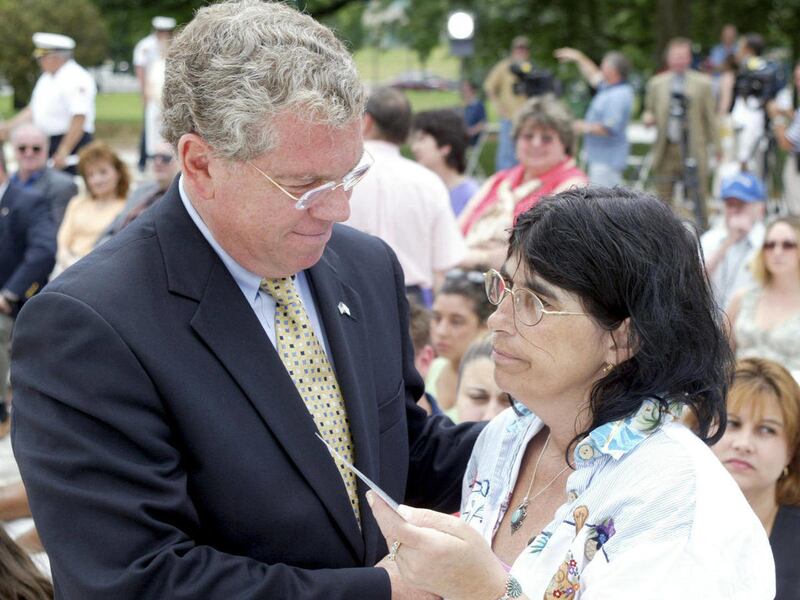
He scored early points for his comforting touch after the deadly Station nightclub fire on Feb 20, 2003, less than two months into his tenure. But rocky patches followed.
His stature was weakened when lawmakers overrode his veto of their budget in his first year; he attended a news conference with a fake "lobbyist" badge and derided lawmakers as union-controlled. That July, he authorized a state police raid on a tribal smoke shop that was selling tax-free cigarettes — a violent clash that Carcieri says he regrets.
After some legislative wins on pension reform and tax relief, Carcieri won re-election in 2006. But huge job losses and foreclosures and a burst housing market combined for an economic nightmare that preceded the global recession.
His approval ratings tanked along with the economy. The last time Carcieri's approval rating was above 50 percent was January 2007, according to polls conducted by Brown University.
University of Rhode Island economist Leonard Lardaro said it's too simplistic to blame the governor alone. But he said Carcieri and the General Assembly together failed to respond with necessary urgency.
He also faulted them both for approving massive cuts in higher education funding even while promoting the state's so-called "knowledge district" in Providence.
"Anyone who says that they can attribute all the — whatever, good, bad — to the governor, in my professional opinion, doesn't know what they're talking about," Lardaro said.
Carcieri's relationship with unions that represent state workers also soured. In 2008, he feuded with labor over a plan to unilaterally raise health insurance costs. Last year, a bloc of unions sued to prevent him from using a government shutdown or mass layoffs to balance a gaping budget hole. Council 94, the state's largest public employees union, ultimately approved a contract that cut their pay but also saved their jobs.
Council 94 president J. Michael Downey said the labor fights showed disrespect for public workers.
"I certainly would not be telling the truth if I said I was going to miss Gov. Carcieri," he said.
Carcieri also clashed with the General Assembly, though he says this year was their most collaborative.
They united on a law cutting the income tax rate for top earners from 9.9 percent to 5.99 percent. Though Carcieri sought more severe pension trims, he says he can live with lawmakers' decision this year to limit cost-of-living increases to the first $35,000 of a pension.
With the state struggling economically, Carcieri in 2008 issued a contentious executive order that directed state police to assist with immigration enforcement and required state agencies to use a federal database to check the legal status of new hires. The order divided the Hispanic community, sparking protests. Chafee criticized the order during his campaign, and has promised to rescind it as his first official act. Carcieri dismisses the controversy.
"It became divisive because people chose to make it that way," he said.
Some of his economic development deals have met with mixed public reception. This year, he endorsed a $75 million loan guarantee to 38 Studios, a video game company founded by former Boston Red Sox pitcher Curt Schilling. The deal's been criticized as overly risky, including by Chafee.
Carcieri says that's only because the agreement is misunderstood, noting that only $50 million is at risk while much of the balance is set aside in a reserve fund. He boasts that the company already has leased a building in downtown Providence.
"Explaining how complicated it is and all the protections that were built into this doesn't lend itself to an easy sound bite. It's easy for someone to say, 'Oh, that's too risky,'" Carcieri said. "Yes, it's a large chunk, but it's 450 high-paying jobs."
Carcieri's legacy is unclear especially since Chafee seems poised to reverse some of his policies — starting with the immigration order. Carcieri, who has not ruled out a 2012 U.S. Senate run, says it's hard to pinpoint his biggest accomplishment or predict how he'll be remembered.
"People in the future will decide what they think is most important."