

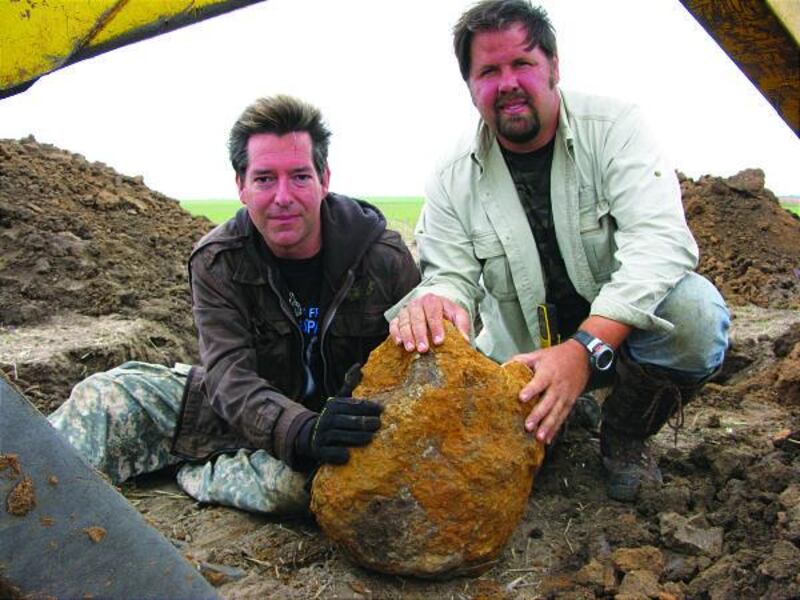
Pasadena, Calif. — Why would two grown men spend a lot of money going around the world looking for rocks that fell out of the sky?
Depends on which one of them you ask.
"The most important thing that we do in 'Meteorite Men' is a quest for knowledge," said Geoff Notkin, one of the two stars of the Science Channel series.
"Money," interjected his partner, Steve Arnold.
"We don't see eye to eye on every little part of this, but I feel that it is an enlightening journey that we're on," Notkin said.
"Meteorite Men" (Wednesdays, 7 and 10 p.m., Science Channel) is sort of a high-tech treasure hunt. But the treasure isn't man-made, it's from outer space.
"The meteorites that we find are the oldest things that any human has ever touched in the history of our planet," Notkin said. "There are meteorites that we, ourselves, have found that predate the formation of our own planet. They're made of tiny grains that were formed in the solar disc during the birth of the solar system. So, not only are they ancient and fascinating, but they're a record, a snapshot of the very beginnings of the existence that we know today.
"The oldest meteorites are much older than the oldest rocks that we find on Earth."
And they're valuable. Sometimes very valuable. Which is how Arnold got into the meteorite-hunting business in the first place.
He was doing research on metal detecting and treasure hunting when he "ran across a story about a lady who had found a meteorite back in the 1800s and had sold it."
"And I thought, 'Wow. If they were worth money then, maybe they are worth money now.' Did a little bit of research, and sure enough, they were. So I started hunting for them and finding them and selling them 18 years ago."
His partner, on the other hand, came to this somewhat differently.
"My father is an amateur astronomer," Notkin said. "My mother supported my very unusual interests in science and would allow me to skip off school when I was a little boy growing up in London and traveled up to the natural history and geological museums in London, where I first put my hands on an actual visitor from outer space.
"That changed my life, and there was no going back after that experience."
The two do work with scientists and experts in the field of meteorics.
"So part of our work is recovering important meteorites and then making a portion of our finds available to researchers to add to the overall body of knowledge," Notkin said.
"Yes, it's a business. We search for meteorites. We make a living from meteorites. But it's also an important scientific journey for us."
It's also pretty interesting. Even sort of exciting at times.
"There are a lot of hazards in our work — rattlesnakes, sunstroke, broken-down vehicles," Notkin said. "We've had many adventures."
And there's a bit of drama, just not the kind you might see in science fiction movies. They're not real worred about unleashing the Andromeda Strain or something.
"Meteorites get incredibly hot when they're hurtling through the atmosphere — 3,000 degrees, at least," Notkin said. "So perhaps if there were dangerous germs, they would be exterminated.
"But meteorites pose a real danger. This thing is heavy. If this hit your car or the roof of your house, it would go right through it. And there is a danger to our planet posed by large meteorites. They have landed in the past. They will land again. So we want meteorites to land on the planet. We just don't want them to be so big that they might devastate a site."
"I am just concerned about getting back alive with the truck not rolling over and things like that," Arnold said.
And, of course, making a profit.
e-mail: pierce@desnews.com