

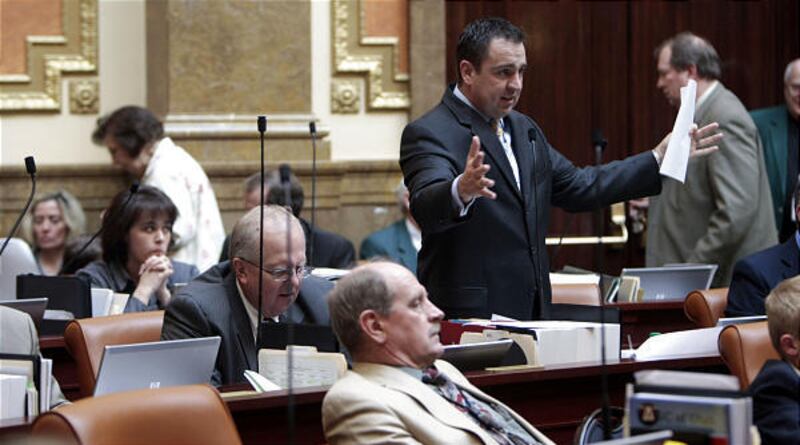
SALT LAKE CITY — The 2010 Utah Legislature enters its last four days with leaders from both parties saying much has been accomplished, especially considering the dire condition of state revenues.
"We've had a very successful session," said House Majority Leader Kevin Garn, R-Layton.
Still to be finished is the 2010-11 budget, although major balancing decisions, like a $1 per-pack cigarette tax hike, have been made.
Garn said the leaders came into the 45-day session with several goals: ethics reform, solving long-term state employee retirement issues and avoiding a general tax increase while closing a $700 million budget gap.
"We've achieved all of those," Garn said.
Senate Majority Leader Scott Jenkins, R-Plain City, said lawmakers have had fewer bills to deal with, likely because there's no money to spend.
"We're actually a little ahead of where we were last year. We're making good time," Jenkins said. "We're pretty happy right now."
Senate President Michael Waddoups, R-Taylorsville, said he's not hearing from any senators who felt their issues have been ignored.
"I'm not feeling any stress from anybody," he said. He's talking about the session being wrapped up early on Thursday night, ahead of the mandatory midnight adjournment.
After all, lawmakers already have approved a package of ethics bills intended to counter concerns raised by a citizens initiative on ethics reform. (Leaders of the citizen initiative say not enough was done.)
The legislative bills set up an independent ethics commission; mandate greater disclosure of campaign finances and conflicts of interests both of office-holders and candidates; restrict personal use of campaign funds; ban gifts over $10; and require disclosure of who takes meals over $10, among other changes.
And lawmakers overhauled the state retirement system, which lost about $6.5 billion in the economic crisis, a liability that could have cost taxpayers hundreds of millions of dollars a year over the coming decades.
Now, in the fix hammered out with employee groups, current workers keep their promised pension plan. But state and local government workers, schoolteachers, police officers, firefighters and others covered by the state system hired after July 1, 2011, will end up with smaller retirement benefits. Money will also be saved, lawmakers decided, by ending so-called "double-dipping" by rehired retirees in most cases.
Plus, lawmakers have made their frustration with the federal government known in a number of so-called "message bills" asserting the state's authority in everything from registering locally made guns to health care.
Decided early in the session was the fate of any gay-rights related legislation. Lawmakers on both sides of the issue agreed to halt attempts to either extend or end anti-discrimination protections for gays and lesbians already in place in Salt Lake City and Salt Lake County that had been endorsed by the LDS Church.
In recent days, the focus has been on the $44 million increase in the state's cigarette tax opposed by Gov. Gary Herbert but approved by both the House and the Senate.
Still to be settled is next fiscal year's budget, which starts July 1. The big question remaining is whether public education, which was not touched in early rounds of budget decisions, will be cut by $21 million as proposed by GOP lawmakers.
That reduction, combined with not funding 11,000 new students next fall, would mean local schools would end up with a 5 percent budget cut. The governor had agreed not to fund growth in public education but has said he won't go further.
The governor's spokeswoman, Angie Welling, said Herbert's "primary focus as we head into the homestretch remains the budget. He continues to focus his efforts on his No. 1 priority, which is protecting education from additional cuts. Keeping funding for public and higher education at current levels, or as close as possible, is critical for the state."
Democrats also want to avoid cutting education.
But that aside, House and Senate minority party leaders say the session has gone well.
"There's a real effort of cooperation," said House Minority Leader David Litvack, D-Salt Lake. That's reflected in a number of issues, including ethics reform. "Our focus has been in the right place."
GOP legislative leaders were worried about a structural deficit built into the new budget.
Herbert's recommended budget had more than $400 million of one-time monies in ongoing programs and salaries.
Garn said earlier this session that such a large tax bill coming due in fiscal 2012 and 2013 would mean a general tax hike, something legislative Republicans wanted to avoid.
GOP lawmakers' budget — still to be finalized — has $320 million in structural deficit with $210 million still left in the state's Rainy Day fund.
"If the economy improves, we're in great shape," said Garn. "If it stays flat, we're OK. If it drops, we have enough in the Rainy Day and other one-time surplus accounts" around state government "to get us through the next two years, at least."
Litvack said he hopes that final budget decisions made this week will add money to community health programs, services for the blind and deaf and college tuitions for Utah National Guard members.
Finally, Garn said, in the final four days the House will pass a rule requiring the speaker to disclose publicly any special lobbyist-paid-for trips for representatives.
The Senate put into one of the ethics bills that the speaker or Senate president can approve such a lobbyist-paid-for trip, but it would not be reported.
House GOP leaders believe such a trip's cost and who went are public information.
Waddoups said he imagines when the issue comes up, it will be a joint rule so the Senate president would also be required to release information about the approved trip.
e-mail: bbjr@desnews.com, lisa@desnews.com