

SALT LAKE CITY — Despite Utah legislators' claim that they took large steps in lobbyist gift-giving reforms this year, a Deseret News analysis of new lobbyist disclosure reports finds that a new reform bill they passed would ban just $1,100 of the $71,700 spent on lawmakers so far this year.
Also, half of all the money spent on meals for legislators during the first three months of the year — when the Legislature was in session — may not be reported at all in the future. That's because the Legislature exempted future reporting of food and drink that is offered to all legislators or large groups of them.
Still, that doesn't mean lobbying reform over the past two years has not had an effect. Lobbyist gift-giving to legislators decreased by about 20 percent this year after a 2009 reform law took effect.
Several lobbyists tell the newspaper that recent gift reforms have basically eliminated the giving of Utah Jazz tickets and other expensive gifts to legislators. Even expensive meals are rarely accepted by legislators now, the lobbyists say.
However, the newspaper also found if the lobbyist gift-ban restrictions found in a citizen initiative petition were in effect, 99 percent of the gifts given to legislators in January, February and March of this year would not have been allowed. The Utahns for Ethical Government initiative would ban all gifts to lawmakers except "light refreshments," which, the newspaper found, amounted to around only $1,500 in the 2010 Legislature.
The figures found in the newspaper's analysis "speak for themselves," said Kim Burningham, a former GOP Utah House member and chairman of Utahns for Ethical Government. By Thursday, the group's supporters must turn in 95,000 voter signatures in order to put the initiative on the November ballot.
"Any improvement in lobbyist giving is important," said Burningham, responding to the fact that lobbyist gift-giving is down by a fifth. "But clearly lobbyists continue to pour big money into legislators" gift-giving, he said, noting the $71,000 total. "We need to go a lot further in order to get citizen control of the Legislature."
The new lobbyist gift law, passed during the 2010 general session, takes effect May 11. It will ban all non-meal lobbyist gifts of more than $10, with a few exceptions.
Meals costing more than $10 must come with the accepting lawmaker's name attached, unless large groups of legislators are invited. If the whole Legislature, the House or Senate, a legislative committee or a party caucus are all invited to the meal, then that expense is exempted, no matter how many actually attend. In fact, the all-invited expense will no longer even be reported by the giving lobbyist, as is the case under the old lobbyist law. Gone from the public record will be how much was spent by this or that special interest group hosting a meal for an identifiable number of legislators, no matter what that expense may be.
In the first three months of this year, $35,168 — nearly half of all gift-giving that was reported, the newspaper found — went for meals where all members or some caucuses were invited, an amount that won't be seen in future lobbyist reports.
In addition, in the 29-member Senate, the president can authorize lobbyist-paid-for trips and expenses for a senator of either political party, and that lobbyist expense won't be reported, either, under the new law. The speaker of the House also may give such a trip exemption for any representative, but by internal House rule (which was not adopted by the Senate), the speaker must disclose that expenditure and the representative who took it in a timely manner.
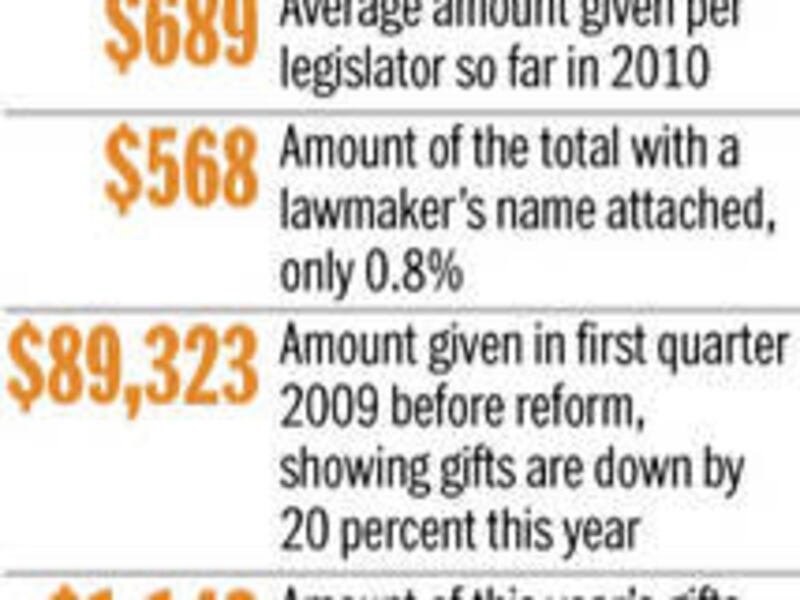
The newspaper found that legislators took about $71,658 in gifts during the first three months this year. That came to about $689 per lawmaker in freebie meals, snacks, trinkets and tickets to concerts or sporting events.
Last year, before the reform, lawmakers took $89,323 during the first quarter — or $859 each. So gift-giving went down by 20 percent after a 2009 reform required lobbyists to disclose the name of any lawmakers who took gift meals worth more than $25 or any other gifts worth more than $10. Before that, they had to attach names only to gifts worth more than $50.
With the change, such things as free tickets to Utah Jazz games disappeared from disclosure forms this year. Also, almost all freebies that were disclosed were meals, the newspaper found. Jazz tickets, especially during the 45-day general session when all legislators are in Salt Lake City, used to be a favorite gift, with some legislators taking hundreds of dollars' worth. An analysis undertaken several years ago by the newspaper found that one well-known lobbyist had spent more than $65,000 on Jazz tickets for legislators over the past decade.
Robin Riggs, a lobbyist for the Salt Lake Chamber, recently told the newspaper that gift reforms had fundamentally changed the manner of lobbying lawmakers. Fewer legislators even want to take a lunch or dinner, Riggs said. Free rounds of golf, also once a popular way for a lobbyist to speak with a legislator during non-winter months, are also disappearing, he said.
Even with the recent reforms, lobbyists managed this year to keep the value of almost all their gifts beneath new name-disclosing thresholds. In fact, only 0.8 percent of the overall gifts had names of lawmakers attached this year. Previously, about 5 percent of gifts had names attached.
The new lobbyist law that takes effect in May will ban routine gifts seen year after year to legislators, events that no doubt some lawmakers will miss. For example, gone will be the Utah Symphony and Opera giving $684 worth of tickets to legislators this year, and Utah State University giving $34 worth of basketball tickets each to Reps. Jack Draxler, R-North Logan, and Sen. Todd Kiser, R-Sandy.
If the new law had been in effect, it also would have required names to be attached to an additional $18,100 in spending that occurred so far this year — because it would attach names to any free meals worth more than $10, instead of those worth more than $25.
Some of the individual groups or lobbyists that reported giving legislators the most in freebies this year included: the Utah Beverage Association, $15,656; Utah Rural Telecom Association, $3,545; Thanksgiving Point lobbyist Mike Washburn, $2,688; Farmer's Insurance lobbyist Mike Mores, $2,521; and Spencer Stokes, a lobbyist for multiple clients, $2,306.
Washburn said while he doesn't particularly like being at the top of the individual lobbyist gift list, he notes that his expense is just one event. The Thanksgiving Point Institute is a nonprofit group that annually provides a free night for legislators, their spouses, their children and grandchildren to its dinosaur museum, with a meal and movie.
Since it is not a ticketed event, and since all the Legislature is invited to the meal, that evening most likely will not only be allowed under the new law, its expense will no longer be required to be made public.
While few legislators have their names attached to gifts, the largest recipients among those few included: Sen. Curt Bramble, R-Provo, $178; Rep. Becky Lockhart, R-Provo, $73; Kiser, $64; Draxler, $51; and Sen. Dennis Stowell, R-Parowan, $48.
e-mail: bbjr@desnews.com, lee@desnews.com