

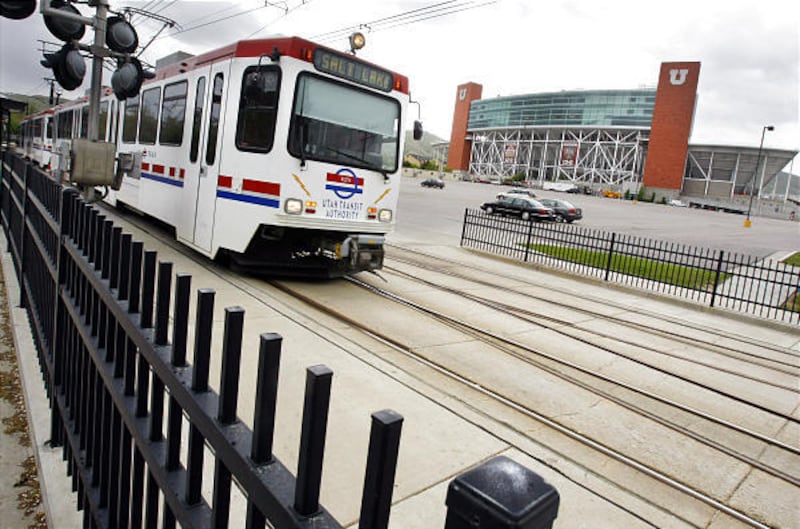
SALT LAKE CITY — A pilot program will soon begin at Salt Lake Community College — and possibly be implemented at other schools — requiring students to pay monthly for Utah Transit Authority passes.
Passes at many schools, including SLCC, have been free to students, the cost covered by student fees and other various college funds. But that's not likely to continue under the pilot program.
"It would be like $25 a month, most likely," said Lorin Simpson, regional general manager for UTA.
UTA, suffering from decreasing revenues after the recession has seen its share from sales taxes drop, is looking for ways to generate revenue. UTA is not earning enough to sustain its Ed Pass program, General Manager Mike Allegra told trustees on Wednesday. Allegra wants to make fares more "appropriate."
At SLCC, students used UTA for about 850,000 trips from June 2008 to June 2009, the most recent data available, an increase of about 20 percent from the previous year, Simpson said.
There isn't money at SLCC to cover the increased cost, said Gordon Wilson, SLCC's director of auxiliary services. And student fares can't be increased, because the student government told the administration in the spring that the student body isn't interested in that. In fact, the transportation portion of student fees will be decreased in the fall to help students absorb some of the large tuition increases that have occurred recently.
"It kind of puts us in a tight spot," Wilson said. "The vice president (of student services) said, we'll go back with the folks at UTA and we'll negotiate something."
The deal being negotiated is a to offer the Ed Pass at around $50 a month for unlimited bus and TRAX service. A regular adult pass for bus and TRAX is $67. "Rather than having the school purchasing special Ed Passes for all the students, UTA offers the regular student pass to students who'd like one," Simpson said. "The school and the student would split the cost."
The student portion of the fares will be deducted electronically from credit cards or bank accounts, Simpson said.
For the next academic year, UTA will closely study the program at SLCC to see whether it leads to a drop in ridership.
"If it goes well, then, yeah, we'd probably talk to other schools about it," Simpson said.
University of Utah law student Katee Tyler uses her free UTA pass to take TRAX three to four times a week, which she figures would cost about $20 a week if she had to pay. She would be open to paying a portion of an Ed Pass because parking by the law school is time-consuming.
"Still, with the amount of tuition and books, not having to pay for transportation has been a boon on my own financial situation," she wrote in an e-mail, "and while I might pay the fee, it would be one more thing to add to my already growing student debt."
Ed Passes vary by school.
For instance, SLCC professors and staff have always paid for a portion of their UTA passes, which provide discounts on express buses and FrontRunner Commuter Rail. "Our desire was to get as many bus passes out so we could reduce pressure on our parking lots," said Wilson, who added the pilot program could reduce fraud by eliminating students who cancel classes but continue to use their free Ed Passes.
UTA and various college representatives told the Deseret News that Weber State University in Ogden issued more than 10,000 free passes in spring 2010, and the passes cover buses, TRAX and FrontRunner. At Brigham Young University, students pay $120 for bus and TRAX pass that is good for a year. Both students and employees of the U. get a free pass that covers all buses and trains. Students at Utah Valley University pay $5 for their passes. At Westminster College, students get the pass upon signing a pledge to use alternative modes, such as bus, bike, etc., of transportation.
e-mail: lhancock@desnews.com
TWITTER: laurahancock