

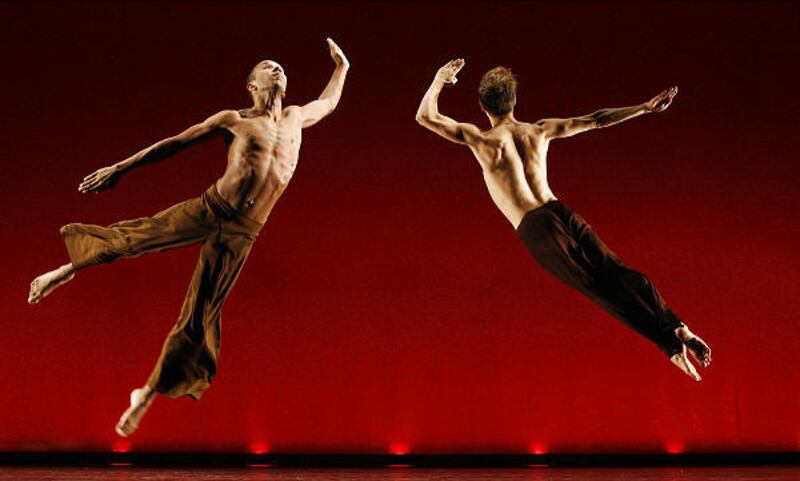
In 1994, Bill T. Jones, choreographer, social activist and artistic director of the Bill T. Jones/Arnie Zane Dance Company, created the work "Still/Here."
The two-act epic intertwined dance and theater, and it featured excerpts of interviews conducted with people suffering terminal illnesses.
Because of the topic and the rawness of the work, "Still/Here" was labeled, among other things, "controversial."
A year later, Jones emerged with the movement-intensive work "Duet."
"He was coming out of 'Still/Here,' which caused a lot of controversy that he never expected," said Leah Cox, dancer and education director for the Bill T. Jones/Arnie Zane Dance Company.
"He felt drained, exhausted and a little bit attacked. So he created this piece to be his 'what-is-pure-movement?' piece."
Cox said Jones wanted to remember what it was like to not have a social agenda, and "just deal with the physical form of the body."
"It was his way of getting back to his roots," she said. "It's about the beautiful security when you're just dealing with the tools of the art form, meaning the human body."
Cox, who first danced the piece in 2001, set the work on the Ririe-Woodbury Dance Company dancers in July.
She said the dancers had to understand the philosophy of the movements' origins to be able to execute the work correctly.
"There's a whole (picture to the work) and that's important to Bill," she said. "He's an artist first and sees art making as a questioning process. I can't just teach the steps. I have to communicate that concept with the dancers, along with Bill's whole history of how he sees and understands the potential of the body."
Cox was overwhelmed when she first learned "Duet."
"It's comprised of task-based movements," she said. "Every movement has a directive. It's fulfilling a task. It was hard for me to think while dancing."
Cox said she also likes "Duet" because it brought Jones back to the basics and showed the audience why he was (and still is) a world-renowned choreographer.
"Because Bill is so known for his socially relevant and socially probing works, I feel the immense contribution he's given to the field of dance, in terms of movement, is often overlooked," she said. "What he's contributed to the field of dance is very sophisticated, but he's thought of first as someone who has a social agenda and (people) forget he has as much integrity when it comes do movement and dance."
Movement and emotion are the basis of David Rousseve's "Bittersweet Chocolate," which RWDC premiered in 1997. The work, deals with issues of love and compassion.
"I had completely forgotten what the piece looked like," Rousseve said during a break in rehearsals.
"When I watched the video, I thought the movement vocabulary captured the ups and downs, anger, joy and bliss and conflict that would be in a long-term love. I thought the juxtaposition of real stories of love, combined with a more poetic exploration of love through the movement, worked really well."
Rousseve said the piece means more to him now than it did 13 years ago.
"Before 'Bittersweet Chocolate,' all my work was engaged in real life, and directly dealt with the humor, politics and glories of the nitty- gritty experience.
"While my work still deals with those issues, 'Bittersweet Chocolate' helped me approach choreography on a more philosophical level."
Rousseve made some subtle adjustments to the piece, but nothing too jarring, he said.
"There were a couple of lags in it, and I felt it could be more propulsive," he said. "We tweaked the rhythm of the piece. So the overall impact is stronger."
Rousseve said when he first created the work for RWDC, he was a bit concerned about the story line.
"We have a predominantly caucasian company dancing the story of a Southern black woman and asking the audience to go with us," he said. "I thought, 'What would people feel about the diversity issues that are visually represented?' "
Now, Rousseve sees how important the work is within the present-day scope.
"The boundaries of diversity are even greater now, and it becomes even more important that we figure out how to negotiate all these obstacles," he said. "This is what this piece is visually about. It's celebrating all these different stories."
e-mail: features@desnews.com
If you go ...
What: "Configurations," Ririe-Woodbury Dance Company
Where: Rose Wagner Performing Arts Center, 138 W. 300 South
When: Sept.23-25, 7:30pm
How much: $15-$30
Phone: 801-355--2787)