

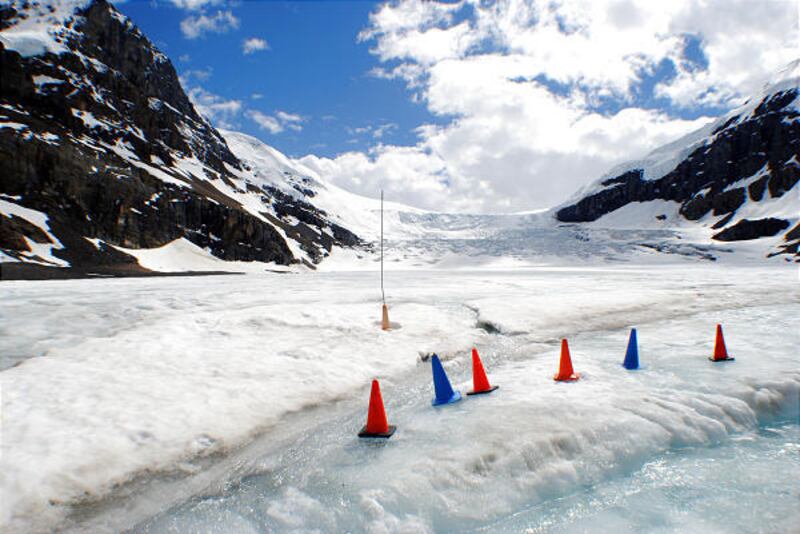
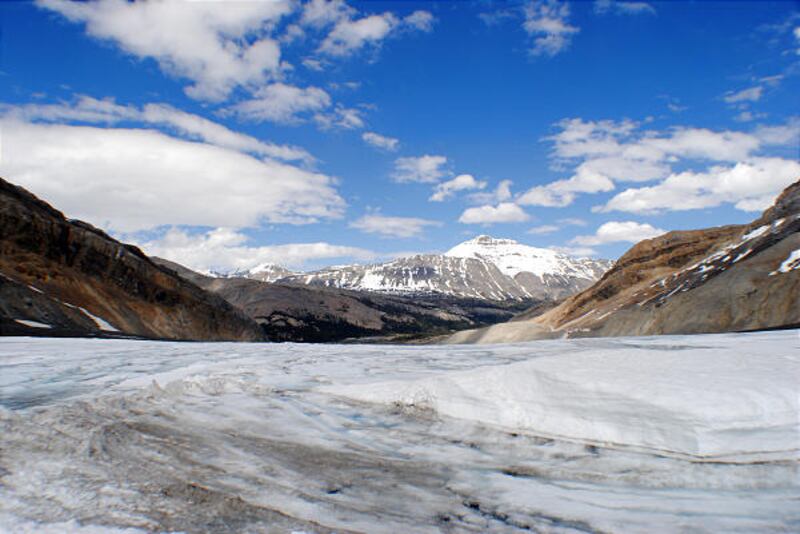
JASPER NATIONAL PARK, Alberta — Ice and snow. Snow and ice. The famed Columbia Icefield is the mother lode of frozen stuff outside the Arctic Circle.
If there's one "must-visit" spot in Jasper National Park, this is it.
Located 2½ hours (124 miles) from the town of Banff, an hour (62 miles) from the town of Jasper, or about 210 miles northwest of Calgary, it sits just across the border from Banff National Park along the appropriately named Icefields Parkway.
Columbia is simply a Canadian icon. It is in the world-class league, like the Great Wall of China, the Statue of Liberty or the Egyptian Pyramids — western Canada's most unique attraction.
Here you can stand on glacial ice almost as thick as the Eiffel Tower (250 meters) is tall. This is the most accessible glacier in the world.
A large modern visitor center, Icefield Centre (elevation 6,600 feet) orients visitors to the Columbia Icefield. It is here, too, where you can lodge in one of 32 guest rooms, enjoy a gift shop, dine in one of two restaurants or visit its museum.
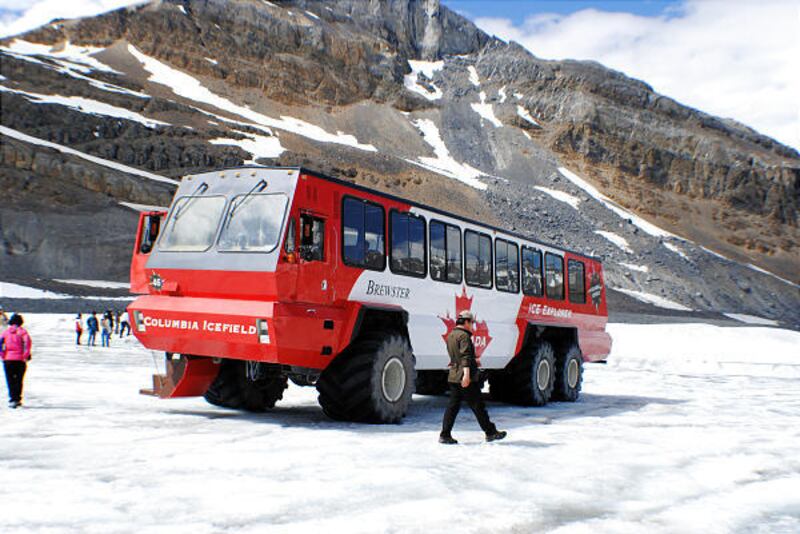
Here is also the staging area for an 80-minute tour of a toe of the Columbia Icefield — the Athabasca section. Tour buses haul visitors up a road to where "Brewster Ice Explorer" buses, specially designed for glacial travel, take you safely deep into the toe of the glacier.
At about $50 Canadian per person, the guided tour allows riders to walk on the glacier and even take a drink of its fabulous, pure waters.
The tour is wheelchair-accessible and suitable for children, too.
For those who want a different experience, they can drive a separate mile-long paved road. A parking lot here allows access to a 600-yard hike to the edge of the actual glacier.
Warning signs discourage hikers from proceeding to or across the actual ice itself, but many still do it and hike up the slope anyway — in the direction of where the guided bus tours go.
Notwithstanding, several hikers have fallen into crevasses along the Athabasca Glacier. In fact, in 2001, a young boy fell into such a fissure and could not be rescued before he died from hypothermia.
Rushing water at the tip of the glacier, as well as the erosion visible underneath the edge of the ice, are strong clues that nature is in motion here.
This part of the icefield is massive, but the lion's share of the ice — the actual body — is not visible on top of the 11,000-plus-foot-high mountain.
There's also a rarity in nature here, too — a triple continental divide/hydrological apex effect. (There's only one other known such water apex in the world, in Siberia.)
The icefield's north side feeds water to the Arctic Ocean; the south and east sides to the Atlantic Ocean and west side to the Pacific Ocean. (After realizing this, all future continental divides you traverse will seem lackluster.)
Average annual snowfall at the Columbia Icefield is about 21 feet.
Ice at the top edge of the Athabasca Glacier requires 150 years to flow down to the lower edge. Generally, the ice moves 15 to 42 meters a year.
Are you a believer in global warming? If not, you may be once you see this icefield.
From 1870 to 2010, the Athabasca Glacier has lost more than two-thirds of its volume and half its surface area.
A half-dozen key signs mark where the glacier was at various years as you drive the road to its toe. The ice has retreated 93 percent of a mile since 1870.
Glaciers form when more snow falls in winter than melts in summer. Over time, this snow condenses into dense glacial ice. A glacier is a mass of ice that moves under the force of gravity, as a "river of ice."
The Columbia Icefield is simply massive. It comprises six glaciers and covers some 124 miles in the area.
Alberta's highest point, Mount Columbia at 12,294 feet, is at the northwest side of icefield.
The Athabasca Glacier has also been a staple in some Hollywood productions over the years. For example, it portrayed the Arctic in all three of the first Superman movies (1977-1983).
Daily admission to Jasper National Park is $19.60. A yearly Canadian National Parks Pass costs $136.40.
For more information, go to www.pc.gc.ca/eng/pn-np/ab/jasper/index.aspx, www.ExploreRockies.com or www.columbiaicefield.com, or call 877-423-7433.
Lynn Arave visited the Columbia Icefield in June 2010.
e-mail: lynn@desnews.com