

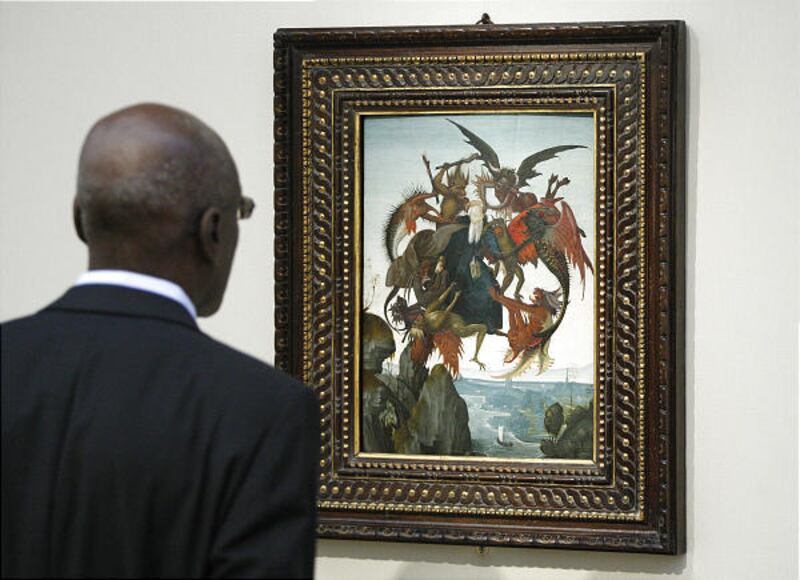
FORT WORTH, Texas — When Fort Worth's Kimbell Art Museum purchased Michelangelo's "The Torment of Saint Anthony," the painting — one of only four freestanding Michelangelo paintings in the world — came with a reproduction frame.
That was like a couture ball gown accessorized with flip-flops, unacceptable for what is arguably the Kimbell's most important purchase. The Kimbell immediately began the search for a suitable replacement, and when the piece finally took up permanent residence in Fort Worth, Saint Anthony was wearing a 16th-century Italian frame.
"We wanted a frame that is period and one that doesn't overwhelm the painting, but we wanted it to be distinctive to underscore the painting's importance. It was a fine line we had to walk, and it took a long time," says Eric Lee, the Kimbell's director.
The Kimbell turned to Stephen Gross of New York, whose grandfather founded the French frame company Georges Bac. They eventually found the perfect fit in one of the company's storerooms; it is an odd, asymmetrical frame, with large corners that jut out. Framers call those "ears," and they make a dramatic silhouette against the gallery wall.
Before the final choice was made, however, Gross brought a half-dozen selections to the Kimbell. They were placed around the painting, were hung on the gallery walls and were judged in relationship to the other frames from the same period.
"It was probably my most challenging framing project since I started in this business," says Gross.
The eventual selection largely passed unnoticed. There was no big announcement from the Kimbell, no sign on the wall drawing attention to the frame. Museum visitors are not supposed to notice frames — they are there to protect and enhance the artwork, not to call attention to themselves. The best ones do just that.
But the care and attention — and money — that go into these frames are not unlike the efforts that go into selecting a piece of art. Museums regularly have to purchase frames for new acquisitions, and often the cost, especially for frames from the 16th and 17th centuries or frames for extremely large paintings, can run well over $50,000. It's not uncommon to see prices range from $25,000 to $75,000, says Rick Stewart, senior curator at the Amon Carter Museum in Fort Worth.
"That's expensive," Stewart said. "But if you have a painting worth seven figures, it's not that big a consideration."
In the case of Michelangelo's "Saint Anthony," there were compelling aesthetic reasons beyond time, location and compatibility with the other Renaissance works that had to be considered, Lee says.
The figure of Saint Anthony and his cadre of tormenting devils is a very shallow image — there is not much depth to the composition — and the shallowness of the frame draws attention to this.
"The shape of the frame accentuates the spinning scene and emphasizes the head of Saint Anthony," he said.
After they made their choice, the Kimbell's chief conservator, Claire Barry, found examples of window frames that Michelangelo designed for the Laurentian Library (in Florence, in 1525) that had geometric details similar to those on the Saint Anthony frame.
"When it is right, there is a lightness to the work," the Kimbell's deputy director, Malcolm Warner, says. "When a frame isn't right, the painting seems imprisoned."
There are also frames that shout their presence from across the room. These offenders are often from private collections or small institutions that cannot afford to reframe their paintings. They may appear in traveling shows that have been compiled from a variety of sources.
The most egregious sins are frames that are too heavy, that have gilding that is too bright, that are from the wrong period, or that were chosen not to enhance the artwork but to match the crown molding in a dining room.
"Even if you don't have a trained eye, you can sense if something is not right. I've seen some private collectors have major works in Kmart frames," says Lee.
Gilding seems to be the most telltale sign, to a trained eye, of a poor reproduction frame. Unless it is done right, the thin layer of 23-karat gold foil that covers an elaborately carved frame is either too bright or the wrong color. Although gilt frames look like an exercise in conspicuous consumption, they had a practical purpose. The reflective nature of the gold foil cast light onto the surface of the painting in rooms that, before the advent of gas and electric lights, were only lighted by candles.
"For years, museums were content to put 19th-century gilt frames on everything," Lee says.
The fancy French frames with gilded surfaces and elaborate carving, or "compo" work (composition is a medium that can be molded to look like carving and dries harder than wood), became the frame of choice for everything; they signified important painting. Collectors, galleries and museums would often choose a 19th-century French frame as the default frame for artwork from any period.
Many of the 19th-century French frames are reproductions of 17th- and 18th-century versions that had been crafted by skilled French furniture makers. As the furniture pieces became more elaborate and decorative, so did the frames.
"Period frames cost as much as a Chippendale tea table," says Stewart. "You can spend the same amount on an 18th-century frame as you can 18th-century antique furniture made by the same craftsman."
Gilded frames are still used for French artwork from the 17th and 18th centuries, but their popularity is waning as museums focus on finding frames that are historically accurate. Reproductions of 18th-century Italian frames — largely black with a touch of gold — are increasingly popular with private collectors who are not as concerned with staying true to the era.
So pervasive was the desire for French frames, however, that frame dealers for years would find vintage frames that weren't French in garbage cans.
"When I began my business in 1978, I found frames from the 19th and 20th centuries that were being thrown away. I would find them in the alleys behind antique stores and in garbage cans. Galleries would give them to me. Now I pray someone will give them to me," says New York framer Eli Wilner, who has reframed many of the pieces in the Carter's collection.
When the Amon Carter Museum took on the task of reframing its early American works in the mid-1980s, it discarded these gold frames with the once-popular title plaques.
"When the museum took them off, we gave them away and they became mirror frames for houses in Westover Hills (Texas). Everybody in town had them somewhere," says Stewart.
Former Kimbell Director Edmund "Ted" Pillsbury, who died recently, was one of the first museum directors to begin a concerted effort to match paintings with appropriate frames. "Ted had a good eye for things; he was a connoisseur. Once you get into it, you are really bothered by anything that isn't right," Gross says.
Pillsbury made a number of changes beginning in the 1970s. Like the collection, the frames get high marks from art experts. "Museum people will comment on the building, the collection and how nice the framing is," says Lee.
When it became apparent that antique frames had value to the museums, Wilner had to start parting with real money to acquire them. He says he could purchase about five a week, especially early American frames from the 18th century. But he considers himself lucky today if he can find one a week.
Early American frames are the rarest, because there were few furniture makers in the Colonies who had the time or inclination to make frames when there was a greater market for furniture. Stewart remembers the collective excitement in the museum world when a rarity turned up at the Gilcrease Museum in Tulsa, Okla. A group of museum people touring the Gilcrease recognized the frame surrounding a John Singleton Copley painting as one made in 1760, one of only three known to exist from a Boston furniture maker. The Gilcrease was unaware of its treasure until that moment.
By the 1800s, artists were taking a hand in how their works were presented, not only choosing the frames but orchestrating elaborate installations. Hudson River School artists Albert Bierstadt and Frederic Church, known for their enormous landscapes, would often put a deep cove frame around their works to give the impression of a window and then cover the paintings with velvet draperies. They'd sell tickets to the unveiling; when the gallery was full of paying customers, they'd pull back the drapes and wait for the gasps of admiration. "They wanted people to be blown away," says Stewart, "and they were."
Church's "The Icebergs," now owned by the Dallas Museum of Art, was exhibited in such a fashion when it was first painted in the mid-1800s, and at times the Metropolitan Museum of Art in New York has done historic re-creations of this kind of staging.
Artists in the 20th century began to look at framing as an extension of their art making, and many modern artists, such as Georgia O'Keeffe, would extend the painting from the canvas onto the frame. Others designed frames with motifs that signaled their regionalism. Santa Fe and Taos artists would incorporate Southwest details into their carved frames. Western artist Frederic Remington used subtle arrow motifs on the corners of his frames. The frames on the Remingtons at the Carter are replicas of ones that Remington designed.
Some of the early modernists of the 1930s and 1940s tried valiantly to separate their paintings from the historical works in gilded frames by using stark white frames with no adornment. The smooth surfaces of the Frigidaire-like frames did not age well, however, and the once bright-white frames turned yellow with age because of the large amounts of linseed oil in the paint.
By the mid-1900s, artists were choosing to use no frames. Some of Jackson Pollock's drip paintings were made to fit the exact measurements of a gallery wall from floor-to-ceiling and wall-to-wall so that the room became the frame. This was at a time when New York galleries were often second-floor affairs with low ceilings and small rooms.
Even more recently, many artists have looked for ways to frame their works without actually showing a frame. They have succeeded so well that it would be difficult to describe a memorable frame at the Modern Art Museum of Fort Worth. Contemporary art framing usually consists of strip frames, which are bands of metal or wood that encircle the wooden stretchers that support the canvas. From the front of the painting they are almost invisible; they can only be seen from the side. They are there for protection of the stretchers.
For an even more minimal effect, artists use gallery-wrap canvases, where the unprimed or painted fabric wraps around a substantial stretcher bar. Some artists have gone so far as to eschew frames and canvases altogether, painting directly on the gallery walls.
In the few instances where there are noticeable frames, these were chosen by the artists, and the museum has left them as the artist presented them. When the Modern does have to reframe a work, it is not at the mercy of antique frame companies; the museum has a person on staff who can easily build a strip frame, curator Andrea Karnes says.
Today, it is considered de rigueur for museums to have either frames that are of the same time period as the artwork or frames that were chosen by the artist. This can add substantially and very subtly to the enjoyment of the works, and sometimes, in cases where the artist chose the frame, lead to moments of eyebrow-raising inquiry.
The Kimbell Art Museum has a broad selection of frames. Elaborately decorated French frames, heavy geometric black Dutch frames, dark Spanish frames with a touch of gilding and simple Italian frames surround some of its most famous works.
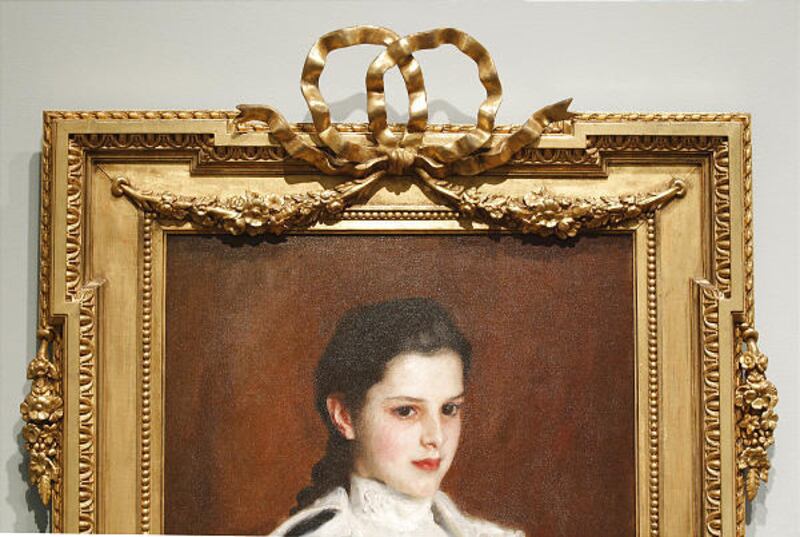
The Amon Carter went to great lengths to restore a spectacular frame chosen by John Singer Sargent for his 1888 portrait titled Alice Vanderbilt Shepard. The very fancy frame has a delicate three-dimensional bow at its apex, but when the museum purchased the painting, both the frame and the artwork were in need of restoration.
"It had descended through the family and had inherent wear and tear. When we acquired the painting, the frame looked its age and not in a good way," says the Carter's painting curator, Rebecca Lawton. "Because it was chosen by Sargent, it was important to restore that frame, and with any frame of that vintage, with that amount of detail, the restoration was costly."
The price of restoring the frame almost equaled the price of the painting and, because of its fragility, "it will never leave the museum," Stewart says. Lawton, though, says that they have considered having a traveling frame made for the portrait.
"A lot of factors go into building the wonder of our collections; certainly it is the quality of the paintings," says Lawton. "But one reason the experience is so terrific is that the frames are quietly adding that lovely dimension to your experience. They don't shout at you."
Distributed by McClatchy-Tribune Information Services