

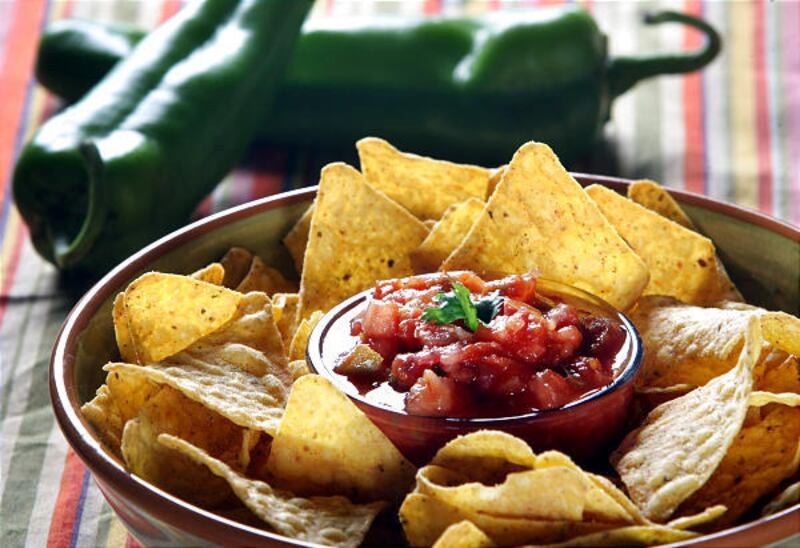
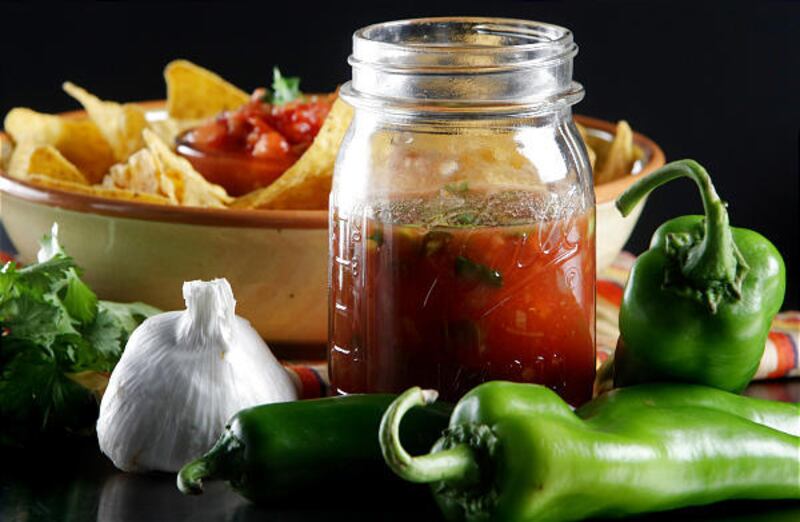

Salsa is America's No. 1 condiment, surpassing ketchup in 2000.
And it's also the most risky product to home can, from a food-safety perspective.
Teresa Hunsaker of the Weber County Utah State University Extension warned students in her "Salsa Sensations" class last week that tomatoes have a potential for bacteria that are not killed with regular cooking temperatures.
If you elect to use a water-bath canner, an acid such as lemon juice or vinegar should be added to your salsa to keep microorganisms from growing.
The right ratio of acid to veggies is critical, so it's best to follow a tested recipe from a reputable source, such as the USDA's Extension Services, the Ball Blue Book of Canning, or the National Center For Home Food Preservation.
Or, use a pressure canner, or just eat your salsa while it's fresh.
Salsa, the Spanish word for sauce, can do much more than accessorize a bowl of chips. It's also a flavorful accompaniment to meats, and it can be thrown into all kinds of dishes, from eggs to soup, to add zip.
Depending on the ingredients, it's usually low in calories, fat and sugar. Tomatoes, the usual base ingredient, are full of the antioxidant lycopene, and a good source of vitamins C and A. Chiles, which give salsa their kick, can be good sources of vitamin C and beta-carotene. Other common salsa ingredients are also packed with nutrients, such as strawberries, mangoes, peaches, raspberries, watermelon or cilantro.
Gardening and home canning are both on the rise as people try to stretch their food budgets in a tight economy. And when you've got a garden brimming with tomatoes and chiles, salsa-making is a natural follow-up.
Tomatoes are the most widely canned product for home canners, and also the most mis-canned, said Hunsaker. Although it's not an everyday occurrence, Hunsaker recalled several deaths and near-deaths in Utah where home-canned salsa was the culprit.
"People say, 'But aren't the bacteria killed with all that boiling?' The answer is no," she said. Certain spores can only be killed when temperatures are at least 240 degrees, which isn't achievable with a boiling water bath canner.
One type of spore, the clostridium botulinum bacteria, can germinate in a low-air, low-acid environment, and produces a lethal toxin. But the spore can't grow in an acid environment.
That's why fruits with high acidity are good candidates for water-bath canning, while low-acid vegetables, such as corn and green beans, must be pressure-canned. Tomatoes contain barely enough acid to to qualify them for water-bath canning.
"In the case of salsa, you're throwing in peppers, garlic, onions, maybe carrots or zucchini, and it all brings the acid level down," said Hunsaker.
So, cooks must be scientists in their own kitchens and add lemon or lime juice, citric acid or vinegar to their tomato products when canning.
"What makes tomatoes safe for water-bath canning is acidity. We must be food scientists in our own kitchen," she said.
The ratio of acid to the vegetables, such as chiles, onions, garlic and so on is crucial. If you have a recipe you want to home-can, you can compare it with approved recipes from the USDA, Ball Blue Book of Canning, or the National Center for Home Food Preservation to see what the ratio of acid is to the total amount of vegetables.
When choosing salsa ingredients, keep in mind that paste or Roma tomatoes are less watery and have a more firm flesh, producing a thicker salsa with less cooking time.
Green tomatoes or tomatillos may be used, they actually have a higher acidity than regular tomatoes.
Hot or mild peppers can be used interchangeably if the total amount of peppers is not increased. For a milder salsa, go with poblano, Anaheim or Hatch, or pepperoncini. Jalapeños supply medium heat. The hottest peppers include cayenne and habanero.
It's a good idea to err on the side of mildness; you can always add more chiles just before you serve your salsa to raise the heat level. Be sure to use rubber gloves when preparing hot peppers to avoid burns.
A small amount of spices and herbs, such fresh cilantro, won't throw the recipe off much, said Hunsaker. However, cilantro loses its flavor the longer it's cooked. She suggested adding at the end of the simmering time, or adding it when you open a jar just before serving.
If you have a recipe you love, but it's questionable for water-bath canning, Hunsaker suggested cooking and freezing it.
"Salsa freezes beautifully. It thaws and warms back up beautifully." Or you can pressure can it, using the time specified for the vegetable with the longest length of time.
"Pressure canning darkens your salsa, but the flavor isn't thrown off that much," she said.
If you're canning your salsa, choose vinegar with 5 percent acidity, Hunsaker said. White distilled vinegar has a harsh taste; red wine or cider vinegar has a more mellow flavor.
During canning, "siphoning" develops when the jars are taken out too quickly from the boiling water bath. This is the No. 1 reason for lids not sealing. "It's like jumping into a cold lake in April," Hunsaker said. "Back off your heat and give them a minute before plunking them out into the kitchen counter."
To help the jars develop a good seal, let them sit undisturbed on the counter for 12-24 hours. Don't jiggle them.
If they don't seal, freeze or refrigerate the contents. "It will keep for weeks in the refrigerator," said Hunsaker. Once a jar is opened and partially used, it will keep about 10-14 days, she said.
If the jars don't seal, refrigerate them as use within 10 to 14 days.
Pineapple Chile Salsa
4 cups cubed, seeded peeled papaya
2 cups cubed, cored, peeled pineapple
1 cup golden raisins
1/2 cup Anaheim peppers
2 tablespoons minced green onions
2 tablespoons minced cilantro
2 tablespoons brown sugar
1 cup lemon juice
1/2 cup lime juice
1/2 cup pineapple juice
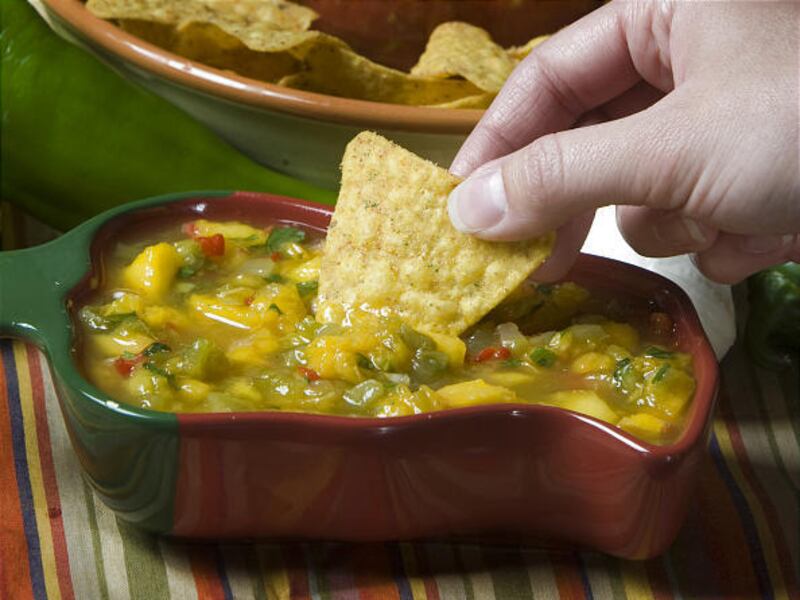
Peach Salsa
This salsa can be refrigerated or frozen, but is not suitable for water-bath canning.
4 large peaches, chopped (about 4 cups)
2 large Hatch or Anaheim chiles, roasted, peeled, seeded and chopped (or 3-4 small cans)
1-2 jalapeño chiles, roasted, peeled, seeded and chopped (or 1 small can)
1/2 small red bell pepper, roasted, peeled, seeded and chopped
Juice of 1 lime
3 tablespoons brown sugar
2-3 green onion stalks, finely chopped (including white part)
3 cloves garlic, finely minced
¼ cup finely chopped cilantro
Mix all ingredients together. Refrigerate until serving, or freeze in 1-cup containers. Makes about 5 cups. This recipe is not intended for home canning.
Options: Add 2 large ripe tomatoes, peeled, seeded and diced. — Valerie Phillips
Tomato Paste Salsa
This is a thicker salsa because it uses tomato paste
3 quarts peeled, cored, chopped slicing tomatoes
3 cups chopped onions
6 jalapeño peppers, seeded, finely chopped
4 Anaheim or Hatch chiles, seeded, chopped
4 cloves garlic, finely chopped
2 12-ounce cans tomato paste
2 cups bottled lemon juice (or lime juice)
1 tablespoon salt
1 tablespoon sugar
1 tablespoon ground cumin
2 tablespoons oregano leaves
1 teaspoon black pepper
Combine all ingredients in a large sauce pan. Bring to a boil. Reduce heat and simmer 30 minutes, stirring occasionally. Ladle hot mixture into pint jars, leaving one-half inch head space. Adjust lids and process in a boiling water canned; 20 minutes at 1,000-6,000 feet (most Utah altitudes), 25 minutes for above 6,000 feet. Makes about 7 pints. — USU Extension
Tomatillo Salsa
5 1/2 cups chopped, cored, husked tomatillos (about 2 pounds)
1 cup chopped onion
1 cup chopped green chiles
4 cloves garlic, minced
2 tablespoons minced cilantro
2 teaspoons cumin
1/2 teaspoon salt
1/2 teaspoon red pepper
1/2 cup vinegar
1/2 cup lime juice
Combine all ingredients in a large sauce pot. Bring mixture to a boil. Reduce heat and simmer 10 minutes. Ladle hot salsa into hot jars, leaving 1/2-inch head space. Adjust two-piece caps. Process 15 minutes in a boiling water canner. Yields about 2 pints. — Ball Blue Book of Preserving
Zesty Salsa
10 cups chopped, seeded, peeled, cored tomatoes (about 6 pounds)
5 cups chopped and seeded Anaheim or Hatch peppers (about 2 pounds)
2 1/2 cups chopped and seeded hot peppers (about 1 pound)
3 cloves garlic, minced
2 tablespoons cilantro, minced
3 teaspoons salt
1 1/4 cups cider vinegar
1 teaspoon hot pepper sauce (optional)
Combine all ingredient in a large sauce pot, adding hot pepper sauce if desired. Bring mixture to a boil. Reduce heat and simmer 10 minutes. Ladle hot salsa into hot jars, leaving 1/4-inch head space. Adjust two-piece caps. Process 15 minutes in a boiling water canner. Makes about 6 pints. — Ball Blue Book of Preserving
Tomato/Green Chile Salsa
3 cups peeled, cored, chopped tomatoes
3 cups seeded, chopped long green chiles
3/4 cup chopped onions
1 jalapeno pepper, seeded, finely chopped
6 cloves garlic, finely chopped
1 1/2 cups vinegar
1/2 teaspoon ground cumin
2 teaspoons oregano leaves
1 1/2 teaspoons salt
Combine all ingredients except herbs into a large sauce pan and heat, stirring frequently, until mixture boils. Reduce heat and simmer for 20 minutes, stirring occasionally. Sir in cumin and oregano during the last few minutes of cooking. Ladle hot mixture into pint jars, leaving 1/2 inch head space. Adjust lids and process in a boiling water canner, 20 minutes at 1000-6000 feet; 25 minutes above 6,000 feet. Makes 3 pints. — USU Extension
Jalapeño Salsa
3 cups chopped, seeded, peeled, cored tomatoes
1 1/2 cup jalapeño peppers
1 1/2 cup bell peppers
1 cup onion
6 cloves garlic, minced
2 tablespoons minced cilantro
2 teaspoons oregano
1 1/2 teaspoons salt
1/2 teaspoons cumin
1 cup cider vinegar
Combine all ingredients in a large sauce pot. Bring mixture to a boil. Reduce heat and simmer 10 minutes. Ladle hot salsa into hot jars, leaving 1/4 inch head space. Adjust two-piece caps. Process 15 minutes in a boiling-water canner. Makes about 3 pints. — Valerie Phillips
e-mail: vphillips@desnews.com