

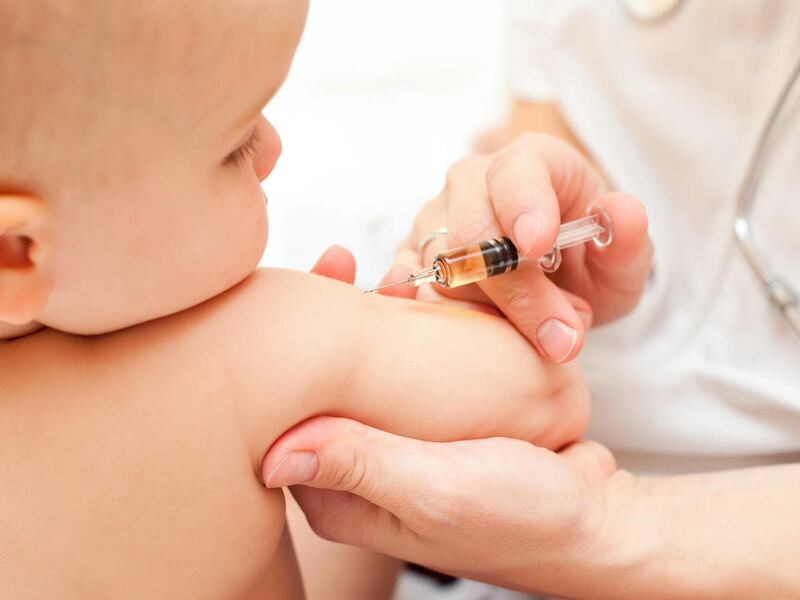

Children usually are study subjects only when they will reap direct or indirect benefit and there is minimal potential for harm. That's not clear with the anthrax vaccine.
Children would be largely unprotected in the event of an anthrax bioterrorism attack because no studies have been done on vaccine risk, benefits and effectiveness in a young population.
On the other hand, subjecting children to vaccine injections when there's no imminent or credibly identified risk "just in case" is problematic, especially since no one knows what will happen.
What to do is a question dividing experts across America. And it's about to be decided. Friday, members of the National Biodefense Science Board will decide whether anthrax vaccine testing should take place in children, something that a working group has recommended, after much debate.
Experts agree that neither option is great: They can either test now in some healthy children and see if it is safe or wait until there's a real attack and then try to gather the data.
In April, Dr. Nicole Lurie, assistant secretary for preparedness and response in the Department of Health and Human Services, wrote the board asking it to decide. She noted the government has stockpiled a lot of anthrax vaccine to be used post-exposure. Periodically the government runs exercises to practice for a mass vaccination effort, including one recently that highlighted, she said, the policy and response challenges with vaccine use in special populations such as children.
"We have no safety, immunogenicity or efficacy data in pediatric populations that would permit the U.S. Food and Drug Administration to evaluate the product for use under an Emergency Use Authorization," she wrote.
Gathering that data would appear to be the answer, she said, but "there are legitimate countervailing concerns regarding subjecting children to risk with no clear benefit at the time of the study."
What to do about testing a vaccine against that threat in kids is a question with both practical and ethical implications, experts agree. Children usually are study subjects only when they will reap direct or indirect benefit and there is minimal potential for harm. That's not clear with the anthrax vaccine.
The Centers for Disease Control and Preparedness has categorized anthrax as having "category A" or most dangerous bioterrorism potential, because it can be deadly, may spread across a large area and requires a lot of planning to protect public health. The anthrax spores are formed by the bacterium Bacillus anthracis and take three forms. They can infect through the skin, lungs or the digestive tract.
CDC notes that 80 percent of people infected through skin don't die, even without treatment. In the gastro-intestinal form, between one quarter and one half of cases result in death. And inhalation anthrax is very severe. In 2001, when anthrax was sent through the U.S. mail system, about half of those who inhaled it died.
In supporting pre-attack testing, Dr. Daniel B. Fagbuyi of Children's National Medical Center in Washington and the working group chairman, asked: "At the end of the day, do we want to wait for an attack and give it to millions and millions of children and collect data at that time? Or do we want to say: 'How do we best protect our children?' We can take care of grandma and grandpa, uncle and auntie. But right now, we have nothing for the children."
A Washington Post story recounts how the vaccine has been tested extensively in adults. More than 2.6 million people serving in the military have also received the vaccine through the U.S. military's anthrax vaccine program.
"But the shots have never been tested on or given to children, leaving it uncertain how well the vaccine works in younger people and at what dose and whether it is safe," wrote Washington Post's Rob Stein. "Unlike with measles, mumps and other disease, the chance that children will be exposed to anthrax is theoretical, making the risk-benefit calculus of testing a vaccine on them much more questionable."
"If you have a situation where a vaccine has never been given to a child," Lurie said, "it's pretty hard to think what you could say to people about its safety and efficacy."
Some doctors opposed to the testing don't mince words.
"With this, you're putting children at risk for no clear scientific or medical benefit," Dr. Meryl Nass of Bangor, Maine, who is one of the most outspoken critics of testing the vaccine in children, told the Washington Post.
He said the vaccine's effectiveness in adults is controversial and noted sometimes serious complications in those who received the vaccine during military service, including nervous system and autoimmune disorders.
Others dispute claims the vaccine has a poor safety record.
EMAIL: lois@desnews.com, Twitter: loisco