




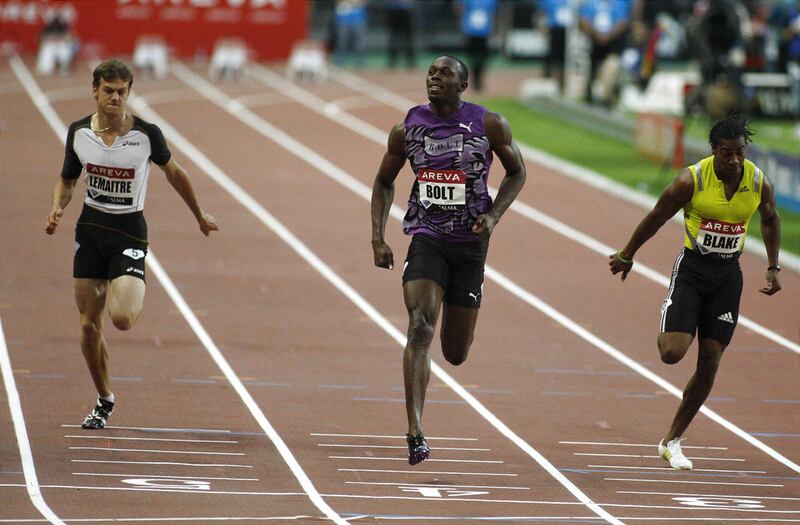
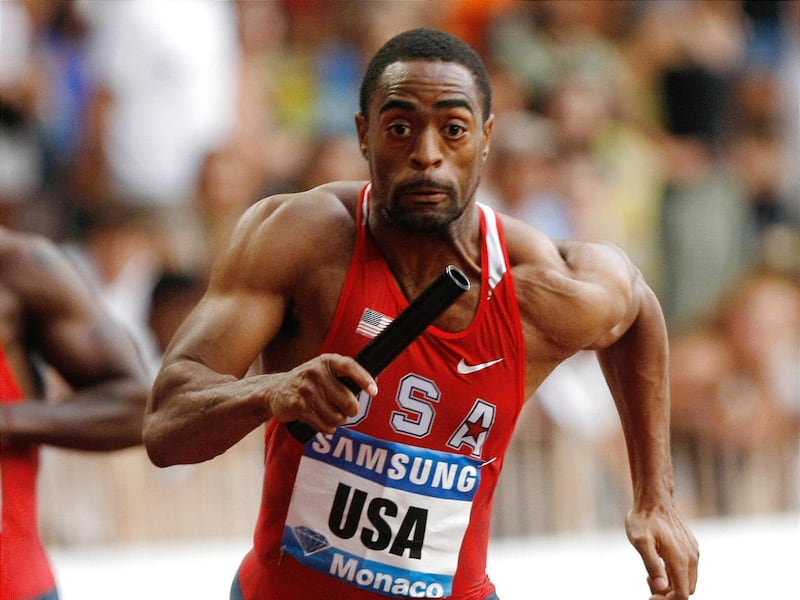

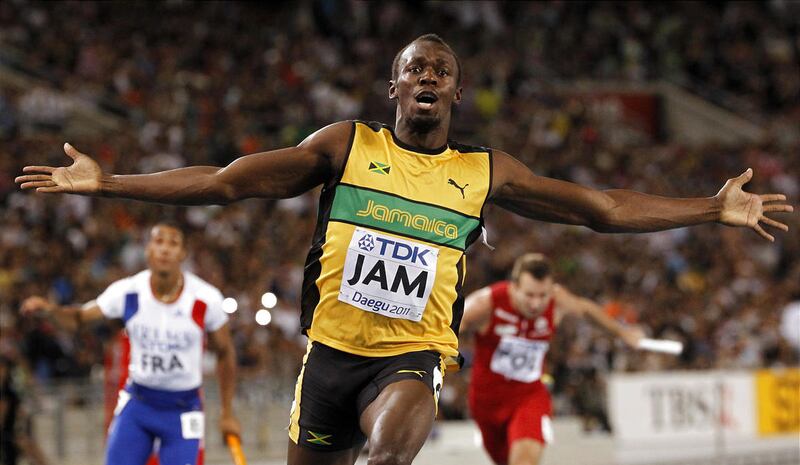

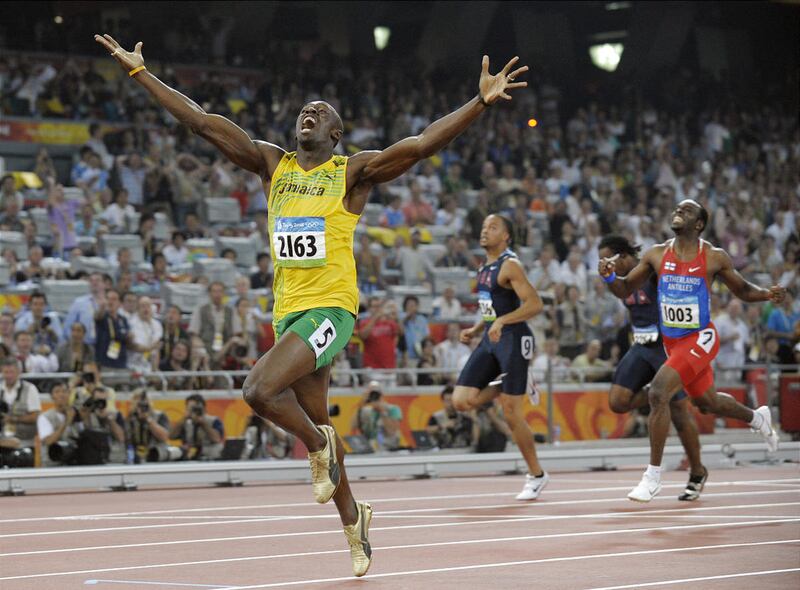
There has never been a collection of fast human beings like the one that has gathered at the London Olympic Games. For the first time, the four fastest men in history could meet in a 100-meter race (provided they survive Saturday's heats and qualify for Sunday's finals) — Usain Bolt (9.58), Tyson Gay (9.69), Asafa Powell (9.72) and Yohan Blake (9.75) — along with history's seventh fastest man — Justin Gatlin (9.80). It is relevant to note that history's fifth-fastest man, Jamaica's Nesta Carter, didn't even make his nation's team. The competition also matches two former Olympic champs — Bolt and Gatlin.
The shelf life of a sprinter is so short that rarely are history's best sprinters around long enough to run against each other, nor do many great ones come along at the same time. And yet here they are.
It's not just one or two men who are running sensational times, as we have seen in the past when a Carl Lewis or Maurice Greene comes along. Already this year 17 men have run sub-10 times. The London showdown could mark the first time an entire field of sprinters runs under 10 seconds in the same race. Perhaps the only thing that could prevent that is London's cool, wet weather.
The current era of sprinting is what the turn of the century was to home-run hitting, what the '60s and '70s were to pop music, what the last decade has been to passing the football, what the late 1800s were to painting. The 2000s have been the confluence of great sprinters. While marks in so many events have stagnated (the long jump has actually gone backward), 100-meter times have fallen off a cliff.
In 1968, Jim Hines set the world record of 9.95. In 1983, Calvin Smith ran 9.93. In 1988 Carl Lewis ran 9.92. In other words, in 20 years the world record was broken only twice, by a scant .03 of a second. In the next 20 years — 1989-2009 — the world record was broken 11 times and tied three times, dropping from 9.92 to 9.58 — a staggering improvement of .34 of a second. The record was broken an average of about every other year. Even if you toss out Bolt's aberrational times, the record was broken nine times and improved .23 — without an altitude-aided time. Meanwhile, from 1968 to the present, the 200-meter record has fallen just five times and the 400 two times. Yet both longer races would seem to have more room for improvement than the 100.
In 1999, Maurice Greene became the first to break 9.80 legally (no drugs, no wind aid). Now the mark has been exceeded 27 times, and that's not counting performances by Ben Johnson and Justin Gatlin, whose sub-9.8 efforts were erased by drug penalties.
There's never been such an assault on the 100-meter record since electric timing replaced hand timing almost 50 years ago. Look at the list of the top 13 sprinters accompanying this story — nine of those performances were produced in the last six years. This in an event that, more than any other, requires near perfect conditions.
Why is this happening? It's difficult to ignore the obvious in this age. It's either the golden era of sprinting, or track's version of the drug-fueled home-run binge that occurred a decade ago in baseball. "I don't believe there is an explanation unless you charge it to doping, and yet they are simply that fast," says Willard Hirschi, the retired BYU track coach who coached Frank Fredericks, a four-time Olympic silver medalist in the 100 and 200. In 1996, Fredericks ran 9.86 — .01 off Leroy Burrell's world record at the time. Thirteen men have run faster since then. In a phone conversation, Hirschi goes back and forth on the issue, trying to make sense of it.
"It requires enormous speculation," he says. "Has training technique changed that much? Perhaps. Yet, I don't think so."
We've learned to be cynical since Ben Johnson's infamous drug bust at the 1988 Olympics. Since then, many other great sprinters have faced drug sanctions: Olympic champions Linford Christie, Marion Jones and Gatlin, former world record holder Tim Montgomery, Steve Mullings, Dwain Chambers, Mike Rodgers. But the rest of them passed drug tests, you're thinking. That's not much reassurance when you consider that Jones and Montgomery took dozens of tests (160 for Jones) and never flunked one.
Even Powell, who has broken or tied the 100-meter world record five times, is like the rest of us when it comes to drug suspicions. Last year he told reporters, "I don't know who is, but I always speculate and wonder if someone else is on stuff. For a long time after Gatlin tested positive I couldn't believe in anybody that I competed against. For the sport itself, it's unfair, but that's the way it is."
But Hirschi, still vacillating, wonders how rampant drug use could exist; "So many athletes have been running close to those world record times. It's not just one guy, but lots of guys. Since you have such large numbers running close to world-record times, it's hard to believe they're all on drugs. You'd hear something about it, like what we've seen happen in cycling. It's hard for that many to keep a secret."
Hirschi thinks there might be at least one other factor: "There is certainly a lot to the notion, 'If he can do it, I can do it.' Once somebody hits a time, then others think it's possible to do it. The mind is a marvelous thing."
Men tried for decades to break the four-minute mile before Roger Bannister finally did it in 1954. "Now that it's been broken, I'm sure other runners will break it, too," he said afterward. Forty-six days later, John Landy ran faster. Within 2½ years, nine other men also had run sub-four miles.
On the other hand, Sergey Bubka, the great Russian pole vaulter, cleared 20 feet 11 times a decade ago, and no one else has followed. The same thing has happened in the men's long jump and the 400 hurdles, among other events. Nobody followed Florence Griffith Joyner's lead when she suddenly produced mind-boggling times late in her career in 1988, performances that fueled a lot of suspicions of their own.
But clearly head-to-head competition pushes athletes to better performances, which is why pacesetters are hired for world-record attempts in distances longer than 400 meters. Gay's best 100 time was 9.77 when Bolt ran 9.69 in 2008. A year later Gay ran 9.71 behind Bolt's 9.58 in the World Championships, and a month later Gay ran 9.69. We can only wonder if he would've run such times if Bolt hadn't shown it was possible.
Bolt's performances also opened the floodgates in his homeland. No discussion of the sprint resurgence would be complete without addressing the Jamaicans. Since Bolt won the 2008 Olympics, Jamaicans seem to have rushed to the scene, especially the men. Four of the five fastest sprinters in history are Jamaicans — Bolt, Powell, Blake, Carter — not to mention Mullings, whose drug-vacated 9.80 would give Jamaica five of the top seven fastest sprinters ever. Except for Powell, they all climbed to the top of the sprint world after Bolt's sensational Olympic performance in 2008.
Before Beijing, Jamaican sprinters had won only three gold medals in the 25 previous Summer Olympic Games — Don Quarrie in the 200 in 1976, Veronica Campbell in the 200 in 2004 and the women's 4x100 relay in 2004. In Beijing they won the men's and women's 100, the men's and women's 200 and the men's 4x100 relay and produced three world records (they also won the women's 400-meter hurdles).
They show no signs of slowing. In the last three World Championships combined — the 2008 Olympics and the 2009 and 2011 World Championships — Jamaicans have claimed 22 of a possible 54 medals in the men's and women's 100, 200 and 4x100 and, more remarkably, 14 of 18 gold medals.
This is a stunning development for an impoverished nation of 2½ million on an island country the size of Connecticut. There has been plenty of speculation about why this has happened. Genetics and lifestyle — they walk and run everywhere. The popularity of track — unlike the U.S., they're not losing most of their athletes to football and basketball. Some have even credited their diet and, specifically, a yam that grows on the island. And there has been drug speculation of course. Any time an athlete or a group of athletes shows sudden improvement, suspicions are heightened.
In the case of Bolt, he might be a wonderful freak of nature. As Hirschi says, "I always said that someday a tall man with the neuromuscular coordination of a smaller man would shatter the world record. Bolt is exactly the man I envisioned."
Bolt showed early promise, posting a world junior record (19 and under) of 19.93 in the 200 when he was just 16. But his best 100-meter time at the outset of the 2008 season was 10.03. That year he ran 9.72, 9.76 and 9.69. A year later he ran 9.58.
It was as if we skipped an evolutionary step for sprinters. World records for 100 meters are broken by hundredths. In one year Bolt took Powell's world record of 9.74 to 9.58 — a drop of .16 of a second. The last time we saw a world record fall like that was when Ben Johnson clocked 9.83 and 9.79 when the world record was 9.93 — and then he flunked a drug test.
In 2009, five Jamaican athletes who were headed to the World Track championships flunked drug tests (later, they were cleared by Jamaica's anti-doping commission). Last year Mullings flunked a drug test and was suspended from competition (he also tested positive in 2004).
On the surface, it appears that Jamaica's rise in the sprint world was sudden, but they've actually been a force for years — they just weren't always wearing Jamaican uniforms. The United States' Sanya Richards, a gold-medal favorite at 400 meters, is half-Jamaican. Canada's Donovan Bailey, the 1984 Olympic 100-meter dash champion, is a native of Jamaica. Linford Christie, the 1988 Olympic champion from Great Britain, is another native Jamaican. Pauline Davis-Thompson, the 2000 Olympic champ at 200 meters for Bahamas, is of Jamaican decent. Johnson, the disgraced sprinter from Canada, has Jamaican roots.
Jamaicans would seem to be naturally gifted sprinters, and why not? Africa keeps churning out great distance runners. More than 60 Olympic medals have been won by sprinters and hurdlers from the Caribbean countries of Trinidad, Bahamas, Cuba, Barbados and Jamaica in the last six decades.
In the end, while trying to explain the resurgence at 100 meters, Hirschi finally throws up his hands: "I don't know what's going on."
Top 13 sprinters of all time
Time Name Year
9.58 Usain Bolt, Jamaica 2009
9.69 Tyson Gay, U.S. 2009
9.72 Asafa Powell, Jamaica 2008
9.75 Yohan Blake, Jamaica 2012
9.78 Nesta Carter, Jamaica 2010
9.79 Maurice Greene, U.S. 1999
9.80 Justin Gatlin, U.S. 2012
9.84 Donovan Bailey, Canada 1996
Bruny Surin, Canada 1999
9.85 Leroy Burrell, U.S. 1994
Olusoji Fasuba, Nigeria 2006
Mike Rodgers, U.S. 2011
Richard Thompson, Trinidad 2011
* Times by Justin Gatlin (9.77), Ben Johnson (9.79) and Steve Mullings
(9.80) have been annulled by drug penalties.Top 13 sprinters of all time
Time Name Year
9.58 Usain Bolt, Jamaica 2009
9.69 Tyson Gay, U.S. 2009
9.72 Asafa Powell, Jamaica 2008
9.75 Yohan Blake, Jamaica 2012
9.78 Nesta Carter, Jamaica 2010
9.79 Maurice Greene, U.S. 1999
9.80 Justin Gatlin, U.S. 2012
9.84 Donovan Bailey, Canada 1996
Bruny Surin, Canada 1999
9.85 Leroy Burrell, U.S. 1994
Olusoji Fasuba, Nigeria 2006
Mike Rodgers, U.S. 2011
Richard Thompson, Trinidad 2011
* Times by Justin Gatlin (9.77), Ben Johnson (9.79) and Steve Mullings (9.80) have been annulled by drug penalties.
email: drob@desnews.com