

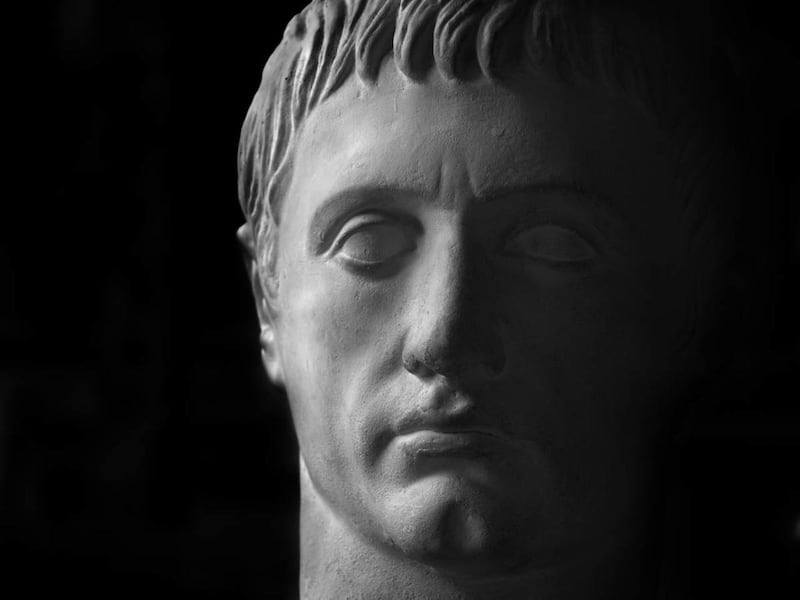
On Oct. 10, A.D. 19, the Roman hero and son of the emperor, Germanicus, died under mysterious circumstances. Many suspected that his adopted father and rival, Tiberius, had ordered his death.
Julius Caesar, later known as Germanicus by his peers and to distinguish him from the founder of the Julio-Claudian dynasty and earlier Roman dictator of the same name, was born in May 15 B.C. Germanicus' father was Drusus, who had been the stepson of the first emperor Augustus, and the younger brother of Tiberius, Augustus' successor. Germanicus' mother was Antonia, daughter of Mark Antony and Augustus' sister, Octavia.
Together with his younger brother Claudius (himself a future emperor), Germanicus was raised in the midst of Roman power in the early years of the imperial period. As he grew to adulthood he took on more and more government posts and military commands and, for a time, his great uncle Augustus considered him to be his successor. Unlike Claudius, who stuttered and who may have suffered from a form of mild cerebral palsy, Germanicus was healthy, good-looking and accomplished. As such, he became quite popular with the Roman people.
In Robert Graves' translation of Suetonius' “The Twelve Caesars,” the ancient Roman historian wrote: “Germanicus is everywhere described as having been of outstanding physical and moral excellence. He was handsome, courageous, a past-master of Greek and Latin oratory and letters, conspicuously kind-hearted, and gifted with the powerful desire and capacity for winning respect and inspiring affection. … He often fought and killed an enemy in hand-to-hand combat; and did not cease to plead causes in the Law Courts even when he had gained a triumph.”
Germanicus served five terms as a quaestor, a sort of Roman secretary of the treasury. In A.D. 12 he was named consul — Rome's highest rank during the republican period, but still considered a high honor not without power during the empire. The Senate appointed Germanicus to military command in Germania in A.D. 14, not long after the death of Augustus. Military ability was highly prized among the Romans, and this was a chance for Germanicus to gain considerable prestige.
Five years earlier, three Roman legions had been destroyed at the hands of German tribes under the Romanized German Arminius at the Battle of the Teutonburg Forest. Now, Germanicus was determined to punish the German tribes and reclaim the lost legions' eagle standards. In this he was successful and his popularity among Rome's citizens continued to grow. His nickname sprang from his accomplishments in Germania.
With the death of Germanicus' father in 9 B.C., the young warrior-politician's uncle and the new emperor, Tiberius, formally adopted him, perhaps signaling his intent to name Germanicus as his successor and bask in some of his new son's glory. Also, it is possible that Tiberius, never loved by most Romans the way Augustus had been, saw Germanicus as a potential rival and was looking to sideline the young man.
Perhaps knowing that a popular commander with loyal troops could prove to be the stuff of revolution or coup, Tiberius ordered Germanicus to Asia, far from his power base in Germany. If Tiberius' hope had been to check Germanicus' popularity, however, he was to be disappointed. Germanicus soon waged wars against Rome's eastern enemies and defeated the Cappadocians of Asia Minor, the Armenians and other kingdoms of the region.
His success soon brought him into conflict with the Roman governor of Syria, who perhaps acting under Tiberius' orders meddled in Germanicus' military and political affairs. Gnaeus Calpurnius Piso and Germanicus frequently butted heads, though supposedly the emperor's adopted son met hostility with magnanimity. In Michael Grant's translation of Tacitus' “The Annals of Imperial Rome,” the Roman historian noted a joint voyage in the Aegean Sea in which the two men sailed in different ships:
“Though aware of Piso's (political) attacks on him, Germanicus behaved so forgivingly that when a storm was driving Piso on to the rocks — so that his death could have been put down to accident — Germanicus sent warships to rescue his enemy. However, Piso was not mollified.”
Tiberius angrily objected when Germanicus visited Egypt, a province that by law was the emperor's personal property and, because of its great wealth, was off limits to senators and others who could possibly pose a threat to him. Finally, returning to Antioch, things in the east grew so heated between Germanicus and Piso that the Syrian governor decided to return to Rome. He changed his mind, however, when Germanicus took ill, and Piso continued to undermine Germanicus' position. Tacitus wrote:
“He wrote to Piso renouncing his friendship, and it is usually believed that he ordered him out of the province. Piso now delayed no longer, and sailed. But he went slowly, so as to reduce the return journey in case Germanicus died and Syria became accessible again.”
Not long after, on Oct. 10, A.D. 19, at only 33 years of age, Germanicus succumbed to his illness and died. Many suspected that he had been poisoned. Seutonius relates that he had “dark stains” covering his body and “foam on his lips,” which seemed to suggest poison. Supposedly, after Germanicus' cremation, his heart had been found intact among the charred remains — “a heart steeped in poison is supposedly proof against fire.”
Suetonius went on to write: “According to the general verdict, Tiberius craftily arranged Germanicus' death with Gnaeus Piso as his intermediary and agent.”
It is certainly possible that Tiberius feared his adopted son's popularity and wanted him out of the way. The emperor had no problem eliminating rivals in the past, such as Augustus' grandson Agrippa Postumus. It is also possible that Sejanus, leader of the Praetorian Guard in Rome, had a hand in Germanicus' death. The ever ambitious Sejanus may have wanted to eliminate Germanicus because he believed that he himself could one day be emperor. On the other hand, Tiberius and Sejanus may have worked in collusion. Also, it is altogether possible that the hero did indeed die from natural causes.
Tacitus noted the reaction to Germanicus' death: “He was decreed every honor which love or ingenuity could devise. His name was introduced into the Salian hymn: curule chairs, crowned by oak-wreaths, were to be placed in his honor among the seats of Brotherhood of Augustus; his statue in ivory was to head the processions at the Circus Games ….” Many more honors were also paid him.
Upon his death, Piso attempted to consolidate his power in Syria, and this led many to suspect his hand in Germanicus' death. Popular outcry demanded an investigation and under such pressure Tiberius ordered a trial. Before the trial ended, however, and without any evidence of his guilt, Piso took his own life, supposedly by cutting his own throat with a sword.
Germanicus' greatest legacy, however, was his progeny. Upon Tiberius' death in A.D. 37, Germanicus' son became the third emperor of Rome. Named Gaius Julius Caesar Augustus Germanicus, after his father and the first emperor, the young man was better known by his nickname, Caligula. Germanicus' son's reign was marked by madness, murder and oppression.
Germanicus' daughter, Agrippina the Younger, eventually married her uncle, Germanicus' brother, the fourth emperor Claudius. Her son from a previous marriage went on to become the fifth emperor, Nero, whose reign was likewise marked with madness.
Cody K. Carlson holds a master's in history from the University of Utah and teaches at Salt Lake Community College. An avid player of board games, he blogs at thediscriminatinggamer.com. Email: ckcarlson76@gmail.com