


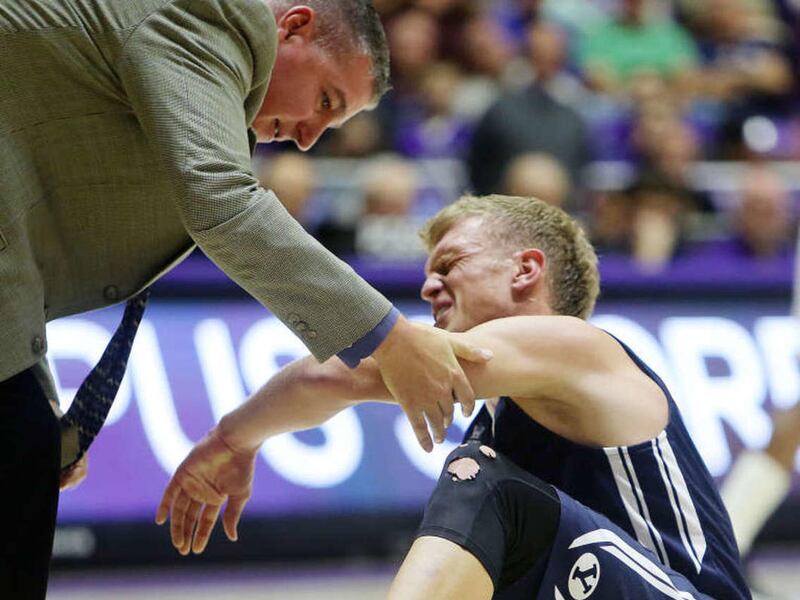
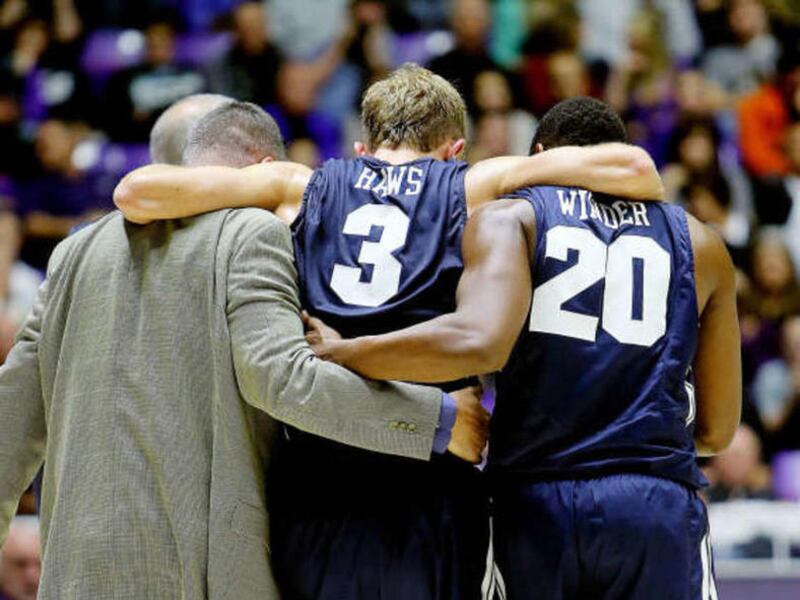

PROVO — BYU guard Tyler Haws has been drafted into the Army of the Aggrieved Ankle.
Yes, indeed. Ankle joints have been an endangered body part in BYU’s major sports programs this year. Now the problem has spread to the school’s top basketball star.
Haws went down with what looked like an excruciating ankle sprain in BYU’s win over Weber State in Ogden last Saturday night. He accepted the aid of teammates to get off the court and did not put weight on that foot. Later, he wore a protective boot but walked under his own power over the weekend.
The ankle dilemma in Provo.
It’s catching.
BYU basketball coach Dave Rose said Haws' injury is day to day. A decision will be made Friday if he can play against Stanford Saturday.
This malady took out nearly two dozen players on BYU’s bowl-bound football team in 2014. They included the Cougars' first three running backs — Jamaal Williams, Algernon Brown and Adam Hine. Other victims were QB sack leaders Alani Fua and Bronson Kaufusi; the defensive quarterback, safety Craig Bills; the other starting safety, Dallin Leavitt; and one of the top receivers, UTEP transfer Jordan Leslie.
When reporters waited for injury reports on Mondays, Mendenhall would go down the list. The coach would name victims missing practice. “Well, what’s he got?” they’d ask. “Looks like an ankle,” said the coach. He had that line memorized.
Mendenhall said he’d requested a study to see if this was an anomaly, a trend, something that could be attributed to a practice or training method, or just bad luck of the roll, so to speak.
Theories abound. Was it the morning practices? Could it be the indoor practice facility turf? Could it be overdevelopment of an upper leg muscle, diet, or just bodies colliding at the wrong time and angle?
In basketball, BYU’s best prospect for pounding the ball in the post is UNLV transfer Jamal Aytes. At 6-6, he was supposed to remind everyone of All-MWC Cougar Keena Young. But Aytes sprained his ankle in early fall workouts and by the time practice began in October, nobody got to see him. They scheduled him for ankle surgery.
Now it’s Haws.
Monday morning he underwent an MRI. It’s where you stick your body in one of those machines that produces a picture of muscles, tendons, ligaments, bones and soft tissue in remarkable 3-D. It’s a fabulous diagnostic tool the Romans could have used during their conquests. It reveals such nifty details, but it can also be wrong, as in the case of BYU QB Taysom Hill’s first major knee injury of 2012.
Ankle injuries, especially ones located high, can be serious. They can nag a guy for weeks if not months or an entire season.
Haws will be lucky to be his normal self through this week, the holidays or even the rest of this year.
The Cougars enter a critical couple of weeks. They need quality wins for their NCAA tournament resume. They came up a hair short against San Diego State, Purdue and Utah. Now they get Stanford and UMass coming to Provo right before the opening of conference play at home against ranked Gonzaga and Portland before New Year’s Day.
Haws, even at 70 percent? Or unable to play?
If that’s the case, it is unfortunate. Haws is not only the No. 3 scorer in the country, averaging 23.8 points a game, but he's BYU’s destined career scoring leader.
He’s the spoon that stirs BYU’s team. He’s so productive from the field, the 3-point line and free-throw line that this team — a perimeter-oriented squad — relies on him for about 25 percent of point production every game.
Nobody comes off screens like him. Nobody hits mid-range shots at his rate. Nobody shoots as fast as he does with his lightning release.
Haws plays more minutes than any other player. He’s tried more field goals than anybody else by 54 and made 27 more; he’s attempted more free throws by 34 and made more from the line than any other player by 39.
He’s taken 30 percent of BYU’s 276 free throws and made 35 percent of the team’s 208 makes. He’s made a quarter, 24.7 percent to be exact, of BYU’s 336 field goals and taken 23.9 percent of the team’s 697 attempted shots. He’s made 35 percent of the team’s 208 made free throws and produced 26 percent of BYU’s nation-leading 89.9 points per game.
Now, in truth, ankle injuries, particularly sprains, are one of the most common injuries to football and basketball players. If you jump around in a gym where other guys' feet are in your landing area, chances are you will twist your ankle and crash to the ground and think the world has come to an end.
But in the case of BYU athletes, they’ve had more than their share.
And when it comes to one Tyler Haws, there are sprained ankles, then there are sprained ankles.
Dick Harmon, Deseret News sports columnist, can be found on Twitter as Harmonwrites and can be contacted at dharmon@desnews.com.