

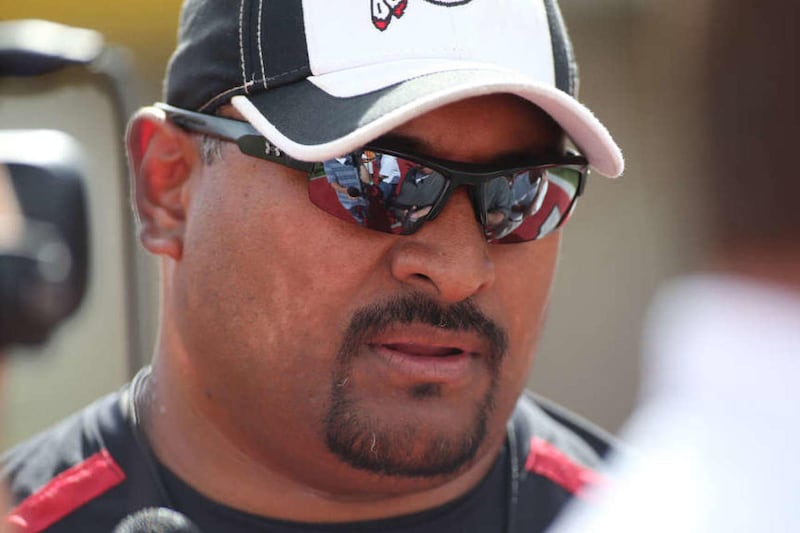
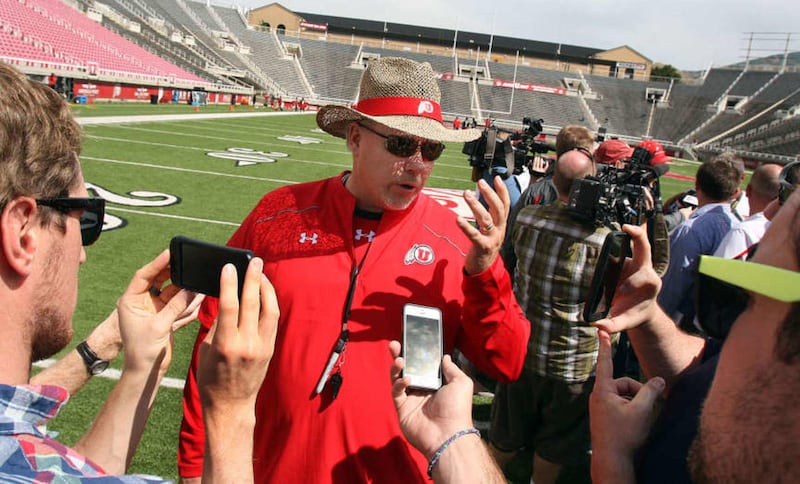
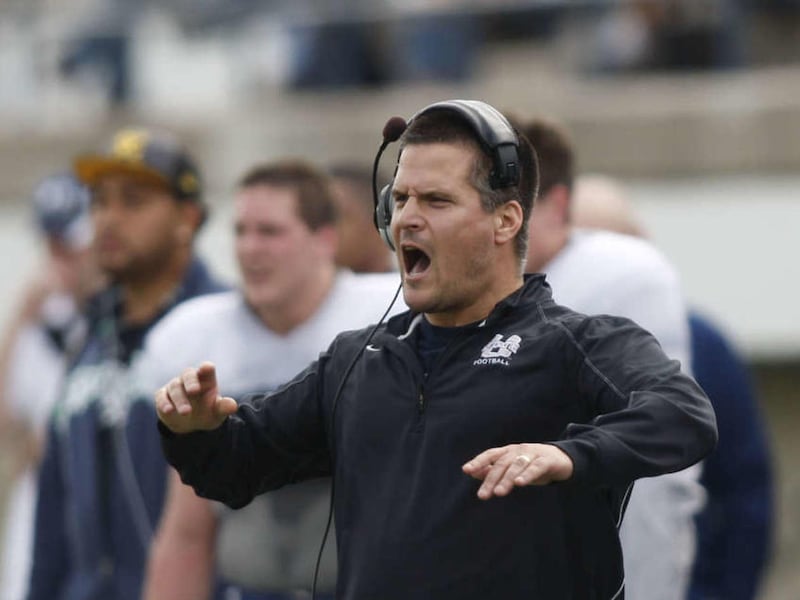
Hiring this staff has been a little different for me. I’ve really been able to go back to my roots and surround myself with the guys that I’ve coached with before and felt the most affinity for. – New Oregon State coach Gary Andersen
From Tuscaloosa to the Pac-12, head coaches teaching young men to tackle, block and pass have seen an explosion in compensation in recent years.
Their assistants aren’t doing too bad, either.
In the college football’s top division, the average assistant’s pay has increased 52 percent in the past five years, to over $236,000, according to the USA Today assistant coach salary database.
Utah is no different. In 2012, the Utes employed Brian Johnson as offensive coordinator. More than just the names changed when, two years later, Utah hired Dave Christensen. Christensen’s $500,000 was more than double Johnson’s salary as Utah’s offensive coordinator.
Television boosting coaches salaries
Experts contribute the explosive rise in college football salaries to the sport's lucrative television rights deals. In Utah, BYU has a deal with ESPN paying it to broadcast at least five home football games a season.
In documents Deseret News Sports received in a GRAMA request, Utah will receive $17.09 million in Pac-12 television rights next year.
According to Utah State’s five-year financial report obtained via state records request, the Aggies were scheduled to receive $300,000 in television rights in 2014.
The median revenue at a Division I athletic department was $6.5 million (2014 dollars) in 1970, according to the NCAA. In 2012, revenue had spiked over 800 percent to $56 million.
Most schools in the "Power 5" conferences far exceed this, according to USA Today's college finance database. While Oregon paced the Pac-12 with $115 million in revenue, Texas led all schools in marketability with $165 million. At Texas, 66 percent of revenues came from football.
Mike Tranghese, the former commissioner of the Big East Conference told the New York Times, “I love the sport of football, but the collegiate athletic world as we know it is absolutely controlled by the sport of football.”
In comparison: head coaching salaries
A college football coach in the NCAA's top division (FBS) made an average of $1.75 million in 2014, a look at the USA Today database reveals. This does not account for the hundreds of thousands of dollars in perks, benefits and incentives.
The top of the NCAA coaching pyramid is even more lucrative. The nation’s 25 best-compensated college football coaches were guaranteed to make $3.85 million in 2014.
FBS coaching pay in Utah
Utah’s Kyle Whittingham made a minimum of $2.2 million in 2014. Utah State’s Matt Wells took home a guaranteed $575,000 this year, according to a Deseret News state records requests with the respective universities.
As a private institution, BYU does not have to provide the financial numbers and contracts of its coaching staff.
While there has been speculation about Whittingham's future at Utah, he has an economic incentive to stay.
If Whittingham were to voluntarily leave Utah before Dec. 31, 2016 to coach in the Pac-12, he would owe the university $600,000 the year he terminates the contract and an additional $200,000 for each additional year remaining on his contract.
If Whittingham were to voluntarily leave to coach in anywhere else before 2017, he would have to pay the university $200,000 for every year remaining under the terms of his agreement.
If the university were to terminate Whittingham without cause he would receive, as liquidated damages, $750,000 a year for each year remaining on his contract.
If Wells were to leave the Aggies prior to July 1, 2015, Utah State would receive 100 percent of his guaranteed base salary from either Wells or his subsequent employer.
Head football coaches often negotiate for higher assistant pay
Head coaches negotiate more than their own salary, years and perks into their contracts. It’s interesting, if not surprising, that head coaching contracts often outline a minimum the school will spend on assistant coaching salaries.
In Wells’ first head coaching contract, Utah State was required to spend at least $1.05 million in assistant coaching salaries. When Wells renegotiated his contract in early 2014, the university increased the minimum assistant coach pay pool to $1.1 million.
Utah State was just shy of this minimum threshold this year. Utah State paid its assistant coaches $1,092,647 in 2014, according to USA Today.
While Whittingham's contract did not seem to have a minimum assistant coaching salary requirement, in a 2010 amendment the head coach negotiated a football staff salary increase of $125,000 in the 2010/2011 fiscal year.
All told, Utah paid assistant football coaches $2,420,000 in base salary in 2014.
College football’s top earners
LSU, with two coaches in Cam Cameron and John Chavis both making over $1.3 million this year, lead the nation in assistant football compensation. The No. 23 Tigers guaranteed football assistant coaches $5,499,269 for 2014 in combined salary.
Virginia Tech’s Bud Foster had the highest NCAA assistant football coaching salary. The Hokies give Foster $1.346 million in base salary, over $800,000 more than he was paid in 2013.
Assistant football coaching a nomadic profession
When Gary Andersen left for Wisconsin in 2012, Utah State had to hire more than a new head coach in Wells. Of Utah State’s 19-strong coaching staff, only four have more than two years experience with the Aggies.
Utah’s Dennis Erickson has more experience than just nine postseason bowls and two NCAA titles. In his football life, Erickson had 15 coaching stops before becoming an assistant at Utah. They are, in order: Montana State, Billings CC HS, Montana State, Idaho, Fresno State, San Jose State, Idaho, Wyoming, Washington State, Miami, Seattle Seahawks, Oregon State, San Francisco 49ers, Idaho and Arizona State.
As running backs coach at Utah, Erickson earns $275,000 a year — not quite the $12.5 million he got from the San Francisco 49ers, according to the AP.
"The money's not why I came back to coaching," he said to USA Today. "It's in my blood. It's what I do."
The current assistant coaching situation in Logan
Contracts to four key Utah State assistant coaches in 2014 were obtained in a state records requests. All four — assistant head coach Mark Weber, defensive coordinator Todd Orlando, offensive coordinator/quarterbacks coach Kevin McGiven and co-offensive coordinator Luke Wells — all had contracts that expire on July 1, 2015.
So long as Wells is head coach, he can renew and extend his assistant coaching commitments this January. Wells can also revisit the Aggies' $1.1 million assistant pay pool minimum on an annual basis with the university.
But there have been recent departures on the Aggies' staff. On Monday, Houston hired Orlando as its new defensive coordinator.
On Dec. 29, McGiven got out of his contract to become Oregon State's quarterback coach. Following the 2014 season where the Aggies posted a 10-4 record while using four quarterbacks and a receiver under center, FootballScoop named McGiven the Quarterbacks Coach of the Year.
"Hiring this staff has been a little different for me," Andersen said in a phone interview with the Deseret News. "I’ve really been able to go back to my roots and surround myself with the guys that I’ve coached with before and felt the most affinity for."
McGiven worked under Andersen as quarterbacks coach on the 2009 Utah State team.
Utah's assistant coaching situation
At Utah, offensive coordinator Dave Christensen's contract was set to run until Dec. 20, 2015. Christensen, however, had a provision that let him terminate his contract "at any time" by giving written notice to the university.
Christensen has moved on, as Texas A&M announced Tuesday he will be the team's offensive line coach.
The contracts to assistant coaches Kalani Sitake and Dennis Erickson terminate on June 30, 2015.
Sitake, Utah's former defensive coordinator, was able to terminate his contract by giving 30 days written notice. On Dec. 23, newly-minted Oregon State head coach Andersen announced that Sitake, along with fellow Utah assistant Ilaisa Tuiaki, were joining him in Corvallis.
"Kalani brings an unbelievable ability to relate and care for kids," Andersen said. "That’s always number one for me. I don’t care about anything else. When it comes to coaching, I feel that always has to come first. He’s exactly what I believe in."
Added Andersen: "Number two, he's just tremendous — tremendous — at developing talent. ... Kalani is at the top of the game when it comes to developing kids. He puts them in a spot to be successful, then teaches them how to be successful."
The Utes sought to keep Sitake. Utah athletic director Chris Hill confirmed he offered Sitake a three-year contract worth $750,000, plus bonuses.
"Kalani wants to be a head coach," Andersen said. "I’m looking forward to helping him make that next step forward."
The Oregonian newspaper filed public records requests for the new hires to the Oregon State football staff. As of publication, the Oregonian had not received the contracts.
Assistant coaching jobs a soft landing spot for fired head coaches
Former University of Florida coach Will Muschamp provides a recent example into how fired college football coaches have found lucrative landing spots as college football assistants.
According to Birmingham News, Florida bought out the last three years of Muschamp’s contract for $6.3 million. Eleven days after the firing, Auburn hired Muschamp to head its defense. Auburn will pay him at least $1.6 million a year. The Tigers' investment in their defensive coordinator doesn’t end there, however; the team is on the hook for the $2.2 million remaining on the contract of recently fired coordinator Ellis Johnson.
“Anytime anyone has tried to make the argument that college football is oversaturated, or there is too much, it seems to me, it ends up being a dynamic that it’s the more the merrier,” ESPN’s vice president for college football programming Ilan Ben-Hanan told the New York Times. “Fans pretty much have an insatiable appetite for college football.”
Contention among the ranks
Not everyone in the academic ranks is on board with college football's rising pay.
Randy Edsall makes just over $2 million as head football coach at the University of Maryland. The chancellor of the Maryland state university system doesn’t sound too pleased.
"It's really an embarrassment for higher education that at a time when both colleges and universities are having fiscal challenges and tuition is rising at rates that has everybody alarmed, here we are paying coaches at the level they're being paid," Brit Kirwan said to Newsday. "It's both indefensible and very difficult to address."