

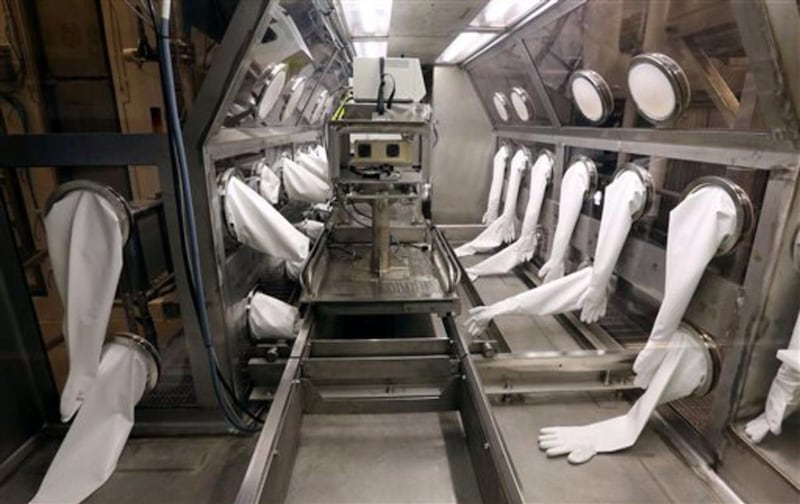

SALT LAKE CITY — A pair of military watchdog groups are blistering mad over what they say is a lack of accountability regarding the shipment of live anthrax spores from the Dugway Proving Ground to more than 180 labs, asserting that recipients should be identified in the interest of public safety.
"I think our system is in need of some overhaul," said Steve Erickson with Citizens Education Project and Downwinders. "We just end up taking the Army's word for it again and again. It is possible that one of these days we will have something catastrophic happen."
The U.S. Department of Defense learned in May that Dugway's Life Science Testing Facility had shipped viable anthrax spores to labs in the United States as well as abroad, including the United Kingdom, France, Germany and Australia. No one was directly exposed to anthrax spores, although close to two dozen people took antibiotics as a precaution. A lab in Utah was one of the recipients.
"We want to know which lab in Utah got it, when they knew about it and what they did about it," Erickson said.
A subsequent review of Defense Department procedures for inactivating and verifying the elimination of live anthrax spores revealed that Dugway mistakenly shipped viable anthrax samples for more than a decade to 183 labs due to low sampling volume.
Dugway is the Army's largest "manufacturer" of anthrax spores for biodefense research and sits on 800,000 acres about 70 miles southwest of Salt Lake City. The military facility did not return phone calls seeking comment for this story.
Anthrax is a serious, often fatal disease caused by a rod-shaped bacteria that is dormant in the environment but can infect domestic and wild animals, including sheep, goats and cattle. It is not contagious from human to human.
In July at the conclusion of an initial review, Deputy Secretary of Defense Robert York issued a scathing memorandum over Dugway's handling of the spores.
"I take no comfort in the fact that public safety risks were very low as a result of these shipments," he wrote. "This was an inexcusable institutional failure."
In September, the Defense Department announced anthrax was discovered outside the primary containment area at Dugway, prompting the military to suspend the production, testing and shipment of any dangerous agents — live or inactivated. The agency also initiated a safety review of all nine Defense Department labs that handle bio agents.
Erickson, joined by Downwinders founder Preston J. Truman, have submitted multiple open records requests to determine the identity of the recipient lab in Utah and are planning to make document requests this week to the Centers for Disease Control and Prevention, which mounted an investigation into Dugway in early June.
The Utah Department of Environmental Quality and labs at Utah State University and the University of Utah said there were no records related to the anthrax shipments over the last 10 years, but Erickson said he has yet to hear back from the Utah Department of Health. Erickson wants to know if the health department has any documents related to any laboratory recipients of Dugway's anthrax spores.
Utah Department of Health spokesman Tom Hudachko said Monday the records have been compiled but they are awaiting a legal review prior to any public release.
The Army Biosafety Task Force is preparing a report detailing its findings and recommendations for the Defense Department's Biosafety Program, a review that is expected to be finished this month, according to Army spokesman Dov Schwartz.
Schwartz added that the Army will not publicly identify any of the labs that received the anthrax spores.
"The public identification of private laboratories remains sensitive as this ongoing matter can disproportionately impact their business as well as the department's ability to conduct research on pathogens," he said. "The decision not to publicly release the identity of facilities was undertaken in consultation with the recipient laboratories, the majority of whom did not want their names released publicly."
Erickson said it is bad for public safety to not disclose the identity of recipient labs and he is bugged by the lack of state involvement in the issue.
"We don't have any means of accountability with the state," he said. "We have these recurring instances of mistakes out at Dugway and nobody gets notified."
In January of 2011, Dugway went on a 13-hour lockdown after a vial of the nerve agent VX was misplaced. The vial was subsequently found in a container that was mislabeled.
At the time, Utah Gov. Gary Herbert said it was unacceptable that there was not any civilian notification of the incident. He later spoke with military officials, whom he said satisfied his concerns.
Erickson said there needs to be greater oversight of Dugway.
"It seems that nobody is the least concerned over this," he said.
Email: amyjoi@deseretnews.com
Twitter: amyjoi16