

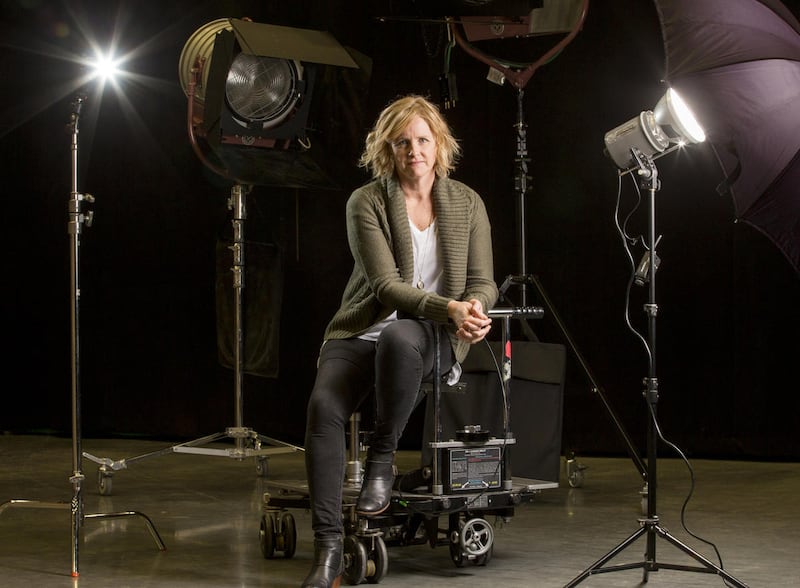
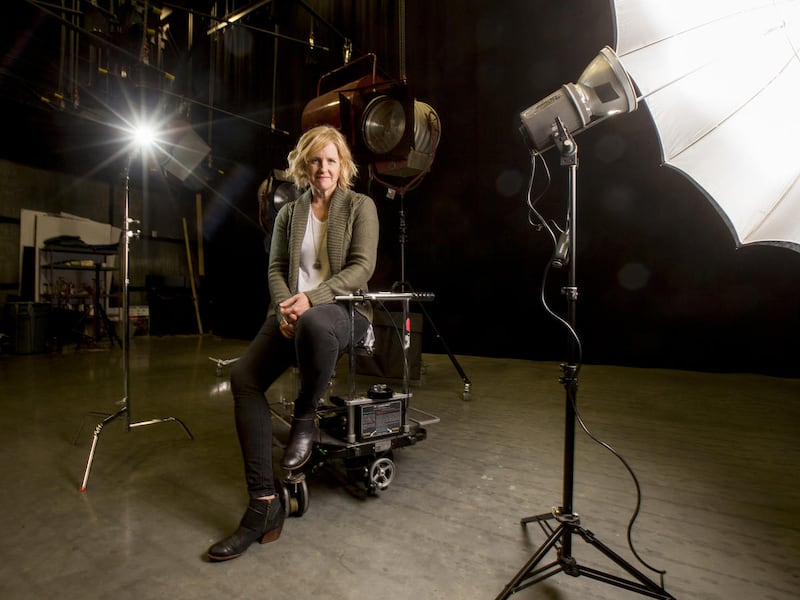

SALT LAKE CITY — In the movie script that is her life, Virginia Pearce gets to play the lead role. The story is part road trip, part coming of age, part romance, part existential searching — all the good stuff critics love.
Welcome to the world of the woman in charge of talking people into making movies in Utah. A little over a year ago, Pearce, 47, became director of the Utah Film Commission when Marshall Moore stepped down after seven years. She brings to the post a love of all things film — both moving and still — that has its roots not in Hollywood, but right here in the Beehive State.
It all began when her parents moved from Louisiana to Utah in 1968 so her father could do his residency at the University of Utah.
The plan was to stay in Utah for two years and move on, but when Dr. Pearce’s residency was finished, the family, replicating the pattern of all sorts of transplants to one of America’s fastest-growing states in the 1970s, decided they liked the place and stayed.
Virginia grew up in Holladay and graduated from Olympus High School. She then accepted an academic scholarship offered by the University of Oregon, where she majored in journalism in a “free-wheeling, college hippie town with more rain that I had ever known.”
But before that, she’d absorbed everything Utah had to offer, including skiing at Alta, where her mother was a ski instructor, and standing in line with her sister Sarah at Trolley Square every year to get tickets to the Sundance Film Festival.
Little did the sisters know that Sarah would go on to become managing director of the Sundance Institute and Virginia would work for Sundance for 13 years before taking over as film commission director — and they’d never have to stand in line for tickets again.
But that’s getting ahead of the story. In a nutshell, after college Virginia went just about everywhere. She worked for a magazine and waited tables in Boston, she traveled through China, Hong Kong and Russia with her brother, she lived in London and Paris, she returned to Utah to work as a slope-side photographer at Alta and as a catalog photographer for ZCMI, then left for Paris to study at the Speos Photographic Institute before taking jobs as a photographer in first Seattle and then Maine.
Virginia’s boyfriend-now-husband, Chris, suggested coming back to Utah for the skiing.
“What am I going to do there?” Virginia remembers thinking. “I felt like I had done Utah.”
But they came back, and within a month Virginia volunteered to work for the Sundance Film Festival.
And the rest is the rest of the story.
During the usual December filmmaking lull, Utah Film Commission director Virginia Pearce found time to sit down with the Deseret News to talk about her story and the story of Utah filmmaking.
DN: Thank you for this opportunity to speak with you. It would appear you took a long circuitous path and wound up right back where you started.
VP: (Laughs). I don’t think I ever would have said I was going to end up here — and I actually think that transfers well to my job now. When filmmakers ask “Why Utah?” I feel like I’m in a very good position to answer that. I’m an insider but also an outsider. I’m someone who grew up here and loved my childhood here, but also wanted to see other things and then came back. So it’s a very authentic story I can tell.
DN: Do you tell your prospects about you and your sister standing in line for Sundance tickets?
VP: A lot of people have heard that story. It was like a ritual for us. Every year we’d stand in line at Trolley Square and every year the lines got longer. We’d go, why is this getting harder? It never occurred to us that, oh yeah, Sundance is growing.
DN: Just how helpful is Sundance in attracting filmmakers to Utah?
VP: Sundance is a huge card for us. Other film commissions talk about, “Wow, you’ve got that in your own backyard and they (the filmmakers) all come to you?!” When I came (to the film commission), that was a big part of it, just knowing how to take advantage of all Sundance offers. I spent so many years on the inside and a lot of my friends are still there, and obviously Sarah is there and we talk about what we can do and all the possibilities.
DN: Was heading the film commission something you planned to do?
VP: I was kind of looking for something else. I’d been at Spy Hop (the youth media organization) for four years after I left Sundance. I was at an industry meeting when Marshall announced he was leaving. It wasn’t my first thought, but then I thought, hmmm, I wonder who’s going to take that job? I did some research and felt this could be a really good fit for me in a side of the film industry I hadn’t really participated in. So I sent in my resume. I said if what you want is what you’ve been doing then it’s probably not the right fit, but if you’re looking for someone to look at what the future could bring for Utah and film and digital media, then it could be a good fit for both sides.
DN: What new directions did you propose?
VP: Just having fresh eyes. Marshall is a friend and he said he thought it was good to have somebody come in from the outside with a fresh approach and more of a marketing head on. Because it’s a marketing job more than anything else. You’re selling Utah, for sure.
DN: Give us your pitch. How do you sell Utah to a filmmaker?
VP: I tell them that you can take your million-dollar film and make a million and a half- or a two-million dollar film in Utah. It’s easy to shoot here, we have all the resources, we have very talented and experienced crews and we have the look that you want.
DN: What about incentives?
VP: Most states have incentives, it’s just the way it works. Utah’s program is a little different because we only give incentives on Utah spend. So it’s Utah residents and Utah goods and services, that’s the portion of your budget you can get incentives on. It’s between 20 to 25 percent of what you’ve spent in Utah, and it’s also post-production. So you finish all your shooting here and submit a CPA audit to the film commission. If everything checks out, you get your money. We’re not investing money ahead of time; we’re basically rewarding success.
DN: How does Utah rank with other states in terms of incentives?
VP: We’re competitive, but we’re on the smaller end and I would love to see the program grow. Our incentive budget is $6.79 million, while New Mexico’s is about $50 million. California is $330 million and New York is about that or more. But we’re doing great things with what we have.
DN: What are some of those great things?
VP: This year ABC shot “Blood and Oil” here, the first major network series filmed in Utah in 10 years. ABC liked the look of Utah, we had the locations they wanted, it was cost effective and we had all the resources. HBO has filmed here this year, Steven Soderbergh is filming right now. It’s like anything else, once you have that foot in the door everything starts to open up wider and you can have conversations with people that you couldn’t have had before. Now we can go to others and say, “It works here, and we can prove to you that it works here,” instead of saying, “We’re great, we had a network series here 10 years ago.”
DN: Coolest people you’ve met since taking over the film commission?
VP: Oh, well, OK, Rob Reiner. He was here shooting a small independent film and I was like, I have to meet Rob Reiner and talk about the Princess Bride and all the things he’s done that I just love. He was shooting downtown and somebody took me over and we were chatting, I’m saying how great it is to have him here, and the photographer took a picture where I’m gesturing wildly with my arms. It looks like I’m telling him how things are and how it’s going to be. But I love it, it’s like look at me, I’m telling Rob Reiner off.
DN: More than 900 major motion pictures have been shot in Utah over the years. What’s your personal favorite?
VP: “Thelma and Louise” is a movie that made a big impact on me. It started an important dialogue for women about feminism and making a statement and being able to speak up. People are still coming to visit where the car scene was shot, outside of Moab near Dead Horse Point. They call it Thelma and Louise Point.
DN: Any advice to aspiring filmmakers out there?
VP: It all comes down to the story. I learned that at Sundance. It doesn’t matter if you’re shooting a $10,000 film or a $10 million film, if you don’t have a good story you’re not going to have a good film. People are always asking, “How do I get my film into Sundance?” Tell a good story. Make a good film. That’s really all you’ve got to do.
DN: Your goals?
VP: My goals are more, bigger films in Utah, and it’s also about more than films. There’s so much going on that you can’t talk about film without talking about new media and trans-media and content and all the innovative things that are happening. One area I’m looking at is family films. I’ve grown to appreciate their value, both as a mom, looking for quality film for my kids, and as a way to simply tell great stories. In Europe this kind of filmmaking is really valued and in America it hasn’t taken off and I would love to explore how we can encourage that. It would be a great fit for Utah. I also feel like maybe we haven’t fully explored really becoming the go-to for independent filmmakers. I’d like to foster that and I’d like to foster local films. There are so many kids coming out from our great colleges that are so talented. I would love to see them stay here and make their films — or go and get some inspiration and then come back.