

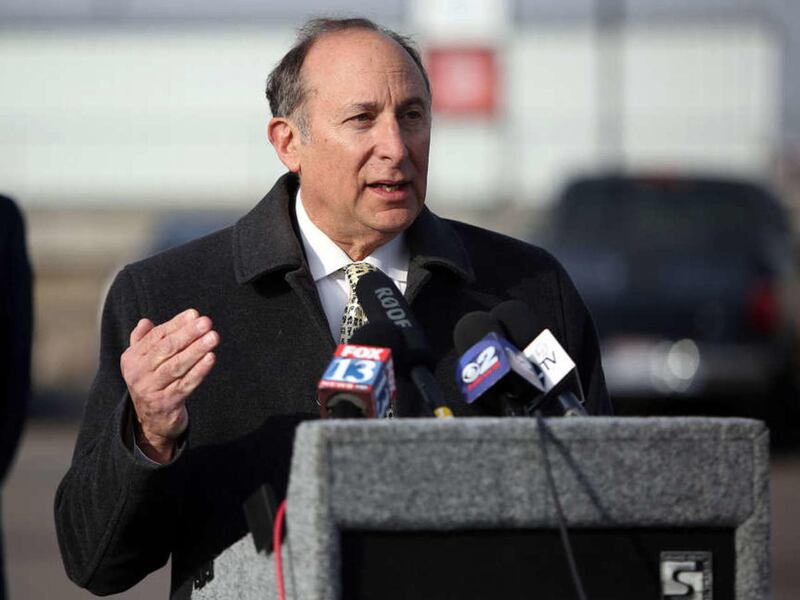

SALT LAKE CITY — After 37 years with the Utah Transit Authority, including the past five as its top executive, Michael Allegra is stepping down as president and CEO of the state’s largest transit agency.
The UTA board of trustees Wednesday announced that Allegra has given notice of his intention to retire and will step down on Aug. 28. He will make the transition to senior adviser to the chairman of the board of trustees through March 2016, while the agency launches a national search for a new transit executive.
Until then, Jerry Benson, current vice president of operations, will serve as interim general manager.
“We are in a great place,” Allegra said. “I feel so fortunate to be here for what we’ve accomplished.”
When he first began with the agency, it ran a few bus routes and little else — while today, UTA employs 2,500 people and runs both light rail and commuter rail in addition to its fleet of more than 600 buses that serve about 45 million riders annually.
“The board extends its deepest appreciation to Michael Allegra for his many years of exemplary service,” said board chairman H. David Burton. “He has dedicated his career to the Wasatch Front community, and we wish to thank him for his service to UTA and his devotion to public transit.”
While the agency has seen unprecedented growth during Allegra’s time at the helm, the agency has also weathered its share of controversy.
In April 2014, a performance audit of the UTA was conducted to review policies and practices at the agency. The comprehensive report showed numerous instances of questionable business practices, concerns about UTA’s plans for transit-oriented development and questions regarding the salaries and bonuses of the agency’s management team.
The audit mentioned the particularly high earnings of UTA executive staff, indicating that the agency’s executive team earned 49 percent more in total compensation than the Utah Department of Transportation's nine highest earners.
Seven of the agency’s top nine earning executives — all of whom made between $142,236 and $228,558 — received at least $29,918 in bonuses in 2013 with two others receiving $24,233 and $10,471, respectively.
Following the audit, UTA made immediate changes with respect to benchmarking and reporting, and conducted a compensation survey of comparable transit agencies to present to the full board.
The agency expanded its incentive program to all 750 administrative employees — not just executive level management — and those awards were significantly reduced for executives and top managers. In fact, the board of trustees amended its policy to require any incentive award greater than $8,000 be reviewed and approved by the board in a public meeting.
There was also the issue of a questionable land deal involving a UTA board member that raised ethical concerns. Though no laws were broken, critics argued the agency was functioning in a manner that cast negative light on its operations.
Allegra noted that in the wake of those kinds of concerns, the agency has made great strides at becoming more transparent and accountable to the public that it serves.
Last year, UTA was recognized with the 2014 Outstanding Public Transportation System Achievement Award by the American Public Transportation Association.
In 2013, the agency experienced a year of record ridership exceeding 44 million boardings, along with the opening of multiple new light-rail lines. During a 12-month period concluding in December 2013, UTA opened four rail lines: the FrontRunner commuter-rail line, two TRAX light-rail lines, and the state’s first modern streetcar line.
The new train lines were part of the agency’s FrontLines 2015 project, which broke ground in 2008 and was expected to build 70 miles of rail in seven years. The program was completed two years ahead of schedule and $300 million under budget.
Meanwhile, last year, for the first time in eight years, UTA recorded no accidental deaths while offering more bus and train routes and serving more passengers than ever.
Allegra said one of his most cherished accomplishments has been to develop a culture where each employee takes safety personally. During his tenure, the agency has made a concerted effort to develop safety features around rail crossings and commuter rail platforms, he explained.
That effort must be maintained for it to continue to be effective, he said.
In retirement, Allegra hopes to spend his leisure time archery hunting along with enjoying more time with his wife. He said he looks forward to tackling new challenges away from work.
“It’s nice to be in this place (in my life) now and be able to turn the reins over,” Allegra said.
Email: jlee@deseretnews.com, Twitter: JasenLee1