

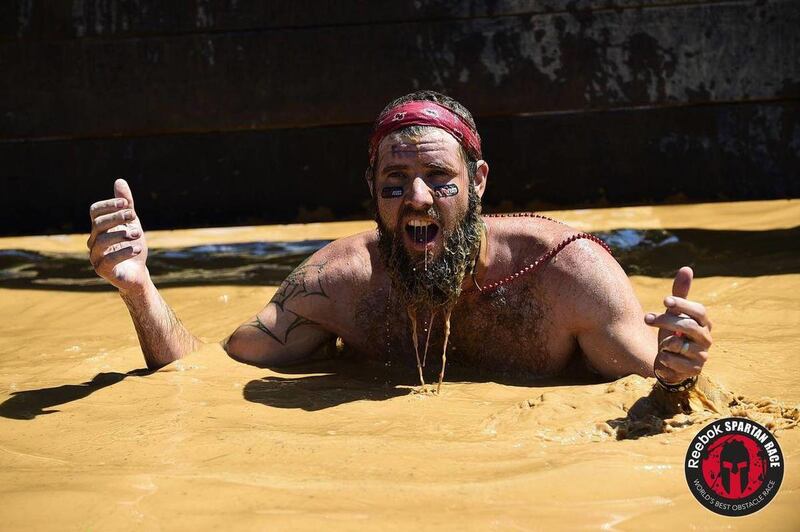

The images of suffering are familiar.
The questions about why people would sign up, pay money and subject themselves to manufactured challenges are some I’ve wrestled with myself, even as I’ve handed over my own hard-earned cash and struggled through pain of my own making. In fact, it’s a common joke at some of these events to console (or mock) each other with the passing reminder, “We paid for this!”
Obstacle course racing, however, has never held any of the allure that marathons, ultramarathons and triathlons have held for me. So when California journalist Scott Keneally offered me the chance to preview his new documentary “Rise of the Sufferfests,” I will admit to being less than enthused. It’s not that I dislike the genre, I just don’t understand the allure, so I wasn’t sure what the film could offer me.
While I’ve actively avoided the industry’s two biggest franchises — Tough Mudder and Spartan — I did run The Dirty Dash in Midway a couple of times. The first time I ran it was with my daughters, and we loved it not for the challenge it provided, but for the belly laughs. Few things are more entertaining that watching family members slipping in mud as they try to talk trash.
But Dirty Dash is a kinder, gentler version of serious obstacle course racing, so much so, that I don’t even know if it’s relevant. But I mention it because I do believe what challenges us changes as we evolve, and while I may no longer question my sanity for committing to the Dirty Dash, I do think it is in those types of races that bigger goals begin to take shape.
I knew the premise of Keneally’s film, and I was intrigued by it, maybe even more because I didn’t share his passion for the franchise. Why is it the world’s fastest growing sport?
“Is it so Joe from accounting can look like Rambo on his Facebook page?” Keneally asks in the documentary. “Are we that narcissistic? Is life too comfortable? Is the internet making us too lonely? Are we chasing the latest fitness fad?”
He uses authors, athletes and psychologists in exploring just about every aspect of the industry and the experiences it offers participants. The foundation of the film is the stunning, even baffling, fact that in just six years, OCR went from obscurity to an integral part of pop culture. In 2009, fewer than 50,000 people participated in OCRs, but by 2015 that number exploded to nearly 5 million. Keneally points out, that’s “twice as many as half marathons and marathons — combined.”
The documentary starts with the questions about why obstacle course racing (OCR) is the fastest growing sport in the world, but quickly launches into a history of the sport. While that’s interesting, it’s not as compelling as what happens in the second half of the film when the narrative turns deeply personal for both Keneally and some of those athletes who help tell the story of the impact the races have on their own lives.
The story is really two simultaneous journeys — one is the industry and how it was born, has evolved and continues serves its participants vastly different desires, while the other is that of Keneally. When we meet him in those first few minutes, he’s a curious, lighthearted journalist hoping for humorous fodder for a story in his local alternative weekly. But a series of events, starting with the discovery of the eccentric Englishman (Ironically nicknamed Mr. Mouse) who is responsible for the birth of the sport and ending with how impending fatherhood impacts how he approaches his own training and participation.
Keneally’s authenticity drew me in despite the fact that we have very little in common when it comes to life experience. We share a profession and a willingness to try just about anything once, but that might be where it ends.
In fact, I found myself initially repelled by his exploration of an assertion that some of what drives people to sign up for these sufferfests is a desire to recapture or redefine masculinity. I was, through his interviews and storytelling, however, persuaded that for many men, the confusion, the frustration and the alienation is real. Therefore, the search for how to repair or redefine what the evolution of our society has lost should be a concern for all of us.
I enjoyed the comparison of Tough Mudder to Spartan and the contrasting philosophies upon which they’re built. Tough Mudder isn’t timed, has no winners and offers good times, bonding experiences and rewards for every finisher. Spartan, on the other hand, is timed, has standardized rules and global rankings. It has winners and prize money and professional athletes. The contrast between the two mirrors that of sports, and takes the age-old question of whether it’s winning or the commitment to compete that matters most.
The exploration offered by “Rise of the Sufferfests” is so comprehensive that each person, whether an athlete or not, will likely find questions and discussions that resonate. For me, Keneally’s low point, which comes after a failed Kickstarter campaign, and how he responded, moved me deeply. The story of James Appleton, a three-time Tough Guy champion who retired from the sport just as it was exploding in popularity and then tries to return alongside Keneally, as well as Spartan and Tough Mudder champion Amelia Boone also provided valuable insights and profound moments.
Ultimately, Keneally’s decision to do more than be a “just enougher” after learning he will become a father is what makes the movie worth watching. It is a question most of us have asked ourselves, whether in sports or in life. What happens if we actually offer our best? How terrifying it is to see what we are truly capable of accomplishing? And what is it that will motivate us to give our best to a quest?
In addition to being deeply moved by certain aspects of the film, I found it funny and enlightening. It also forced some introspection regarding my own “just enough” philosophies, how I’ve handled recent failures and whether or not I’m sufficiently compassionate to how and why people engage with sports.
I have always despised the way recreational athletes judge each other for their choice of challenges. Whatever motivates someone to get outside, connect with other people and challenge their own limitations should be applauded, not mocked. As a wise man once told me, you don’t know someone else’s struggle. Maybe what would never appeal to you is exactly what will save them.
I didn’t intend to be judgmental about the OCR and its participants, but as often happens to us humans, I didn’t question my gut-reaction until “Rise of the Sufferfests” asked me to do so.
Not only am I grateful I took the time to watch the film, which is available on iTunes, Amazon, Google Play and at the www.riseofthesufferfests.com, because it was an entertaining hour and 34 minutes, but because it forced me to consider new questions, new reasons for seeking challenge and new ways of connecting with other people.
Email: adonaldson@deseretnews.com
Twitter: adonsports