



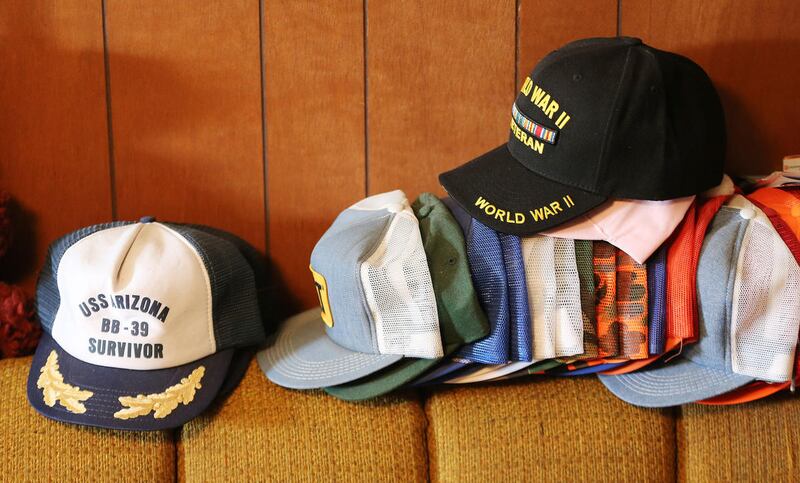

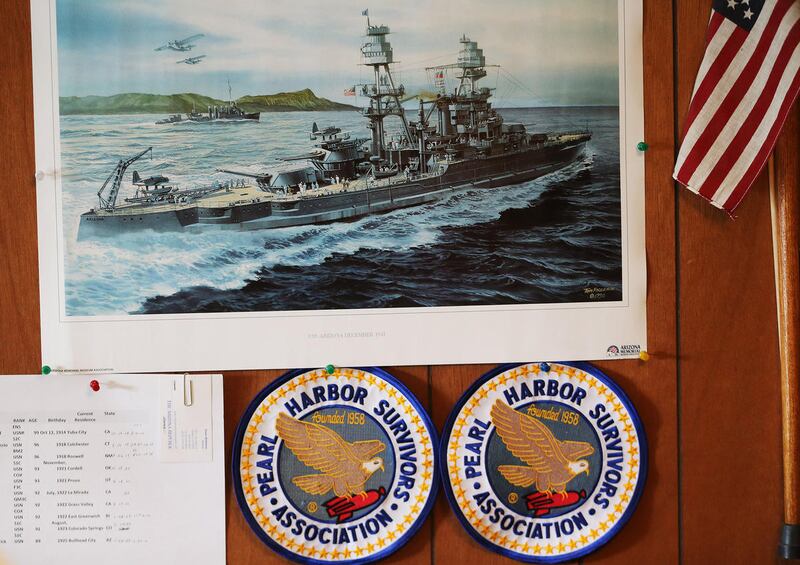

PROVO — One day last week, a limo service pulled up in front of the frame house just off Center Street in west Provo where Ken and Doris Potts have lived for the past 56 years. The couple was ushered with VIP pomp and ceremony into the backseat and driven to the Salt Lake International Airport, where they were escorted to first-class seats on a United Airlines jetliner bound for Honolulu.
Seventy-five years later, the 95-year-old Potts, one of just five men still alive who served on the USS Arizona when it was attacked at Pearl Harbor, was returning to the scene of the crime.
Today, as America pauses for yet another reminder not only that Pearl Harbor happened, but that it was survivable, Ken Potts serves as Exhibit A of both.
He was expected to be joined at the special Pearl Harbor commemoration ceremonies by fellow Arizona survivors Don Stratton, Lauren Bruner and Lou Conter (due to failing health, a fifth survivor, Lonnie Cook, was not able to make the trip). They’re all who's left of the 1,511 men who made up the Arizona’s roster the morning of Dec. 7, 1941, when five Japanese warplanes swooped down the Waimea Valley from the north and in just five minutes, between 8:01 a.m. and 8:06 a.m., dropped torpedo bombs that destroyed the 27-ton battleship and killed 1,177 members of its crew — almost half the total 2,403 who died in Pearl Harbor.
Only 334 Arizona sailors, 1 in 5, survived, and Potts was one of them. A coxswain, whose job was to transport goods and run men back and forth in the harbor, he was on a harbor boat that morning returning to the ship when the chaos began. He clambered back on board, somehow managing to duck and dodge the debris and shrapnel and runaway fires for the next three hours before he heard the abandon ship signal and slung himself into a motor launch that transported him the few hundred yards to Ford Island. That afternoon, he was taken back to the Arizona, where, for lack of a better idea, he spent the night.
He was later put on a diving crew that was tasked to dive down to the sunken parts of the ship and retrieve dead bodies. Once the bodies were released, Potts recalls, “They shot straight up out of the water because they bloated up bad.”
Ken will talk about that, and other details from the aftermath, but when it gets down to discussing those minutes-turned-to-hours when almost all of his division died right in front of him, he clams up.
Asked why he lived, he goes silent, the corners of his eyes get moist. His only answer is the index finger on his right hand that he points heavenward.
He’s no hero he’ll tell you, and he doesn’t understand why he’d ever be considered one. Still, there’s no denying his longevity has turned him into a reluctant celebrity. There isn’t a week that goes by that he doesn’t get a card from someone somewhere in the world asking for his autograph. Usually attached is one of two or three photographs of him as a handsome young man that can be found online.
Potts can’t wrap his head around why someone in Austria or Mississippi or China wants him to autograph a photo of himself when he was a 20-year-old sailor.
But he signs them anyway and sends them back in the self-addressed stamped envelopes, tacitly acknowledging that ever since Dec. 7, 1941, Pearl Harbor has defined part of who he is.
“There isn’t a day goes by you don’t think about it,” he says, effortlessly recalling how calm he was when the attack happened. “I wasn’t even scared. When there’s turmoil like that you don’t have time to get scared” — and the trauma it left in its wake.
When he returned home after the war, he couldn’t hear a siren without getting skittish. “I’d be standing on the street and a siren would go by and I’d start to shake. It took a long time to get over that, but I did get over it,” he says.
“We had air raid sirens go off after the first attack,” he explains. “We thought they’d land and take over the island. Somebody with a BB gun could have taken over that island.”
Little could the soldiers left to guard Pearl Harbor know that the Japanese were long gone, never to return to Hawaii. For four long years, there was always an edge. No ships were allowed to refuel in the harbor, so Potts was first put on a detail that worked on an oil tanker in the ocean fueling ships. After that, he became a boatman’s mate and ran a cruiser from Honolulu Harbor to Pearl Harbor providing security. He had an office on the ninth floor of the Loa Tower. “That was good duty,” he says.
He was on the ninth floor when the war ended. A ship took him to San Francisco where he made sure he first used up his 30 days paid leave and then “didn’t hesitate one cotton-pickin’ minute getting out,” securing his discharge at the Great Lakes Naval Training Center.
After that, it was back to Springfield, the little town in Illinois next to the farm he grew up on and left in 1939 when he was 18 years old. The Great Depression was in full swing at the time, and he joined the Navy because there were no jobs.
“I bet everybody on board that ship probably was in there for the same reason,” says Potts. “It was a way to make a dollar. I believe it was $30 we got, a month.”
He reported to a sleepy Hawaii and the USS Arizona on Dec. 31, 1939. It would be another two years before Pearl Harbor became America’s clarion call to war.
Potts has a quick answer for why he left Illinois after he returned stateside in 1946: “Itchy feet.” From a Navy friend he heard about good jobs in Oklahoma and was taking the long way there, via California, when he pulled off the road in Payson, Utah.
“Some woman told me what a wonderful place this was,” he recalls, so he bought a house in nearby Spanish Fork and found work as a carpenter.
“Been here ever since,” he grins. “Never made enough money to get out.”
He met Doris, a Utah farm girl from Monroe, and they were married in 1957. In 1960, they bought the house in Provo where they’ve raised four kids and where they live independently to this day.
Neither he nor Doris, Ken boasts, has a single restriction on their driver licenses. “My doctor says I’m in better shape than he is,” she says, “and my optometrist says my eyesight is better than his, but they’re just trying to make me feel good.”
He worked full time until he was 81. Besides doing carpentry, Ken owned his own car lot in Orem, Beehive Motor Sales, and he also worked as a plumber.
As to his secrets for living long and healthy, he concedes he is a product of good genes. Two members of his extended family have made it to 100.
He hesitates before adding, “The doctor would disagree with me, so I shouldn’t tell you, but I eat whatever I want whenever I want. I don’t smoke and I never drink, except every day of the year before dinner I drink two glasses of orange juice with one ounce of bourbon.”
Still, 95 is 95, and after all the fuss over Pearl Harbor’s 75th anniversary, he admits, “I’m about wore out. I guess it could be because I’m old.”
His return trip this week to Pearl Harbor is his third since the war — all of them within the past decade. The first was for the 65th anniversary in 2006. He went again in 2011 as an invited guest of Timpview High School for a band competition. There were only 20 Arizona survivors then. By the start of 2016, the number had dwindled to seven, and it has since been lowered to five.
He agreed to this year’s 75th trip largely because “of all the work put into this,” by the family members of fellow Arizona survivor Don Stratton, who felt the need to organize one more grand remembrance while men are still alive who were there. “Boy, they’ve worked their butts off for two years,” Potts says. “That’s the main reason I wanted to go.”
And, of course, there’s the opportunity to once more stand at the USS Arizona Memorial in Pearl Harbor, look down at the battleship that’s never been razed — left to rest in peacetime — and again salute, in person, the men who didn’t make it.
“Those are the real heroes,” says Potts, echoing a statement that might well be the most enduring refrain of the Greatest Generation. “They’re the ones who gave their lives so the rest of us could live.”