

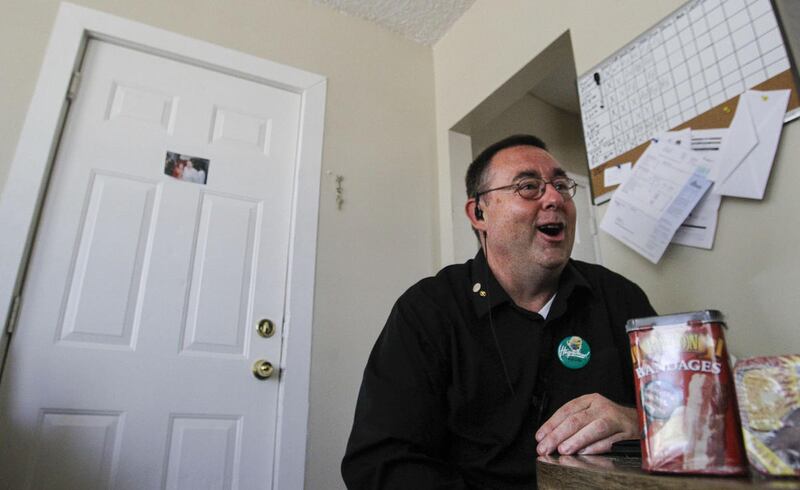

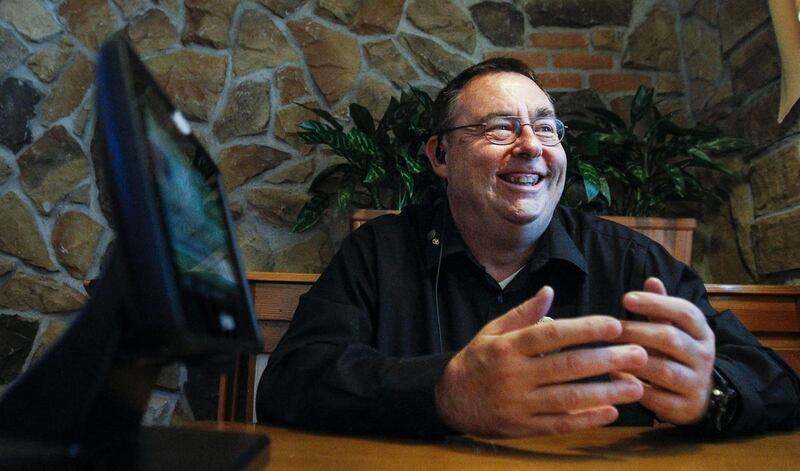

OGDEN — Walk into Kevin Sutherland's apartment and the first thing you see is his Miami Dolphins swag.
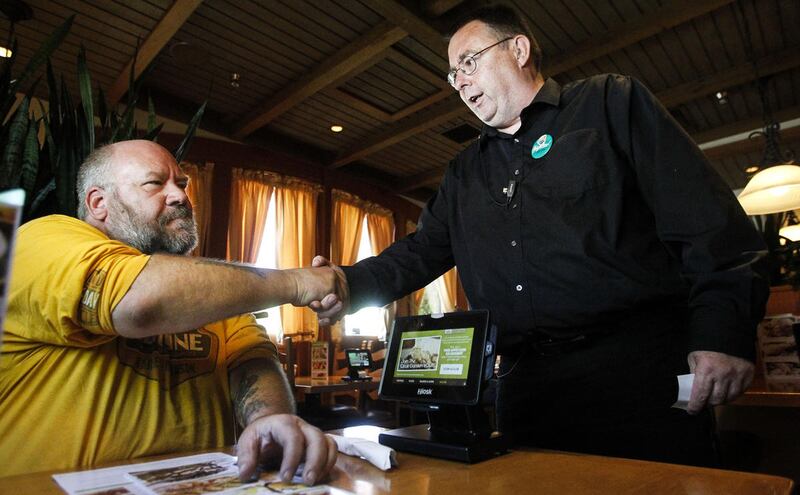
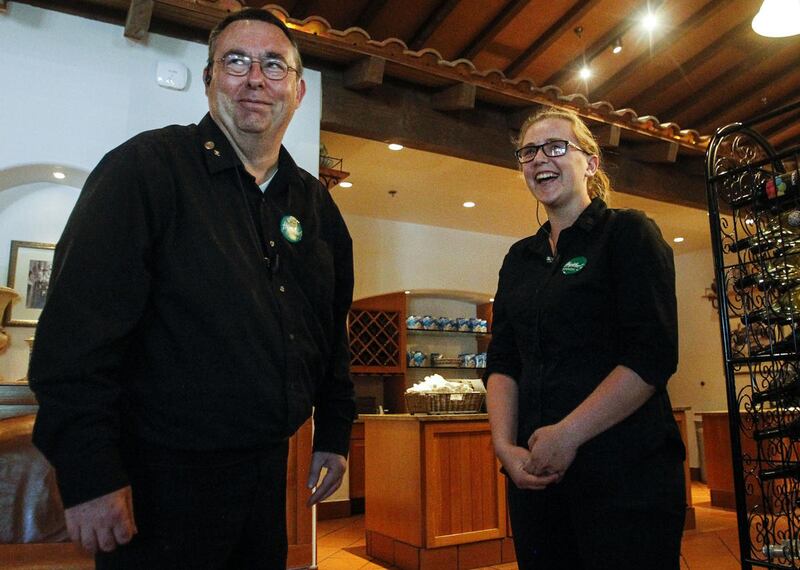
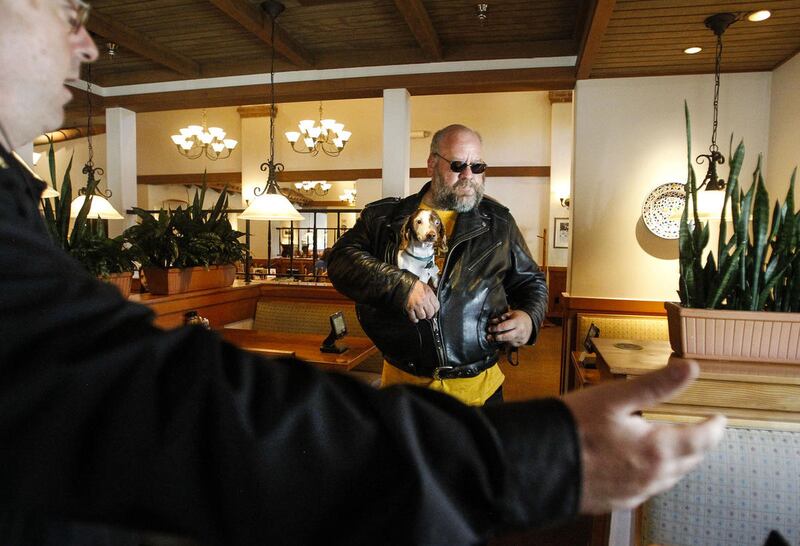
They're gifts from regular customers of the Olive Garden restaurant in Riverdale where Sutherland has worked for more than 1½ years as a host.
They're also emblematic of the connections that Sutherland, 54, has made in the community through a job he was able to land because of support he's received from the State Office of Rehabilitation Services.
A Vocational Rehabilitation counselor helped Sutherland obtain hearing aids he needs because of a profound hearing loss, a condition he was born with but has worsened over time. Voc Rehab, as it's often called, also paid for his trifocal eye glasses.
"I went from regular glasses to trifocals, jumped right over bifocals," he said.
Vocational Rehabilitation also connected him with counselors to help him manage a form of schizophrenia affected by a mood disorder.
His counselor also encouraged him to keep applying to Olive Garden, which hired him in November 2014.
"I love Olive Garden and they like me, too. It's a good thing," he said.
"They know about my three disabilities and they work with me."
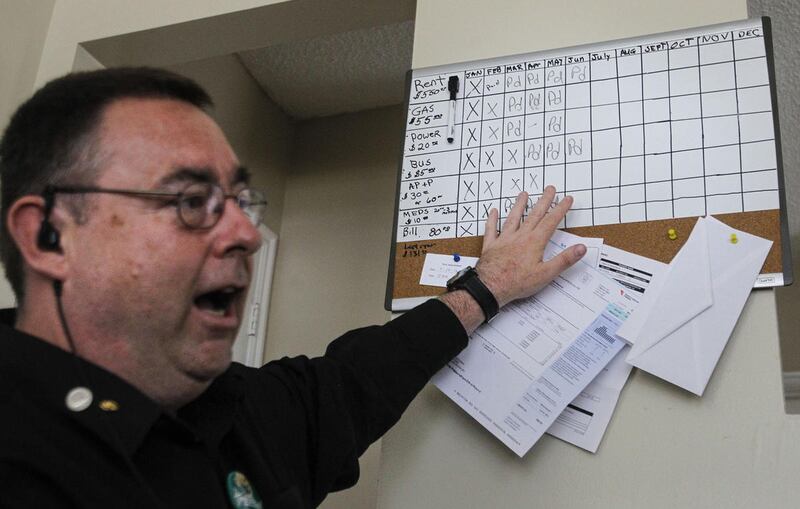
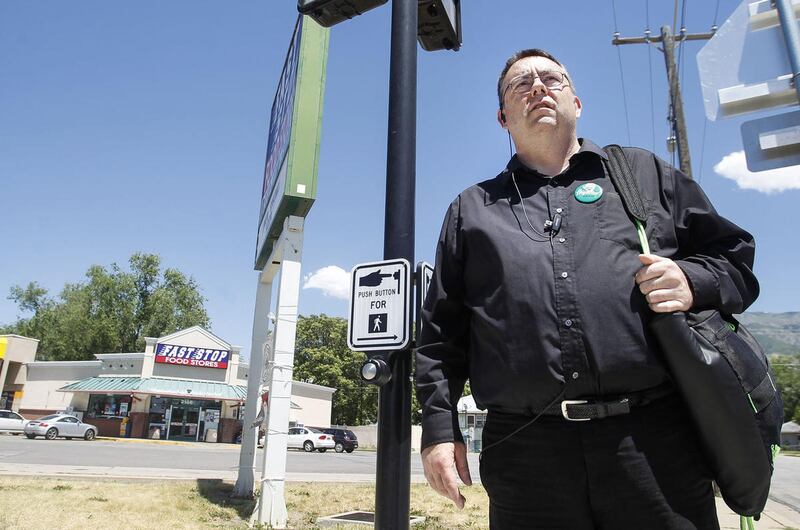
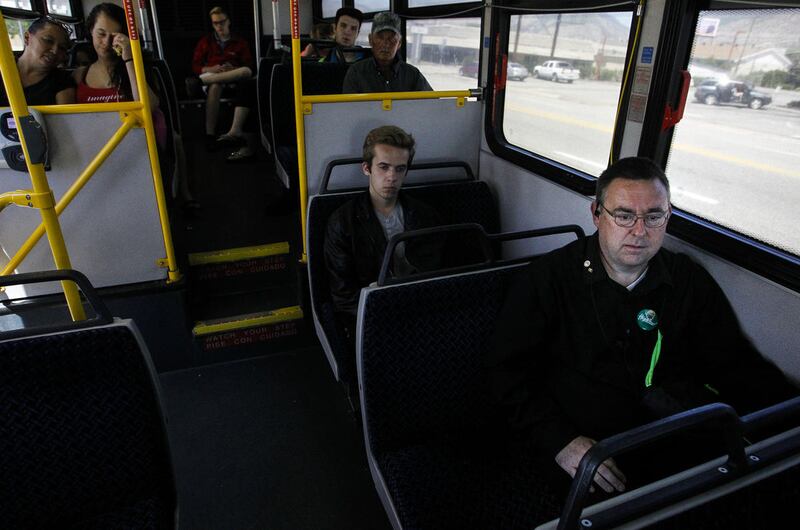
Sutherland works full time, which enables him to rent a modest apartment and pay his other bills. He rides the bus where he needs to go. Fortunately, the bus that serves Riverdale Road operates every day but Christmas and Thanksgiving, the two days the restaurant is not open.
If not for the support of Vocational Rehabilitation, Sutherland, who is college educated, says he likely would have become homeless.
"Without hearing aids, I'm shot. I don't even know sign language so what would I do?"
Sutherland describes himself as a "graduate" of Vocational Rehab but his counselor has made clear to him that her door is open if he needs further assistance.
"I'm an alumni but I keep in touch in case something happens. My hearing can change at a moment's notice," he said.
Need for change
Sutherland is among the tens of thousands of clients served by the Office of Rehabilitation, which will transition into a division of the Department of Workforce Services and out of the Utah State Office of Education by Oct. 1.
HB325, passed by the Utah Legislature earlier this year, called for the change after two legislative audits and an audit by Office of the State Auditor found significant problems with the agency's budgetary practices and as a consequence, challenges with service delivery.
Darin Brush, who for 10 years led the Community Development Corp. of Utah, was hired about a year ago to essentially "right the ship."
While he's adept at finance, budgets and policy, the position appealed to him for deeply personal reasons, he said.
"I had a job I loved but I loved the mission of the State Office of Rehabilitation. One of the reasons for that is because everything we do across all four of our divisions relates to Utahns with disabilities. I have family members who are disabled, family members who have been served in these programs," he said.
While some people might steer clear of the responsibility of reforming a state agency, Brush doesn't shy away from challenges.
During his first tenure with the Department of Workforce Services from 1994 until 2005, Brush served as its deputy director. While there, he spent a sabbatical with U.S. Agency for International Development in the Middle East consulting the Minister of Labor and his staff as the Kingdom of Jordan created its public employment service.
More recently, Brush led the Community Development Corp. of Utah, taking helm of the nonprofit organization which develops affordable housing shortly after its executive director was killed in an avalanche in December 2004.
"It was an organization in turmoil. I think that’s really where I truly cut my teeth in terms of organizational change. We grew Community Economic Development Corporation of Utah over those 10 years and served a lot of low-income families," said.
Before accepting his latest job, Brush said he did his due diligence on the agency.
In 2015, a legislative audit found that the Utah State Office of Education did not give the Office of Rehabilitation the administrative support it needed.
"As a result, the office mismanaged its budget leading to a $4.9 million deficit in 2014; a need for a $6.3 million state supplemental appropriation in 2015; a $5 to $6 million penalty owed to the federal government and reduced future spending abilities," the audit found.
Still, Brush said he could "see a path forward to restoring the dignity of the agency and fix things that needed to be fixed so that our budget was in balance, we were more transparent in our operation, we were measuring the right things and ultimately delivering services in the most effective and efficient way while preserving that culture of a real commitment to people with disabilities," he said.
Tough choices
Reforming the state agency has meant eliminating 50 positions, physically relocating about two dozen employees and putting into place policies and financial practices to keep the office's $86 million budget in balance.
"One of the things the agency had resisted forever was applying an average cost to what a client requires. It was sort of seen by some as dehumanizing. As we brought a new management team in, we said, ‘We’ve got to understand what it cost to serve a client on an individual basis,' " he said.
Brush's team built a case service expenditure rate model and back-tested it nine years.
"We began to understand month-to-month what an average cost per client looks like, across different categories of disability types. Once we had that information, then we could start to get predictive about what our spending will be and start to control our budget. That was a key turning point for us the first three months."
The reorganization has been guided by two principles, he said:
"The first was continuity of service to our clients and No. 2 was a minimal impact on our staff delivering services. So those of us in mid- and upper-management are supposed to be the shock absorbers of our staff so they can continue to deliver services without interruption," he said.
To that end, most Office of Rehabilitation employees will continue to serve clients in the locations where they have traditionally worked.
The goal is to make the transition for clients as seamless as possible and further the staff's commitment to help clients become as independent and engaged as possible.
"I’m regularly impressed by the commitment throughout the organization to the people we serve. It’s just is fascinating to me how committed our staff are to serving people with disabilities, all walks of life, all kinds of disabilities, all kinds of functional limitations," Brush said.
"We have a wonderful, strong culture and I think we will gain many things in this transition in terms of infrastructure we have lacked for many years in terms of support in key areas of the organization with our relationship with the State Office of Education."
Giving help
Office of Rehabilitation Services assists people with disabilities obtain meaningful employment and live as independently as possible through its Vocational Rehabilitation program, the largest of its four programs. It also provides a variety of services for people who are blind, visually impaired as well as the deaf and hard of hearing.
"We also disability determination services, which is 100 people in Salt Lake who determine Social Security benefit eligibility and reviews," Brush said. "The feds take the applications but the state actually process those applications, so it’s kind of cool. Those are state employees running a federal program. Again, what’s in common with the mission of our agency? It’s that we’re serving people with disabilities," he said.
Among the four programs, the division serves some 50,000 people a year, some who have short-term contact with the division and others whom counselors may assist for years.
Increasingly, the division is working with "transition-age youth, students with disabilities, students ages 16 to 21 who have supports through special education in the public school system but are in the transition to some kind of additional training or a certificate, ultimately employment of some kind," Brush said.
According to the transition plan, one of the major reasons the Department Workforce Services was selected as the landing spot for the office is that "71 percent of USOR customers also received services from Workforce Services."
The office is one of the oldest social services agency in the state of Utah, Brush said.
"We have been around almost 100 years so I think we’re at 94 years. We originally served World War I veterans who had become disabled and help them get retrained. So we have an amazing heritage," he said.
As much as the job of reform is about financial decisions, case management systems and policy changes, Brush said the end goal is to serve clients as effectively and efficiently as possible and support 400 employees who have endured an agency under fire.
"You know, morale is high and we’re not losing people. I just left a meeting with one of our largest offices and people are more positive than they’ve ever been so I think people feel like we’re doing the right thing to right the ship. I really am proud of the reform we’re doing. We’ve got a lot more to do but things are coming together," Brush said.
As Sutherland attests, sometimes people need just a little assistance to live independently and be part of their communities.
Hearing aids, glasses and counseling have meant the difference between unemployment and being part of a team.
"Of all the missed opportunities I've had, it makes me appreciate this even more," Sutherland said, sitting in a corner booth of the restaurant before the start of his shift Friday.
While some consider his job as host an entry-level position, Sutherland said he is content where he is.
"I'm still doing exactly what I want to do."
Email: marjorie@deseretnews.com