

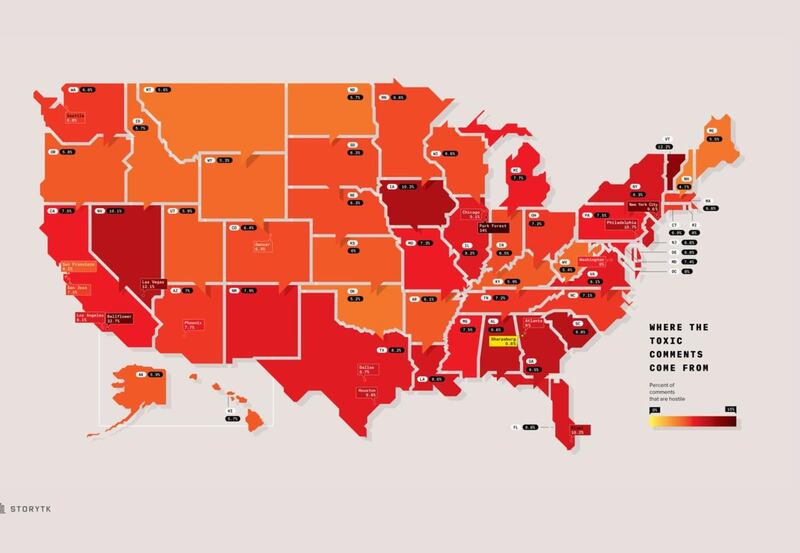

Where do all the internet trolls live?
That’s question that Disqus, an online commenting platform, looked to answer with its latest partnership with WIRED. Both organizations looked to find where most of the internet’s “most toxic trolls” call home, analyzing 92 million comments from a 16-month period of time.
In total, more than 2 million authors were reviewed from 7,000 different forums, who use the Disqus software.
Facebook and Twitter don’t use the Disqus software, so users on those social media platforms were not included in the review.
Vermont proved to be the state with the highest amount of trolls, with 12 percent of all “toxic comments” originating in the state.
Meanwhile, New Hampshire, which sits right next to Vermont, proved to be the least toxic state with 4.7 percent, according to Wired.
Sharpsberg, Georgia, however, ranked as the least toxic city in the country.
“Sadly, it’s not because scenes from The Walking Dead were shot here and zombies have eaten all the trolls. It’s just a small town, and the smaller the group, the more influence a few bad apples (or bright pennies) will have,” according to WIRED.
Utah sat about middle of the road, with 5.9 percent of all toxic comments originating in the Beehive State.
Review the entire map over at WIRED.
No one knows exactly who these trolls are, and research has worked to find out what most trolls are like.
A Stanford University study found that anyone can become a troll, since anyone can be "disruptive, combative and often unpleasant with their offensive or provocative online posts designed to disturb and upset."
The report looked into whether or not internet trolls are born intrinstically, or if it's a skilled that can be learned.
“It’s a spiral of negativity,” Jure Leskovec, associate professor of computer science at Stanford and senior author of the study, said in a statement. “Just one person waking up cranky can create a spark and, because of discussion context and voting, these sparks can spiral out into cascades of bad behavior. Bad conversations lead to bad conversations. People who get down-voted come back more, comment more and comment even worse.”
disruptive, combative and often unpleasant with their offensive or provocative online posts designed to disturb and upset.