

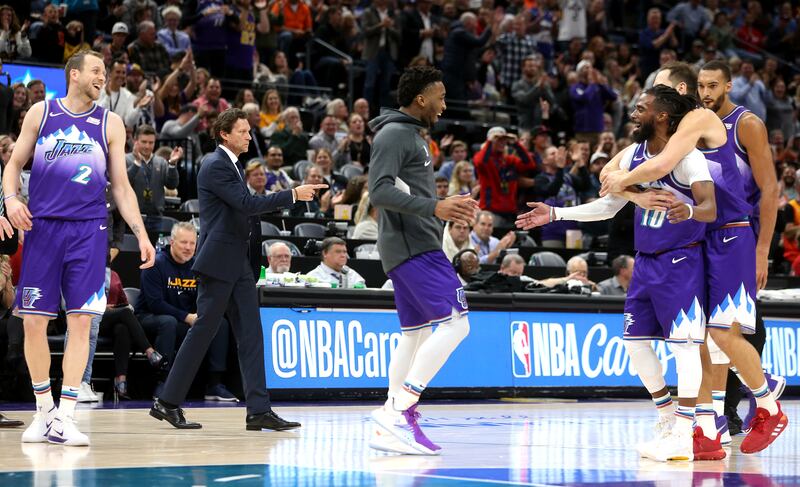

SALT LAKE CITY — For more than two decades, the Utah Jazz were the model of excellence in the NBA. From 1983-84 to 2009-10, the franchise finished at or above .500 in all but one season (2004-05). That level of success was matched only by the San Antonio Spurs over the same period. Building such a culture of winning takes time, effort, vision and complete organizational buy-in to create sustained brilliance year after year after year.
In the NBA, the Los Angeles Lakers and Boston Celtics are franchises that have had extended periods of prosperity over the years. The Chicago Bulls and Golden State Warriors had short reigns of superiority more recently. In the NFL, the New England Patriots are the latest organization to build a dominant culture of success, winning six Super Bowls — tied for most in league history — beginning in 2001 and missing the playoffs just two times during that period.
Considering only a relatively small number of teams can boast such an achievement of consistent winning, figuring out the formula presents an obvious challenge. The Jazz are in the process of working to reestablish that culture originally molded by Frank Layden and Jerry Sloan, this time with current head coach Quin Snyder. So what does it take? According to Snyder, it’s a step-by-step evolution.
“I remember when Doug Collins, who I’ve known a long time and hired me when he was head coach in Philadelphia, came in to watch practice (and) talked about, ‘OK, first you got to be relevant, then you’ve got to be in the mix and then you’ve got to be competing,’” Snyder said. “What we’ve talked about as our group is, first we have to be good and then you have to be consistently good. And to get consistently good, you kind of go to the next level where you’re really good. If you’re really good for long enough, you have a chance to be great.”
He added that being great is still not the pinnacle because truly great teams can go even further in their development.
“To go from being great to elite is another level and requires some good fortune, requires some timeliness. There’s external things that also come into play but I think to be consistently good gives you a chance to take the next step and that same mindset going forward beyond that is consistency,” Snyder said.
He said the development process includes adding players to the roster that are complementary to each other and who believe in the organizational ethos and who are willing to put in the work necessary to become elite.
“Part of it is how guys learn to play with each other and make each other better. So not only the individual players (or) individual parts can improve, but the interaction between those parts — the sum of the parts — can also continue to improve,” he explained. “Collectively, with the team, kind of everybody making each other better by how they adjust their games (sometimes) and then also them improving individually.”
Snyder said part of player development is figuring out how to mesh into a team-oriented mindset that pushes an individual player to evolve in a way that makes them more impactful in helping the team win rather than seeking personal achievement first.
Newly acquired Jazz point guard Mike Conley enjoyed a fair amount of success with the Memphis Grizzlies — making the playoffs seven consecutive seasons from 2010-2017, having missed them his first four seasons in the league. He said that experience helped him understand what was required to become a winner and what it took to keep winning. He believes that same attitude is being instituted throughout the entire Jazz franchise.
“When I showed up the first day you could tell just from management all the way down to the coaches, to the trainers — how you run a top-notch organization. This is the beginning of it,” he said. “How you treat the players, what you expect from the players, the demands from the coaches, the work ethic of the coaches. Everything is top-notch and that’s what allows us to go out there knowing we have all the resources, knowing that we have everything in place, that we have the mindset that we’re going to win.”
“We’ve got to treat ourselves as if we’re going to be a championship organization. It has to be a mentality first. You have to believe it. You have to live it,” Conley said. “There’s no days off. You got to do it every game and do the little things. Each guy has to sacrifice something in order to be a part of that kind of culture.”
For forward Joe Ingles, who’s been a Jazz man since 2014, developing a culture of perennial winning takes effort, patience and long-term commitment.
“It’s taken time. It’s taken a lot of hard work from the players from the coaches, from the Millers, from top to bottom,” he explained. “They’ve built a culture here — obviously a winning culture and a really good culture.”
“When I first got here, we couldn’t get guys to come here. That’s completely flipped around,” he said. “I’d like to say more because of me than Donovan but it’s probably not really true.”
All joking aside, Ingles said he believes the change in attitudes toward Utah and the Jazz starts with creating a culture and environment that is attractive to players and staff who want to be part of building something great.
“Guys want to be involved and want to play for Coach (Snyder) and want to win and want to play for the fans,” he said. “Obviously, having talent and and all that helps as well our (player) development (programs that) we’ve got. The effort and pride they take in that and getting individuals better is key. A bit of luck always helps. It’s a lot of things. It definitely doesn’t just happen overnight.”
“That starts with Coach and a lot higher up than the players,” Ingles said. “But once it gets fed down and the players buy into it and try to figure out things that can make you better (individually) as well the team and the whole organization — from top to bottom, the organization’s done a hell of a job.”