


This fall, a major public library in Delaware determined it would not be a “good fit” to host a “Liberty Story Hour” where kids listened to the Tuttle Twins books, which teach kids about free market economics and freedom. That same library had hosted in recent years a “Drag Queen Story Hour” for children that was deemed a success.
Actor Kirk Cameron had a nearly identical experience with his Christian book for children, entitled “As You Grow.” The book, which teaches love, joy and kindness, was turned down by more than 50 public libraries.
Say what you want about Liz Cheney, but she did utter at least one especially prophetic message on the campaign trail, saying “the world is upside down.”
By that, of course, she’s referring to her own rapid turnaround within a political party that once elevated her father to the vice presidency, but which now considers her an anathema. Utah’s Mitt Romney has faced the same sea change in reception after being Republican’s top pick just a few years ago.
But the weirdness of the political world is just the beginning. Since when did police become the bad guys? And street protesters and socialists the inspirational heroes? And how is it that in the span of a few years the word “woman” has become so fraught, while expressing appreciation for traditional marriage is enough to make you essentially unemployable in most of higher education?
We can take some comfort in knowing this sense of things feeling skiwampus and topsy-turvy is nothing new. In the 1640s, after Parliament passed a ruling that outlawed traditional English Christmas celebrations due to the belief the holiday should be more solemn, a ballad called “The World Turned Upside Down” was sung as a protest:
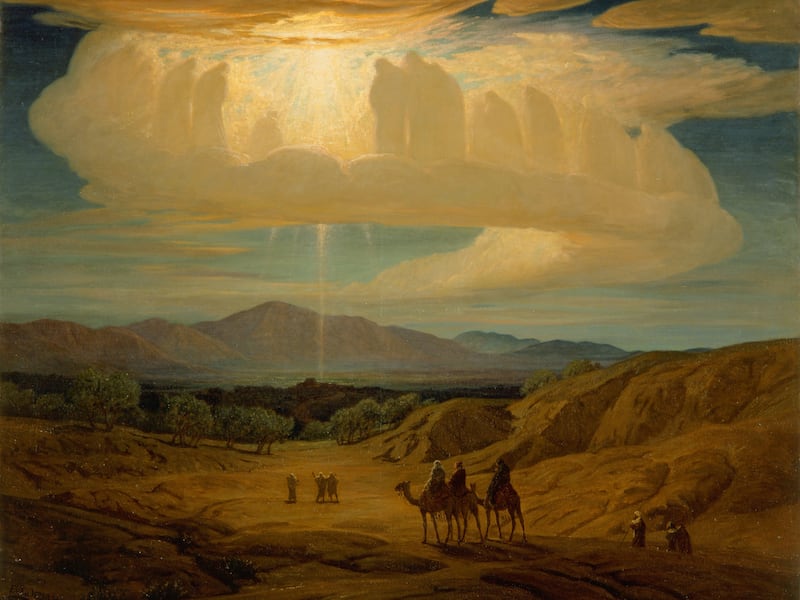
The wise men did rejoyce to see our Savior Christs Nativity: The Angels did good tidings bring, the Sheepheards did rejoyce and sing.” Yet the song continued, “Command is given, we must obey, and quite forget old Christmas day….Holy-dayes are despis’d….Old Christmas is kickt out of Town. Yet let’s be content, and the times lament, you see the world turn’d upside down.
Nearly 150 years later, tradition has it that the British band accompanying Gen. Charles Cornwallis’ 8,000-strong force played another version of “The World Turned Upside Down” when they surrendered at Yorktown in 1781 — signaling how unusual it was for this mighty empire to be defeated by Yankee insurgents.
Although not as hip as Lin-Manuel Miranda’s Yorktown song by the same name in the musical “Hamilton,” the more ancient lyrics had their own flair, including, “If ponies rode men and grass ate cows, and cats were chased into holes by the mouse ... If summer were spring and the other way round, then all the world would be upside down.”
With the American Revolution as our exhibit A, let’s be fair and say that trying to turn things upside down is not always a bad thing. And as one of my college mentors told me recently, “If things are fundamentally problematic, turning them upside down is a good and important thing.”
Consistently, early Christians were accused by frustrated locals of having “turned the world upside down.” Instead of giving sole deference to Caesar, after all, these stubborn radicals kept “saying that there is another king, one Jesus.”
We don’t always appreciate how radically different Christian teaching is from popular culture and intellectual tradition. When I was in graduate school, Robert Millet delivered one of the most exciting sermons I’ve ever heard. Speaking to an interfaith audience at the University of Illinois on “The Radical Nature of the Restoration,” he highlighted various ways that Joseph Smith’s early revelations challenged long-held notions in orthodox Christianity — with an implicit encouragement that we should make space for challenging conversations rather than running from them like a threat.
And as World War II raged, C.S. Lewis famously said that Christians are like a rebel force living in “enemy-occupied territory — that is what this world is.” Christianity, Lewis said, “is the story of how the rightful king has landed, you might say landed in disguise, and is calling us to take part in a great campaign of sabotage.”
All this begs the question as Christians the world over celebrate Jesus’s birth: is the world really upside down — or are just the Christians upside down from the dominant trends around them?
In the U.S., the current library debate lays out two sides: social conservatives seeking to overcome iniquity, or social justice advocates seeking to overcome inequity. Different problems lead to diverging solutions. And it matters which one we start with, since a priority focus on inequity arguably distracts from the internal “cleansing of the vessel” needed to achieve a society of true justice. And attempts to impose such fairness and justice from the outside — regardless of individual hearts and minds — have not gone well this past century, to say the least.
But don’t tell that to young activists today, many of whom are convinced that confronting the next instance of unfairness is the grand key to a better world.
It’s not, although that can sound really good. But if we’re ever to get to that better world, we must become even more revolutionary than Karl Marx. Since his diagnosis didn’t go nearly deep enough, his treatment fails to deliver on the deeper redemption we as a people need.
But there are others with their eye on that redemption — true revolutionaries and radicals preparing the groundwork for a societal renovation and deconstruction unparalleled in all of human history. Across different denominations of belief, we collectively prepare for the landing of the “rightful king” ready to deliver on the liberation we all need — while rejoicing today “even as though he had already come among” us.
To me, that sounds like a happy new year indeed.
Jacob Hess is the editor of Public Square Magazine and a former board member of the National Coalition of Dialogue and Deliberation. He has worked to promote liberal-conservative understanding since the publication of “You’re Not as Crazy as I Thought (But You’re Still Wrong)” with Phil Neisser. With Carrie Skarda, Kyle Anderson and Ty Mansfield, Hess also authored “The Power of Stillness: Mindful Living for Latter-day Saints.”