



- A new Gardner Policy Institute report digs into the details of data center development.
- Utah is on track to triple its data center capacity in the next few years.
- Water, energy and environmental impacts figure into the math behind the projects.
When it comes to the burgeoning field of artificial intelligence software, computing power is king and right now, demand for data center processing capacity is far outstripping supply.
Utah currently plays host to 48 operational data centers that draw 920 megawatts of power with and additional 2600 megawatts now under construction and set to more than triple the state’s overall data center output, according to an April 2026 analysis released Wednesday by the University of Utah’s Kem C. Gardner Policy Institute.
Data center development is concentrated mostly along the Wasatch Front and a small number of larger facilities dominate the market. The state’s 10 biggest data centers account for roughly 80% of total current capacity and some even larger projects are in the pipeline including a massive, so-called hyperscale facility (generally defined by an energy draw in excess of 100 megawatts) near Delta, Utah.
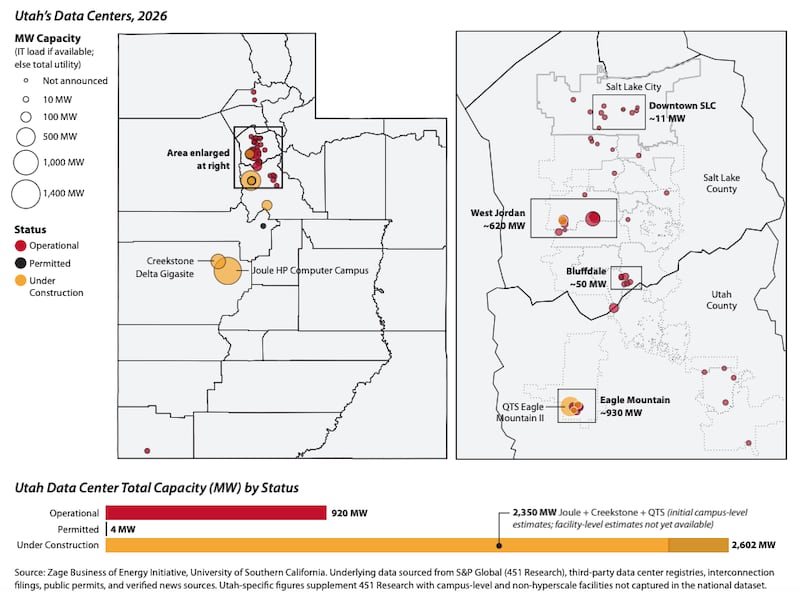
The growth reflects a national boom, driven primarily by artificial intelligence development and cloud computing needs. Data center buildouts are getting bigger and more powerful, according to the Gardner report, with average capacity per facility more than quadrupling over the past decade. Across the U.S., some 700 hyperscale and co-location data centers are under construction, adding to the 3,000 centers already in operation.
On Wednesday, the Gardner Policy Institute hosted a Societal Impact Seminar, part of an ongoing series, focused on the topic of data center growth in Utah and across the country.
Speakers included Shon Hiatt, business professor and director of the Zage Business of Energy Initiative at the University of Southern California’s Marshall School of Business; Bill Anderegg, University of Utah professor, climate researcher and former director of the school’s Wilkes Center for Climate Science and Policy; Darin Knapp, vice president, Layton Construction, and Utah state Rep. Paul Cutler, R-Centerville.
The seminar comes amid concern about data center power and water consumption across the country. Maine became the first state Tuesday to restrict construction of large data centers.
Hungry for power and water

Hiatt, the seminar’s featured speaker, noted AI-dedicated data centers are more resource hungry than those housing standard processing equipment.
“AI data centers are using a lot of power,” Hiatt said. “Generally, eight to 10 times more power than your traditional CPU data center. As of 2025, we have 3,000 of these facilities operating in the country. Under construction right now and in operation by 2028 are 75 gigawatts of planned utility power.”
To illustrate the scope of 75 gigawatts, Hiatt noted that it equals about 1.3 times the amount of power used by the state of Texas in a year, with Texas being the leading energy user in the country.
That power demand is among the most pressing concerns surrounding data center development. In Utah, Gov. Spencer Cox unveiled his “Operation Gigawatt” effort in 2024, declaring the goal of doubling Utah’s power output and making the state a player on the world energy stage, particularly when it comes to nuclear and geothermal generation.

Utah is facing an escalating risk of power shortages, and Hiatt shared a data analysis showing a rising chance of power blackouts as the state’s consumption nears its output capacity. The report found that the North American Electricity Reliability Corporation projects Utah will face elevated grid risk in 2031, where electricity supply shortfalls may occur under extreme conditions.
Anderegg noted that Utah has incredible potential, the second highest in the country behind only Nevada, when it comes to enhanced geothermal power development. He underscored it as a highly reliable energy source and friendly to the state’s air quality challenges.
“There’s a huge opportunity to do this right in Utah with lower air pollution,” Anderegg said.
Shrinking water resources across the state are also a concern when it comes to adding data center needs to the mix.
Nearly all of Utah’s operational and planned data centers are sited on the Wasatch Front, classified as “high” baseline water stress by the World Resources Institute, per the report. Currently, a 100-megawatt data center consumes approximately 2 million liters of water each day, roughly equivalent to the daily use of about 6,500 households. Hiatt and others, though, noted that the evaporative cooling systems once commonly used to keep a data center’s massive banks of computer processors cooled down have evolved significantly and new, closed-loop systems are 70% to 75% more efficient.

Do data centers bring jobs?
The economics of data center development also raises questions about efficiency and long-term benefits. Data centers are highly automated once operational, employing relatively few workers compared to other large industrial developments.
According to the Gardner report, construction employment related to new Utah data center buildouts peaked last year, nearing 6,000 positions and is expected to decline through 2030. Permanent data center operations jobs will range between 2,000 to 3,250 positions by 2030. That number would put the industry in the same range as other Utah employers including Utah Tech University, Wells Fargo and the Utah Transit Authority, for example.
Some critics argue that the relatively low employment levels required to oversee and sustain data center operations limit their broader economic contributions, particularly when weighed against tax incentives or subsidies that are sometimes offered to attract them.
Facebook’s Utah tax break
Facebook owner Meta, which operates one of the state’s biggest data center campuses near Eagle Mountain, has been and continues to be the recipient of a tax break that was created to lure the company to Utah.
Meta reportedly spent $150 million on infrastructure to accommodate its data center in Utah County, including bringing power to the 500-acre site from a nearby high-capacity power line corridor, extending sewer and water service, bringing in telecommunication lines and improving roads.
That investment is expected to be equalized by the Phase 1 tax benefits of $150 million over 20 years. That tax break gives Facebook 100% tax relief on personal property taxes due and 80% relief on real property taxes due for 40 years for four of the five taxing entities it’s beholden to.
A study commissioned by Eagle Mountain found that if Meta carries the project through five phases inside the 40-year limit, the company would earn $750 million in tax relief.
Only the Alpine School Board created some caps on those benefits, with limits of $40 million per phase and $120 million total over 35 years. Alpine School District represents the biggest beneficiary of the taxes Meta pays — and the entity giving up the most via the tax break package — as the recipient of about 70% of the total taxes due. Meta also enjoys some Utah sales tax exemptions, created specifically for data centers by the Utah Legislature.
While its unclear what tax incentives may be offered to future Utah data center developers, Knapp noted that Utah is in competition with other states that have not hesitated to offer generous tax breaks to lure investment.
What communities are saying
Community pushback is also a factor when it comes to new data center construction. The report found that 17 data center projects were canceled and 18 delayed due to opposition between 2023 and 2025.
Besides water and energy concerns, the top complaints from communities near potential data center locations include noise/light/quality of life impacts, land use/place preservation, traffic and environmental/ecological worries, per an analysis in the Gardner report.
Cutler argued that some community backlash is the result of policymakers’ failure to fully illustrate the relative pros and cons of data center development.
“We have to communicate the benefits of building these data centers and mitigate the negatives,” Cutler said.
Cutler and his colleagues appear to be working to strike a balance between incentivizing data center development across the state while acknowledging public concerns. Recent legislation has introduced stricter reporting requirements for water usage, clarified how large energy users pay for grid upgrades and limited certain tax incentives unless projects meet specific development criteria.
When it comes to data centers, the policy landscape is complex as Utah leaders actively encourage their growth as part of the state’s economic future, while many community members question the returns on such investments in light of environmental and potential quality of life impacts.
Opting for the pause button
While Utah is working in real-time to navigate data center expansion challenges, other states are exploring alternative paths, including carving out pauses to consider the broader implications of such developments.
On Tuesday, Maine lawmakers passed the country’s first state ban on data center development, establishing an 18-month moratorium on data centers with power needs in excess of 20 megawatts.
During that period, a coordinating council will convene to produce recommendations and guidelines to shape the future of the Maine’s policies on large data centers, according to a report from The Hill. The council will include government officials, experts and other stakeholders.
The story notes that at least 12 other states led by Republicans and Democrats are considering similar temporary bans on data center construction projects.