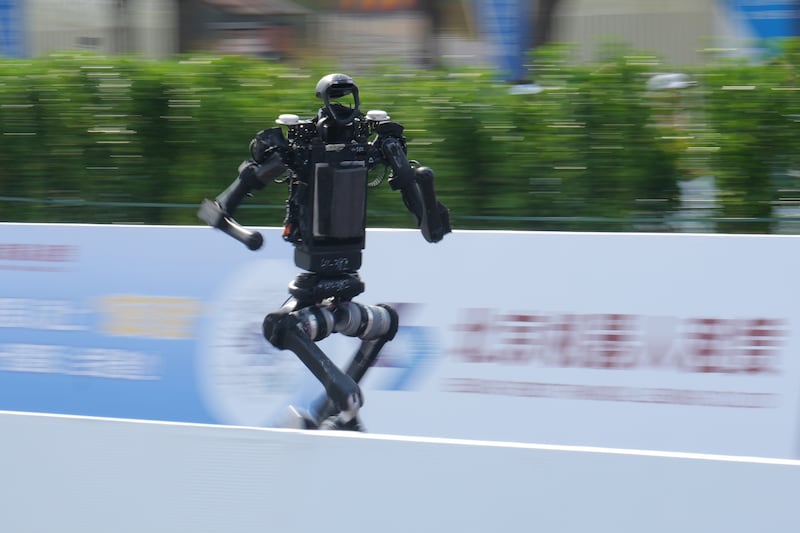

- A humanoid robot broke the human world record time for a half marathon on Sunday.
- The feat occurred at an even in Beijing that pitted robots against human runners.
- The humanoid robotics market is on the rise and could reach 1 billion machines by 2050.
A 5′ 5″ bipedal robot named Lightning just crushed the human world record time for running a half marathon, besting a recently set mark by almost seven minutes at an event in China over the weekend.
At the second annual Beijing E-Town Half Marathon and Humanoid Robot Half Marathon on Sunday, Lightning, a bright red humanoid robot that features stubby arms, 3-foot legs and a “head” that appears to be topped by straw boater, crossed the line in 50 minutes, 26 seconds, well ahead of the current best human time of 57 minutes, 20 seconds set just a month ago by Ugandan runner Jacob Kiplimo.
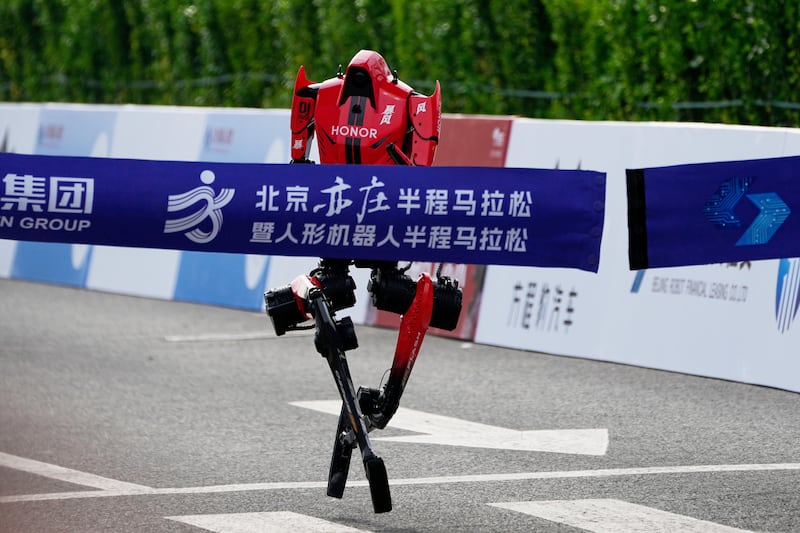
Lightning and the other two top-finishing robots were all developed by Chinese smartphone maker Honor and, according to a report from the New York Times, raced about 300 other robots, but separated from 12,000 human runners.
Lightning outpaced its competitors in spite of colliding with a barricade and falling down during the final sprint, per a report from China Daily. The robot teams included both autonomous and remote-controlled machines which competed on different metrics.
This year’s top robot performance in Beijing was nearly three times faster than the best time – 2 hours, 40 minutes, 42 seconds – set at last year’s inaugural event.
While the robots were faster and more autonomous this year, Alan Fern, a robotics professor at Oregon State University, told the New York Times that the results said more about the state of robot hardware manufacturing in China than about any major scientific breakthrough.
“What appears to have changed this year is that some of China’s many humanoid companies have invested the engineering effort needed to make these systems robust enough for a long-duration race,” Fern said. “That is genuinely impressive.”
The rise of robot athletes?

Last summer over 500 robots squared off on soccer fields, running tracks, ping-pong tables and more in Beijing for the first ever World Humanoid Robot Games.
The U.S., Germany and Brazil were among the 16 countries represented by 280 teams, from both private industry and universities, that pitted advanced, bipedal machines in an array of competitive sports scenarios as well real-world settings like performing office duties and housekeeping tasks.
The games’ organizers required robot competitors to meet a long list of criteria including that they “must be self-developed, purchased or leased by the participating teams,” they “must have a trunk, upper limbs, and two feet,” and “should have their own energy sources,” according to a report from Mashable. There were also a handful of event-specific rules, like robots competing in the long jump or high jump couldn’t use elastic or take-off devices.
A report released last year by Morgan Stanley predicted humanoid robot adoption will accelerate in the coming decades and could number a billion by 2050 amid a market acceleration to $5 trillion, driven primarily by use in commercial and industrial applications.
“Adoption should be relatively slow until the mid-2030s, accelerating in the late 2030s and 2040s,” Adam Jonas, Morgan Stanley’s head of Global Autos and Shared Mobility Research, said in the report.