



- Shark Tank star Kevin O'Leary has plans for a massive data center development in Utah
- The Stratos Project would be sited on 40,000 acres in Box Elder County.
- The project includes plans for 7.5 gigawatts of power development.
Software developer turned investment guru Kevin O’Leary, known widely as “Mr. Wonderful”, an ironic play on his blunt, no-nonsense style of delivering advice or putdowns to hopeful entrepreneurs who appear on “Shark Tank”, describes himself as a man with “passion, excitement and the the utmost enthusiasm” in his online biography.
That enthusiasm was well in evidence Friday when O’Leary appeared before Utah’s Military Installation Development Authority, touting a planned 40,000-acre development that would include massive new power generation infrastructure and an equally massive platoon of advanced data centers.
A spinoff of O’Leary’s venture investment firm, O’Leary Digital is reportedly planning on two such efforts, one in Utah and another in Alberta, Canada, dubbed the “Wonder Valley” developments. While the $70 billion Canadian project in the municipal district of Greenview in northwestern Alberta, was announced in 2024 and is further down the road, the Utah project is just now working to clear regulatory hurdles and earning some generous tax relief benefits along the way.
O’Leary spoke to the MIDA board ahead of its votes on a handful of motions aiming to help move Utah’s “Wonder Valley” closer to reality, arguing that time was of the essence in a global race to develop data centers and achieve AI dominance.
“We’re in a race with (China) and we seem to have gone asleep nationally with this and it’s bad. The challenge we all have is it’s hard to get permitted, it’s hard to build a data center campus,” Leary said via video conferencing. “I know that because I’ve been doing it for three years and I’ve looked everywhere in North America.
“What’s extraordinary about Utah is I heard about this opportunity just five months ago. That’s it, and here we are on the cusp of doing something absolutely phenomenal together.”
O’Leary praised Utah leaders for their work to accommodate the massive project and listed the benefits he believes the state will realize for playing host to the development.
“It’s going to be great for the state because it’s going to bring us thousands of jobs to do this and at the same time it’s going to advance state of the art AI compute,” he said. “All kinds of auxiliary businesses will come to support and service this area. All kinds of manufacturing that’s very advanced.”
What is the proposed site for the project?

According to state documents, the footprint of the development, which the state is calling the Stratos Project, consists of approximately 40,000 acres of privately owned land and 1,200 acres of military and state-owned land, all located in the unincorporated area of western Box Elder County. The development will include, according to documents provided by MIDA, state-of-the-art energy generation; hyperscale data center(s); advanced manufacturing; housing, commercial facilities, and other compatible uses; and the corresponding infrastructure and improvements.
At full buildout, the project includes planned capacity of up to roughly 7.5 gigawatts of power at the Utah site, which would position the state as a leader in next-generation energy and compute infrastructure. To provide a sense of that scale of power generation, the entire state of Utah consumes about 4 gigawatts of power over the course of a year.
“Utah continues to lead the nation in innovation and opportunity,” Utah Gov. Spencer Cox said in a press statement. “The Stratos Project Area represents the kind of forward-thinking investment that strengthens our economy, supports national security, and creates meaningful opportunities for Utah families, while being done the right way — in partnership with local communities.”
Following O’Leary’s appearance, the MIDA board passed a handful of resolutions, all by unanimous vote, including a development proposal that outlined some valuable tax breaks for the project and other details. Those agreements won’t become final until they are approved by the Box Elder County Commission which is slated to vote in a meeting Friday evening.
Those tax breaks include 100% personal property tax relief, in the form of rebates, on the data center portion of the project. Real property tax on the “compute campus” would be taxed at a rate of 0.927%, but 80% of that tax revenue would be returned to the developers with the state and MIDA sharing the proceeds of the remaining 20%. According to discussion in the meeting, an energy use tax would also be reduced for the project, from 6% to 0.5%, a move made necessary to allow O’Leary’s company to “be competitive.” That reduced rate would still generate some $30 million annually for Box Elder County in the first phase of the project, according to MIDA.
The source of that on-site energy has yet to be stipulated but in a February interview about the project, O’Leary Digital said its Utah site benefits from “access to major interstate natural gas infrastructure,” without going into further detail on how it will get its hands on 7.5 gigawatts of power. The same report from industry website Data Center Dynamics cites the newly formed energy developer West GenCo as a partner in the Stratos effort, tasked with handling permitting and state-level regulatory coordination for the project.
Data center development challenges

As was highlighted at an event hosted by the University of Utah’s Kem C. Gardner Policy Institute last week, energy and water consumption represent the two biggest challenges to building out massive new data center campuses like the one planned for Box Elder County.
Utah currently plays host to 48 operational data centers that draw 920 megawatts of power with an additional 2,600 megawatts now under construction and set to more than triple the state’s overall data center output, according to a Gardner analysis released this month.
Data center development is concentrated mostly along the Wasatch Front and a small number of larger facilities dominate the market. The state’s 10 biggest data centers account for roughly 80% of total current capacity and some even larger projects are in the pipeline including a massive, so-called hyperscale facility (generally defined by an energy draw in excess of 100 megawatts) near Delta.
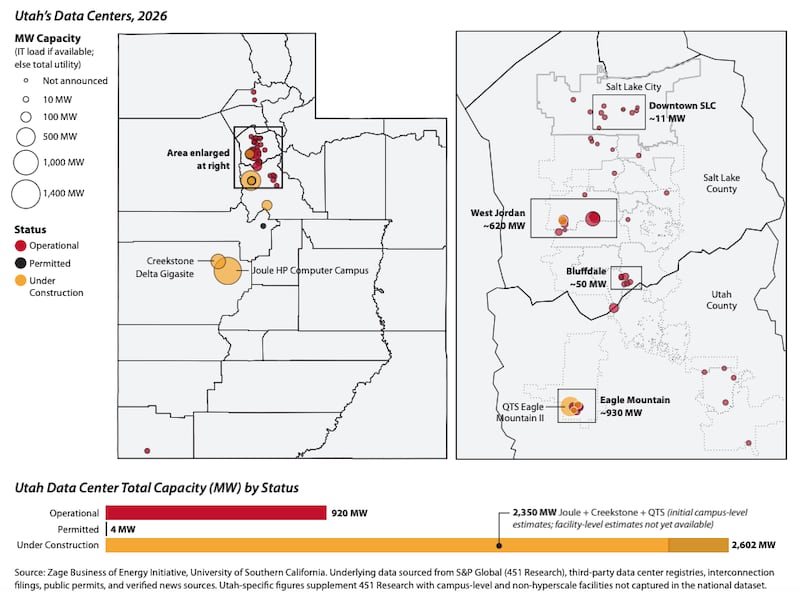
The growth reflects a national boom, driven primarily by artificial intelligence development and cloud computing needs. Data center buildouts are getting bigger and more powerful, according to the Gardner report, with average capacity per facility more than quadrupling over the past decade. Across the U.S., some 700 hyperscale and co-location data centers are under construction, adding to the 3,000 centers already in operation.
Shon Hiatt, business professor and director of the Zage Business of Energy Initiative at the University of Southern California’s Marshall School of Business noted at a Gardner forum last week that AI-dedicated data centers are more resource hungry than those housing standard processing equipment.
“AI data centers are using a lot of power,” Hiatt said. “Generally, eight to 10 times more power than your traditional CPU data center. As of 2025, we have 3,000 of these facilities operating in the country. Under construction right now and in operation by 2028 are 75 gigawatts of planned utility power.”
To illustrate the scope of 75 gigawatts, Hiatt noted that it equals about 1.3 times the amount of power used by the state of Texas in a year, with Texas being the leading energy user in the country.
That power demand is among the most pressing concerns surrounding data center development. Cox unveiled his “Operation Gigawatt” effort in 2024, declaring the goal of doubling Utah’s power output and making the state a player on the world energy stage, particularly when it comes to nuclear and geothermal generation.
Utah is facing an escalating risk of power shortages, and Hiatt shared a data analysis showing a rising chance of power blackouts as the state’s consumption nears its output capacity. The report found that the North American Electric Reliability Corporation projects will face elevated grid risk in 2031, where electricity supply shortfalls may occur under extreme conditions.
Shrinking water resources across the state are also a concern when it comes to adding data center needs to the mix.
Nearly all of Utah’s operational and planned data centers are sited on the Wasatch Front, classified as “high” baseline water stress by the World Resources Institute, per the report. Currently, a 100-megawatt data center consumes approximately 2 million liters of water each day, roughly equivalent to the daily use of about 6,500 households.
Hiatt and others, though, noted that the evaporative cooling systems once commonly used to keep a data center’s massive banks of computer processors cooled down have evolved significantly and new, closed-loop systems are 70% to 75% more efficient.
