

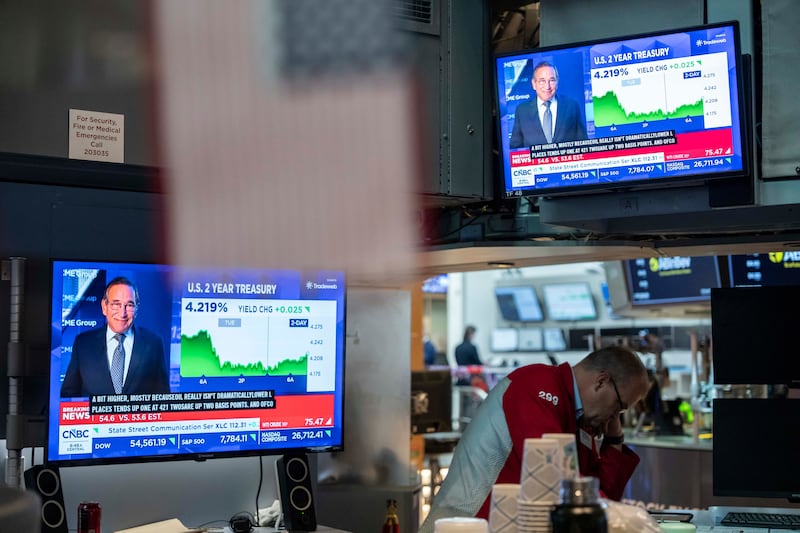

- The yield on 30-year U.S. Treasury bonds touched 5.3% on Tuesday, the highest in 19 years.
- Rising bond yields drive up rates on mortgages and other consumer and business credit.
- Yield changes reflect current investor pessimism about direction of the U.S. economy.
One of the ways the federal government raises money for paying for things like social programs, military equipment and highways is by selling bonds, an investment security that is essentially an IOU agreement that will pay you interest over time. The more time you allow the government to take in paying back your investment, the more you can earn.
Interest rates and yields on those bonds, which are issued in a variety of terms ranging from a few months to 30 years, are variable, and in the case of the longer term notes, determined in large part by investor demand.
Bond pricing and yields typically move in opposite directions and, generally speaking, positive investor sentiment about the direction of the U.S. economy sends bond prices higher and yields lower while investor pessimism can drive bond prices down and yields higher. More simply put, Treasury bonds are less attractive as an investment vehicle when the prospects of the U.S. economy are looking dim.

And, at the moment, widespread selloffs of U.S. Treasury-issued debt is casting a darkening cloud over the bond market with the yield on the 30-year note rising briefly Tuesday to 5.3%, the highest level since 2007. And 10-year bond yields, which act as an interest rate benchmark for U.S. home mortgages and other long-term debt, were hovering around 4.71% on Tuesday, also near multi-decade highs.
The high yield rates and underlying investor cynicism, can be traced back to a number of factors including a national debt that’s fast approaching $40 trillion; persistent inflation north of the Federal Reserve’s 2% target rate for over five years; and expectations that the Fed will raise its own benchmark interest rate in an effort to rein in the rising costs of consumer goods and services.
Economists also point to the ongoing Iran war, alongside concerns that stock markets could be overvalued thanks to irrational bets on artificial intelligence development, as other contributing factors driving up bond yields.

“Our current fiscal trajectory is plainly unsustainable, and that’s the best-case scenario,” BPC president and CEO Margaret Spellings said in a statement, per the Washington Post. “AI disruption, a recession, global war, or any number of other events could quickly push us over the edge from a challenge into a full-blown crisis. Even in the rosiest scenarios, we’re speeding toward a cliff and refusing to turn the wheel.”
How high bond yields impact household budgets
Since hitting a 12-month low of 5.98% in February, the average interest rate across the country on a 30-year fixed rate mortgage has been following a mostly upward trajectory and was 6.67% on Tuesday, according to tracking by Freddie Mac. A sustained period of elevated yields on 10-year Treasury bonds could put further upward pressure on those borrowing costs.
Credit card rates are set by issuing institutions based on a number of factors, including the applicant’s personal credit history, but base rates are computed in part using the prime lending rate which is tied to the Fed’s benchmark rates. A report from Reuters notes that while rising long-term yields alone may not lift card rates right away, expectations of a more restrictive Fed can.
Rising Treasury yields increase the cost of credit for businesses as well. Reuters notes that higher borrowing costs can make capital-intensive projects such as data centers, energy infrastructure and industrial expansion less attractive, potentially curbing future investment and earnings growth. That is a particular concern for the tech sector, which is issuing record amounts of debt to finance AI-related projects.