


A wayward fragment from a SpaceX rocket that has been floating in space since last year will unintentionally smash into the moon early Wednesday morning in a rare human-made lunar collision.
The school-bus-sized SpaceX Falcon 9 rocket booster, now an abandoned piece of space debris, is on trajectory to strike the lunar surface at 5,400 mph around 12:35 a.m. MDT. The impact is expected to kick up a plume of lunar dust and debris, though it likely won’t be visible to the human eye.
But for those will a telescope, the crash may be visible.
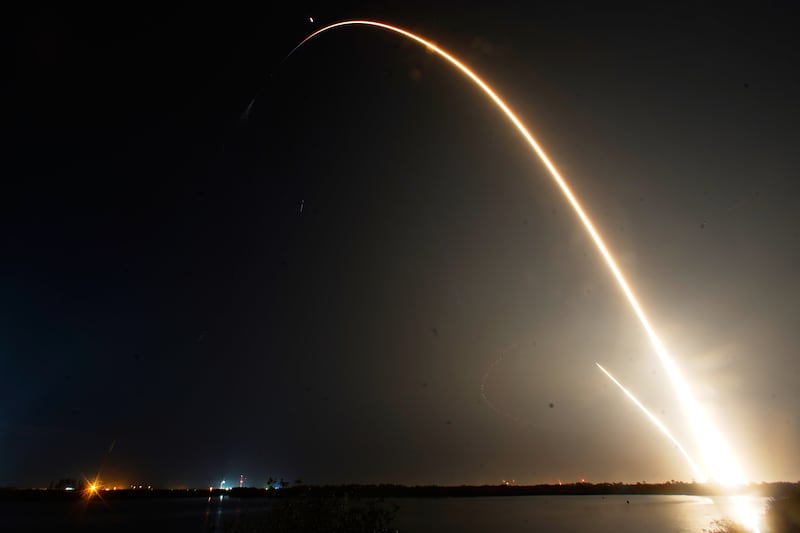
The Falcon 9 rocket launched from the Kennedy Space Center in January 2025, carrying a pair of lunar landers — the Blue Ghost lander developed by Texas-based Firefly Aerospace and the Resilience lander built by the Tokyo-based Ispace.
It was a partially successful mission. Blue Ghost successfully landed on the moon, while the Resilience crash-landed on the lunar surface. The Falcon 9’s spent upper stage, which was intended to be disposed of by burning up in the Earth’s atmosphere, has been drifting through space ever since.
Julianna Scheiman, SpaceX’s director of NASA Science and Dragon Programs, said in a Monday morning press conference that all “the appropriate rules and regulations” for correctly discarding the upper stage were followed.
“What has happened is essentially a mixture of solar activity and gravity forces have put it on a path towards the moon,” she added.
The approaching impact presents no danger to Earth.
“This may be of some — probably minor — scientific interest, and we may learn some things from it,” said Bill Gray, creator of widely used astronomy software who published a report on the stage’s impact in April, per Reuters.
He added, “It doesn’t present any danger to anyone, though it does highlight a certain carelessness about how leftover space hardware (space junk) is disposed of.”
Unintentional lunar impacts from space debris are rare, although the moon is regularly struck by natural objects such as meteoroids and asteroids.
The first intentional impact occurred in 1969, when the Soviet Union launched an object into the moon’s surface. In the 1970s, NASA intentionally crashed stages from its Saturn V moon rocket into the lunar surface to study seismic effects.
NASA late conducted another intentional lunar impact in 2009, crashing a rocket stage into the moon to study the plume of debris generated by the collision.
More recently, Russia’s robotic spacecraft, the Luna-25 lander, malfunctioned and spun out of control in 2023, unintentionally crashing into the moon.
Studying the impact could present an opportunity for researchers to better understand these sorts of lunar collisions and how best to prevent them.
“We want to understand these processes so that we can eliminate that as a source of risk,” Paul Wiegert, a professor of astronomy and physics at the Western University in London, Ontario, told CNN.
“What happens when an object crashes into the moon? We know it makes a crater, and of course it does eject material, but we don’t really understand that process in great detail ... we really want to understand that process better.”