

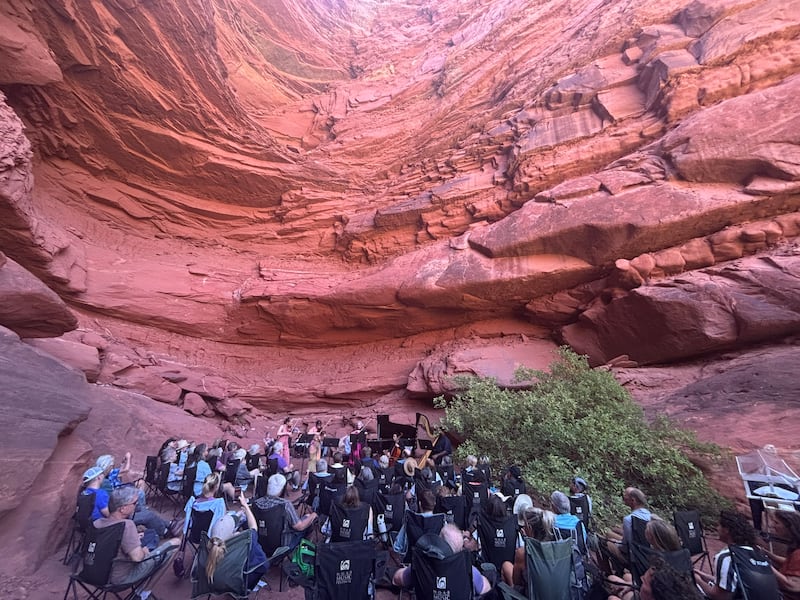

Nestled in a curve of the Colorado River, in the upper northeast corner of Canyonlands National Park, is a small grotto carved from ancient red rock. Its walls have been carved by millions of years of water and wind. Every September, it becomes a concert venue.
I normally spend my Thursday mornings in the office. On Sept. 3, however, my workday began on a riverboat with a handful of world-renowned musicians.
This was the second day of the Moab Music Festival, which has made “music in concert with the landscape” every year since 1992. Since 1993, that has included transporting an entire grand piano down the Colorado.
A crew brought the piano and other equipment into the grotto earlier that morning. They helped us off the boat and onto boards that served as temporary walkways through the shifting sand. We wound through a narrow path surrounded by willows until the grotto opened before us.
Looking up at the canyon walls, I couldn’t help but think of Ariel’s treasure cave in “The Little Mermaid.” As it turns out, I wasn’t far off; a park ranger told me the top layer of rock here is marine limestone, and the strata are embedded with fossilized shark teeth. The whole thing was under the ocean millions of years ago.
The musicians performed their sound check — Mark Dover on clarinet, Inon Barnatan and Peter Dugan on piano, Charles Overton on harp, Tessa Lark and Geneva Lewis on violin, Beth Guterman Chu on viola, and Jay Campbell on cello. The sound cuts through the air there, so you can clearly hear the music no matter where in the grotto you stand.
I asked Lewis what I could expect from the event.
“I find a lot of the experiences listening to music here to be more spiritual than a lot of other settings,” she told me. “It just makes you feel really connected with the world around you, I think, to experience things here.”
After warmup, one musician called for everyone to hush. Dover played a note on his clarinet, sweet and high. A few seconds later, the sound repeated faintly high off the canyon walls, like the rocks were singing back.
Access to this grotto changes every year. One year, a crew member said, they had to construct a ramp from the boat to the grotto because the beach had mostly washed away. This year, drought has lowered the Colorado River so much that they worried boats couldn’t make it down. But recent flash floods, which caused destruction in other areas of the state, added a few precious inches back to the river.
The “Grotto I: Fantasy” program began with messages from two park rangers, who explained the geology and history of the land and invited us to preserve it. Tessa Lark, a violinist and the festival’s artistic director, shared some thoughts on the program.
The theme of the 2026 Moab Music Festival is “This Land,” in honor of the 250th anniversary of American independence. The concerts explore American identity through music — American composers, genres born in America, international music that influenced American artists. The Grotto I program, for instance, featured pieces from both Europe and the Americas and spanned the 1700s to the 2010s.
Lewis, who was born in New Zealand but immigrated to the U.S. as a child, said our country’s music is as diverse as its people. There is no singular American sound, but our land ties it all together.
“I think one of the most spectacular things about America is the landscapes,” Lewis said. “Being able to share any kind of music in these spaces with all these people is sort of the American experience.”
The canyon seemed to welcome the music. At one point, a hummingbird flew over the crowd and suspended in the air near the piano before flitting off. A dragonfly spun in loops above the audience.
Nature was silent as the artists played Schubert’s “Fantasy,” but the wind picked up as Lark began her own composition, “Appalachian Fantasy,” the rustling trees joining in like a background chorus.
A harp string broke during the final performance. While Overton replaced it, Dugan and Campbell broke into an impromptu rendition of Saint-Saëns’ “The Swan.” Although the bird is not native to this area, it was easy to imagine one had joined us in the grotto.
How do you move a piano down the Colorado River?
The work is not done once the musicians pack up; it’s just the halfway point for the festival crew, who are dedicated to leaving the grotto as untouched as they found it. They leave nothing behind, not even footprints — the last crew member to leave swept them away with a broom.
If you’ve ever moved a piano, you know it’s stressful and difficult in even the best of situations. Now imagine you’re maneuvering it not through hallways and down stairs but through overgrown shrubbery on loose red dirt, over a narrow ramp and onto a tiny riverboat.
Jack Hanely, the festival’s operations manager, said the crew is incredibly mindful of the grotto and environment.
“Our goal here is to create an experience where people feel like they’re integrated into the landscape,” he said. “That’s what sets us apart from other music festivals. ... Putting on something like a Grotto event, we have a really astute awareness of our surroundings.”
Hanely said the festival is in regular communication with the National Park Service, which stewards the area. The crew works with park rangers to ensure both safety and preservation.
This is Hanely’s first year working with the festival, but he’s lived in Moab for a decade. The river has changed in those years, he said, and it presents concerns for the future of the festival.
“None of us would be able to live here without the river, let alone make this incredible experience for people without a healthy river,” he said. “It’s extremely essential — for our events, but also just for our well-being as creatures that depend on the Colorado River — that it’s healthy and flowing.”
Kevin Fitzgerald has been part of the festival crew since its inaugural year. He said it’s a priceless experience because of the music and the environment, even though the Colorado’s changing nature represents challenges.
“It’s a living river,” he said.
The Moab Music Festival, which runs from Sept. 2-18 this year, includes several Grotto concerts as well as performances in other indoor and outdoor venues. In all his years working for the festival, Fitzgerald said he only remembers one instance when the grotto was unreachable — the concert was moved to a ranch upriver instead.
Fitzgerald said his favorite part of the Grotto concerts is the 20-minute boat ride.
“The water is just beautiful, the reflections off the rock and the sun, and it’s the most spectacular ride,” he said. “On the way home, I’ll turn to everybody and say, ‘This is why we do this’ ... we were able to bring 120 people down here and give them the trip of a lifetime.”
‘Music is apolitical’
America250 celebrations have been colored by partisan politics. As the Deseret News previously reported, patriotism is declining in the U.S., but Republicans are more likely than independent or Democratic voters to say they’re patriotic.
Moab is a blue island in a red state. The Moab Music Festival, however, takes no stance on politics.
“Music is apolitical,” Lark said. “Music is just a response to the human soul, to express things that cannot be championed through politics or expressed in words. It’s really for everybody.”
Issues like politics and climate change still weigh on people’s minds, Lark said. But the focus of “This Land” is to celebrate freedom, forge community and embrace art for all.
“The thing I’m reminded of here in Moab is that when those basic needs are met to keep you alive — food, water, shelter — the next thing that humans need is community and artmaking,” Lark said.
The Moab Music Festival, she hopes, is “a moment to get that nutrition of art and community that we so desperately need, to just unplug and remind ourselves what it means to be human together.”
American history in music
The Moab Music Festival offers several free concerts and a number of events more affordable and easier to access than the Grotto. Each explores a different aspect of American history and identity.
On Friday night, I attended “Rhapsody in Blue,” a music and dance program in Moab’s Star Hall. The building is not impressive like a canyon or imposing like Carnegie Hall, but the festival still respected it as a landscape; its history inspired the night’s program.
Star Hall opened in 1906, the Tin Pan Alley era. Friday’s lineup drew on music from that time, featuring pieces by Scott Joplin, George and Ira Gershwin, and Irving Berlin, among others.
One artist literally interacted with the building to create music, showcasing four walls and the human body as percussive instruments in a performance that was unlike anything I’ve ever seen before. Caleb Teicher began the show with a brief tap dance, then jumped off the stage, tapped around the entire hall, leapt back onstage and smacked the walls for a beat.
This opening dance, which was not accompanied by music, sounded like a drum solo. Teicher joined the musicians for several numbers, functioning less as a dancer and more as a visually entrancing drum set.
The artists gave the impression that they were truly having fun. Teicher had incredible comedic timing; the harpist grinned and nodded as he played; and when he sat at the piano, Peter Dugan shouted, “Make some noise for Rachmaninoff!” like he was at a rock concert.
The audience responded in kind.
Lark said the most exciting thing about programming the festival was getting the opportunity to show audiences a new side of classical music.
“There is so much music that has been written recently in America with America and our cultures in mind that people can relate to,” Lark told me. “There really is music that is our music, and I love being able to feature that here.”
Who belongs on American land?
On Friday morning, another riverboat became the venue for “Floating Concert I,” showcasing Andrew Yee, a Grammy-winning cellist and the festival’s composer-in-residence. She performed on the prow of the boat as we floated down the Colorado River in the shade of a canyon wall.
Yee’s program, “Halfie,” features both new and old classical compositions, and she sings during some parts. At times, the strings and her voice were clear; at others, she was joined by the sound of cars on the road that runs along that stretch of the river.
But this, too, felt like part of the landscape — whether you like it or not, humans have been changing the earth since we first inhabited it. I found I didn’t mind the roar of civilization accompanying Yee’s music.
“Halfie” explores belonging, a concept deeply tied to the American story of immigration and expansion. Yee said she started the program after coming out as transgender — she didn’t know how the world would perceive her, especially after she’d already developed her career. But growing up as a biracial daughter of a Chinese immigrant, she had long struggled to feel like she belonged in certain spaces.
“I was only sort of half part of a lot of communities,” Yee said. “So I decided to have a project that spoke to both of those identities.”
Yee said “Halfie” fits with the festival’s theme of “This Land” because it evokes the question: Who is allowed to be here?
“It speaks to immigrant communities,” she said. “It also speaks to trans communities about belonging and simply existing in spaces.”
The audience on the Colorado River that morning listened intently as Yee told her story of belonging through music. The sun grew so strong during Yee’s performance that her iPad overheated, blocking her digital sheet music for a few minutes. But she played on despite the heat and blazing sun.
Yee ended her performance with “Oh What A Beautiful Mornin’,” which she sings to her son every night. Normally the song is rousing and bright, but Yee performed it like a lullaby, her serene voice accompanying the cello.
“All the sounds of the earth are like music,” she sang. For a second, even the traffic abated, and there was only the music, the river and the wind.