



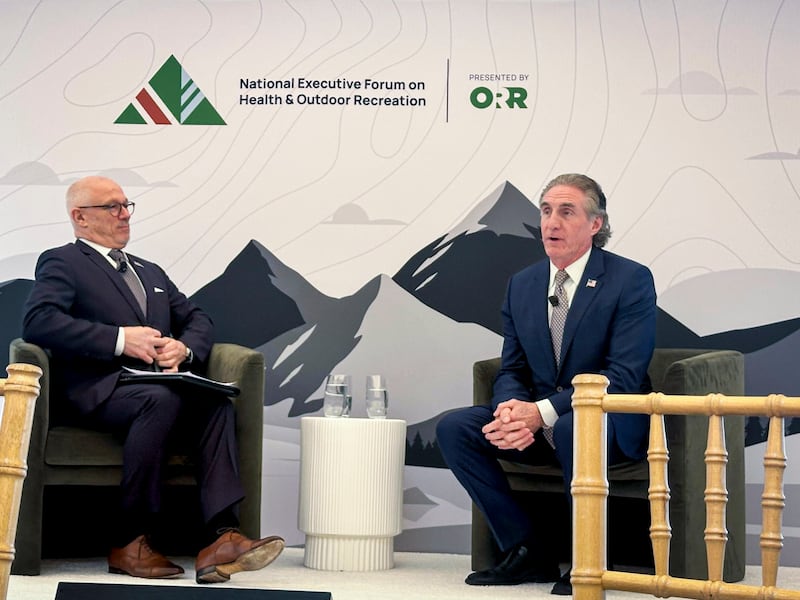
- The first National Executive Forum on Health and Outdoor Recreation convened last week in Washington, D.C.
- Leaders and researchers from the healthcare space met with recreation and public lands leaders to find ways to ensure time outside is incorporated into healthcare.
- Among many big takeaways, nature can prevent nearsightedness in children, there are a multitude of benefits to making playgrounds green spaces and how daily walks can demonstrably improve health.
Executives from both the health and recreation industries met with federal agency leaders last week at a conference in Washington, D.C., to partner in ensuring outdoor recreation is treated as a solution to some of the nation’s pressing health challenges.
Armed with 10 years of studies and empirical evidence, health and recreation leaders made the case that time spent outside and in nature overwhelmingly benefits the health of children and adults alike. They agreed the country needs to integrate time outdoors into our healthcare systems, behaviors and policies.
“This is our moment to lead a movement to more deliberately and effectively weave together public lands and healthcare systems, and to seize this opportunity to make access to nature a reliable part of everyday life,” said Carrie Besnette Hauser, the CEO of Trust for Public Land, “to prescribe — just like any other medicine or remedy — the outdoors and nature for physical, mental, emotional and civic health.”
The conference was organized by the Outdoor Recreation Roundtable, a coalition of outdoor trade organizations, businesses and state agencies that has led a number of successful bi-partisan initiatives to increase access to the outdoors for Americans, as well as ensure the outdoor recreation industry is recognized as the economic behemoth it is.
The 150 or so attendees of the invite-only event included Secretary of the Interior Doug Burgum, members of the White House staff, directors of the Bureau of Land Management and the U.S. Fish and Wildlife Service, the chief medical officer of Medicaid and Medicare, CEOs of recreation businesses, health researchers and leaders of large foundations.
The vast amount of emotional and clarifying information presented ranged from the particulars of insurance billing, campground use data, institutional research funding and the necessity of community access to green space, all the way through the impact of nature on addiction and recovery as well as how important it is for policymakers to focus on the many small, day-to-day needs of access rather than systemic overhaul.
Attendees were not necessarily surprised by the presentations. Instead, the event proved something they seemed already aware of: Spending more time outdoors and in nature has a direct benefit on humans’ physical and mental health and that those in the room needed to do something about it.
“To me, the summit is really encouraging because it makes express that direct connection between outdoor recreation and public health, both physical and mental,” said Steve Bullock, former governor of Montana, in remarks introducing Burgum.
“It recognizes the touching grass, quiet places, or exploring BLM lands on a side-by-side contributes to our lives and well-being in ways that go beyond that singular experience.”
A smattering of what health experts shared

In her opening remarks, ORR president Jessica Wahl Turner mentioned an event 10 years ago when members of Congress told the outdoor recreation industry and public land professionals they needed evidence to prove nature is beneficial to health before any action could be taken.
One of the day’s speakers who was also at that meeting, Dr. Michael Suk, an orthopedic surgeon and past chair of the board of trustees for the American Medical Association whose career weaved public policy with medicine starting in the George W. Bush administration, referred to a tremendous amount of research easily accessible on PubMed that’s been published in the years since.
“We have evidence,” he said. “We’re not in the space of saying, I wish I could prove this.”
Among some of the multitude of stories and facts presented, Dr. Laura Goldberg, an assistant professor of ophthalmology at Johns Hopkins Medicine, said that by 2050 almost 50% of the world will be nearsighted. According to her research, nature can significantly reduce that myopia.
“It’s really important that we have doctors — and more specifically eye care doctors — who can emphasize the importance of outdoors,“ she said. ”Studies have shown that if kids are outdoors for at least two hours a day, their risk of (myopia) progression diminishes by 50%.”

Not a healthcare professional, Steve Nygren is the founder of Serenbe, a wellness community of 1,400 people outside Atlanta that is integrated into nature. The town is fully walkable, with schools, doctors offices and supermarkets all incorporated into the outdoors. He said they believe in daily life being connected to nature and “free range kids and uncaged elders.”
The effects that such a lifestyle had on children was particularly staggering.
“Over 300 kids living there full time and not one reported sign of asthma,” Nygren said. “(That’s) statistically impossible in the United States.”
Nooshin Razani, a pediatrician and professor at University of California San Francisco, explained how she prescribes nature for her patients in Oakland, taking the kids and their families on weekly excursions into the nearby redwood forests.
Insurance covers some of the cost, and with additional philanthropic help she’s witnessed the benefit for her patients over 15 years of consistent “field trips.” The area where her clinic is has only 4% tree-cover, but up the hills its 90%. Across that divide, she said, “life expectancy is about 10 years different depending on where you’re born.”
Screen time was a major through-line, not just with Goldberg’s research on nearsightedness, but especially with mental health.
“The screens are much more dangerous, by the way, than any of us are aware,” said Dr. Harold S. Koplewicz, president of the Child Mind Institute. “It’s not only that your kids get swallowed up by the screens... they can really trap your kid.”
Sharing some harrowing details about social media’s algorithms suggesting dieting to teenage girls and noose-tying lessons for people watching depressing videos, he said that screens prevent kids from being with other kids, but also from going outside and exercising.
That only leads to more mental health issues, he said. Koplewicz was quick to point out both on stage and over dinner that the scale of those issues is more dramatic than folks even realize. “There’s 15,000 kids in the United States who have cancer,” he said. “There’s 17 million who have a mental health disorder.”
What can be done?

Among case studies discussed was expansion of state offices of outdoor recreation to help create more opportunities for folks to get outside.
Utah was the first to open one in 2013, and its director, Jason Curry, was among the day’s speakers. Now 20 more states have opened statewide, state-funded divisions.
In one charming moment, the most recent state to open a division, Connecticut, officially signed on as a member of the coalition of outdoor recreation offices, standing among representatives from all 21 states.
One Health US is literally putting medical care into parks. Roger Still, founder and managing partner, said his organization is opening a 201-acre park that’s also an integrated lifestyle health clinic in Columbia, Missouri.
Relying on both public and private investment, that park lets visitors recreate and access a full health clinic, as well as — if one is so inclined — drop in on an agriculture business incubator with productive farm land.
Suk, too, had some action items of his own. He emphasized that outdoor recreators need to think and speak of themselves as an upstream solution for health issues and to use the very specific language of healthcare.
“I would love to tell the outdoor recreation to start talking like doctors. And I’m giving you the words right now. Remember: Nature is good for you — we know this — but ‘nature actually will lower the total cost of care,’" Suk said.
By using the terms “lower the cost of care,” he said, the ideas may register as beneficial, which could release billions in research and insurance benefits.
That notion of being upstream was emphasized in a presentation by Linda Powers Tomasso, a environmental health researcher at Harvard’s T.H. Chan School of Public Health.
Rather than a cost-benefit analysis, she suggested a cost-effectiveness analysis.
Spending time in nature could reduce hospitalization costs of “everything from systemic heart disease, cardiovascular (disease), morbidity, hypertension,” as well as mental health, emotional health and depression, she said. But, it could also have an effect on the additional costs of sick days and subsequent lost productivity. Those kinds of elements are not generally considered in the cost assessments of going outside.
“If we could be looking at this as a comprehensive life cycle with downstream benefits, then we could be better assessing what are these interventions,” Tomasso said. “Whether they’re a nature prescription, whether they are an investment for green space in neighborhoods, investment to put in green trailways and other things, as well as the infrastructure necessary to get people out to the big nature of landscape scale nature.”
She suggested that economic argument would appeal to pharmaceutical companies and insurers.
Outdoor recreation as a public health priority?

While this new direction may appear a departure from the Outdoor Recreation Roundtable’s work, Turner said she and the board realized the health benefits of outdoor recreation are just a natural extension of its core values. Plus, it just kept coming up in conversations with various member organization, colleagues and elected officials. It even came up in congressional hearings.
Rep. Bruce Westerman, R-Arkansas, asked her about the health benefits of outdoor recreation, as did — unprompted, and in a hearing about the EXPLORE Act — both Rep. Celeste Maloy, R-Utah, and Rep. Mike Kennedy, R-Utah.
“(Kennedy) said, you know don’t we need to get more people outside for health?,” Turner said. “I was like, ‘This is so cool. I’m not here to talk about health but you have a doctor and a congresswoman from Utah who are asking me health-related questions because they see the connection.’”
If ORR’s mission is to grow the recreation economy for the benefit of all Americans, getting more people outside for any reason is going to advance their interests, she said. Tapping her chest, she said that there was some indescribable feeling she had when thinking about the intersection of heath and recreation.
“Our team can sense when we’re on to something big,” she said. “So, when we started thinking about health, talking about health and hearing about health from CEOs, I was like, ‘This is something we should get on board with.’”
Burgum agreed with the notion and mentioned something similar while listing his priorities as the secretary of the Interior, an agency that manages more than half a billion acres of America’s landscapes.
“These are public lands. (The outdoor recreation) industry — $1.3 going to $1.5 trillion, 3% of the employment of the country — and all of the economic activity, the communities, the jobs, and then the health benefits of people getting off (being) a screen-based world, for our kids and our grandkids and all that..." Burgum said.
“One of the key public uses is recreation, and we just gotta make sure that we’re making sure that it’s a priority.“
