



- One historian reflects on the public's appetite for simple "hero and villain" accounts, including in religious history.
- Early relations between Utah pioneers and Native American communities included both conflict and peace, tragedy and inspiration.
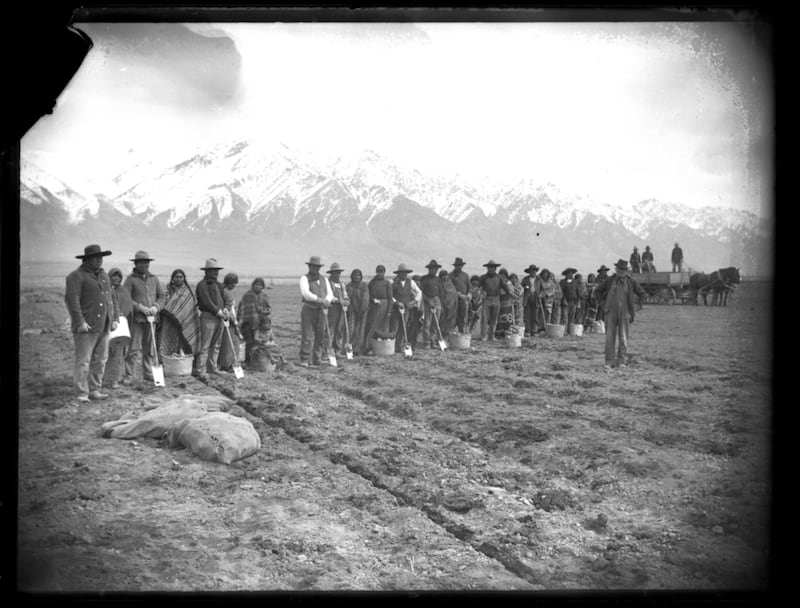
- More than 1,500 early Northwestern Shoshone members are documented in the records of The Church of Jesus Christ of Latter-day Saints, including some who helped build the Logan Utah Temple.
- Projects like "Saints," "Native Saints" and the new Museum of Utah integrate different perspectives on historical events, reflecting an effort by historians to foster greater understanding among diverse communities today.
W. Paul Reeve, former chair of the University of Utah History Department, shared a Facebook post on Sunday, July 19, with the Century of Black Mormons project he leads about the first known black Sunday School teacher in The Church of Jesus Christ of Latter-day Saints.
Samuel Chambers was first baptized in Mississippi in 1844, 20 years before he was freed from slavery.
It’s a remarkable story — and certainly worthy of historical mention. But among the post’s tens of thousands of views, Reeve was struck by the bifurcated response it elicited online. On one hand, some religious commentators seemed to feel vindicated, responding along the lines of, “oh, see — we had no racial problems. This is amazing. The world keeps painting us in a bad light.”
On the other hand, because of the positive story from a Black member in early Latter-day Saint history, the scholar noted that other commenters couldn’t seem to “handle hearing anything positive” about the Church of Jesus Christ.
Neither group appeared ready to accept a more nuanced, complex picture faithful to the full historical record — one that contained both nobility and tragedy, inspiration and sadness.
Utah’s pioneer and native histories

Reeve’s ancestors were among those who perished at the Hawn’s Mill massacre in Missouri, where 17 Latter-day Saint men and boys were killed in 1838. So, the historian is acutely aware that those Latter-day Saint pioneers “felt they had nowhere else to go.”
Roughly 70,000 Latter-day Saint pioneers in subsequent years deliberately traveled 1,300 miles to Mexican territory, leaving the boundaries of a nation that had failed to protect this religious minority from brutal persecution.
This historic trek, commemorated in this weekend’s Pioneer Day celebrations in Utah, has received central attention over the years. Yet, Reeve also highlighted the value in “being willing to stand back and understand what this looks like from the perspective of Native American people” — for instance, the ensuing, profound loss of land over this time period, going from controlling 100% of the territory to holding just 4% today.
Although pioneers sought to establish peaceful relations generally, painful conflicts also erupted — with an estimated 150 to 200 violent engagements and several regional wars between settlers and Native Americans.
These tragic conflicts can be acknowledged, Reeve and other scholars say, without eclipsing the courage of pioneer settlers and Native Americans alike.
Fairness for all in history

Darren Parry is a Shoshone historian and author of “The Bear River Massacre: A Shoshone History.” As waves of settlers crossed the United States, Parry said that “Native communities lost land, language, lives, and opportunities to determine their own future. Families were displaced. Entire cultures were pressured to abandon traditions that had defined them for generations.”
“Those realities should never be minimized. They are part of our shared history,” he told the Deseret News. “Neither, however, should they erase the sacrifices of the pioneers who crossed the plains seeking a place where they could worship freely. Both stories belong to this land, and both deserve to be told honestly.”
Rather than seeing these stories as competing with each other, Parry sees value in bringing them together — “not to assign perpetual guilt or claim perpetual innocence, but to better understand one another.”
“We honor both communities by telling their stories truthfully, acknowledging both extraordinary courage and undeniable suffering,” he said. “History is rarely divided neatly between heroes and villains.
“We can acknowledge mistakes without fearing that truth somehow threatens faith,” Parry added. “Healing never begins by pretending tragedy did not happen. It begins when people are willing to face difficult truths together.”

‘Saints’ as a historical model
Models of this kind of balanced approach to Utah history have proliferated in recent years.
A year after the culmination of the 27-volume Joseph Smith Papers project, in October 2024, the four-volume “Saints” history was completed. Deeply sourced, this series recounts a wide range of diverse experiences in the development of a global church — with the pioneer exodus from Illinois detailed in Volume 2.
Scott Hales, a historian centrally involved in the project, said at a 2025 conference that one should “always approach the past as a Christian … with a great deal of charity, recognizing that we’re all human beings, we all make mistakes, that we are all striving to be better through the Atonement of Jesus Christ.”
Even while we “strive for understanding and to be truthful in our portrayal of history,” said Brittany Chapman Nash, co-author of the four volumes of “Women of Faith in the Latter Days,” we ought to bring “the two great commandments” into scholarly work by “treat(ing) historical characters with compassion.”
The faith and courage of ‘Native Saints’
This year, “Native Saints: The Washakie Ward” was released, drawing together hundreds of profiles of Shoshone faith and courage — thanks to a collaboration between historians with Church of Jesus Christ and the Shoshone nation.

Central to this website is the database of 1,555 profiles of Northwestern Shoshone men, women and children whose names appear in church records because they either accepted baptism into the church or died as children in these families.
Tragic violence experienced by these early Shoshone communities is recounted in Chapter 27 of the “Saints” history — with a later Chapter 34 illustrating remarkable faith shown by many early Shoshone members as well, some of whom helped volunteer time to build the Logan temple.
In addition to thousands of Native Americans who demonstrated faith in Jesus Christ and willingness to participate in the church in previous centuries, many of their descendants have remained committed to the faith, as historians confirm.
This historical reality contradicts the idea that the Church of Jesus Christ is somehow inherently hostile to Native Americans and other minorities — or that these thousands of people were not — nor can ever be — “fully” Latter-day Saint. Such cynicism also discounts consistent Latter-day Saint teachings emphasizing God’s call to love all, including this scripture from the Book of Mormon:
“(The Lord God) inviteth them all to come unto him and partake of his goodness; and he denieth none that come unto him, black and white, bond and free, male and female; and he remembereth the heathen; and all are alike unto God, both Jew and Gentile.”
Museum of Utah as a model
Just last month, the new Museum of Utah officially opened its doors in a building adjacent to the state Capitol. Utah’s first official state history museum, operated by the Utah Historical Society, is a 17,000-square-foot facility with free admission and is being called by some “the Smithsonian of Utah.”
Jennifer Ortiz, Utah Historical Society director, said the museum is working to “tell stories from multiple different angles.”
Patrick Mason, a historian at Utah State University, told the Deseret News how impressed he was by the even-handed, fair way this new museum represents both challenging and inspiring aspects of Utah’s rich story. “Instead of historians calling balls and strikes, this museum does an impressive job just telling the stories of people and letting the complexity of history speak for itself.”
As Deseret News writer Emma Neff reported at the grand opening, the museum’s layout ultimately hopes to foster “a sense of belonging for all visitors.”
“Whether your ancestors walked these lands millennia ago, crossed the plains with the pioneer handcart companies, arrived as a refugee or you recently moved to the state yourself,” Neff wrote, “the museum’s overarching goal is to connect every visitor to the diverse people who shaped Utah’s history.”
