


- About 17% of U.S. children currently live in blended families, down from 23% in 2013.
- Racial and educational factors greatly impact likelihood of children living in blended families.
- Non-blended families have a higher median net worth compared to blended families.
More than 1 in 6 children in the U.S. live most or all of the time in a blended family. But the definition of a blended family is not always two adults who marry each other and bring children from an earlier relationship.
Blended families are any that include a stepparent, stepsiblings and/or half siblings, according to a new report from Pew Research Center called “5 facts about U.S. children living in blended families.”
The study found that the 17% of children who live in a blended family is lower than the 23% in 2013, the first date that a comparable dataset from the U.S. Census Bureau’s Survey of Income and Program Participation was collected.
Because of custody arrangements and other factors, there may be more children with blended family members that live elsewhere or a half sibling who no longer lives at home.
Study author Jake Hays, a Pew research associate, told Deseret News that the center decided to look at blended families because they are a dynamic and “not uncommon” group with different experiences. The report, he said, is “part of a broader portfolio on families and relationships and how they’re changing.”
“I think the overall important finding is there’s not really one typical blended family arrangement. Some children have a half sibling. There are others with a parent and stepparent. There are a wide variety of arrangements,” Hays said, noting different combinations of relationships within a child’s household.
Factors that influence likelihood of a blended family
Race, ethnicity, parent education and age are all associated with whether a child will live in a stepfamily or have a half sibling.
Asian families are the least likely to live in a blended family, at 7%, compared to 15% of white children, 19% of Hispanic children and 28% of Black children.
When parents have at least a bachelor’s degree, children are also less likely than the children of less-educated parents to be in a blended family, according to the Pew Research analysis. With a parent with no more than a high school education, 28% of children live in a blended family, compared to 23% of families where a parent has some college and 9% with a parent who has a college degree or higher.
Hays noted that the report uses the education level of the custodial parent or the highest level of education attainment in cases where the child lives with both parents. He also notes that parents can be biological or adoptive.
Per the report, “This may be the case because adults with a bachelor’s degree are less likely to have children outside of marriage and less likely to divorce.”
Blended families are not all made up the same
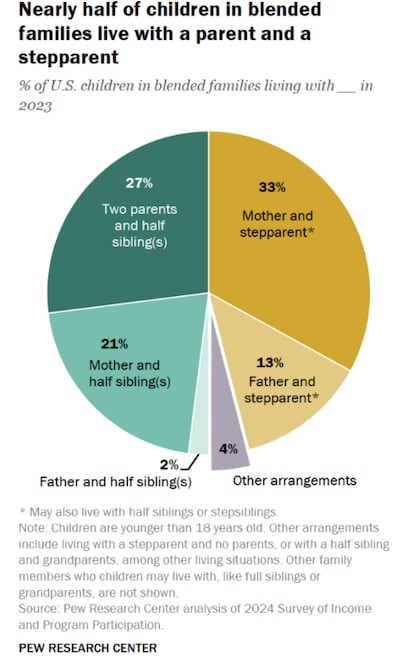
Just under half of the kids in a blended family live with a parent and a stepparent — married or a cohabiting partner — and may or may not have any half siblings or stepsiblings. Of those, 33% live with their mother and her partner and 13% live with the father and his partner.
Half of children in blended families live with at least one half sibling but don’t have a stepparent. And more than 1 in 4 (27%) of children who live in blended families do live with both of their own either biological or adopted parents and one or more half sibling. Hays said the half sibling is typically an older child from one parent’s previous relationship. Another 23% live with a single parent (usually their mother) and at least one half sibling.”
Children who live with their own single parent or with both their parents without any stepsiblings or half siblings are in the non-blended family category, Hays said. As for blended families, he said the study included “pretty similar shares of two-parent households and one-parent households.”
In two-thirds of households where children live with a parent and a stepparent, those adults are married to each other. In that same parent-and-stepparent arrangement, 27% of children only have half siblings in the home, 15% only have stepsiblings and 14% have both half siblings and stepsiblings at home.
Non-blended families tend to have more financial resources
The analysis found that the median net worth for blended families with children is $86,300, compared to the $194,400 for non-blended family households.
The factors are likely related to some of the previously presented demographics. Pew research suggests that education is a major factor that is “strongly linked with income and wealth.”
The report also notes that blended families are less likely to own their own home than non- blended families (55% vs.66%). Among those who own homes, non-blended families have a higher median home equity.
Most blended families with a child support agreement get cash
The analysis found that 46% of blended families with at least one child living with just one of his or her parents have some kind of child support agreement — either court-ordered or an informal arrangement that both parties agreed to follow.
In other blended families with at least one child who has a non-custodial parent, 15% receive in-kind support, such as food, school supplies and clothes. Some families with monetary agreements may also receive in-kind support.
“Blended families who have cash support agreements and receive payments get a median of $400 monthly (in 2023 U.S. dollars). This is 12% of their monthly household income, on average,” per the report.