

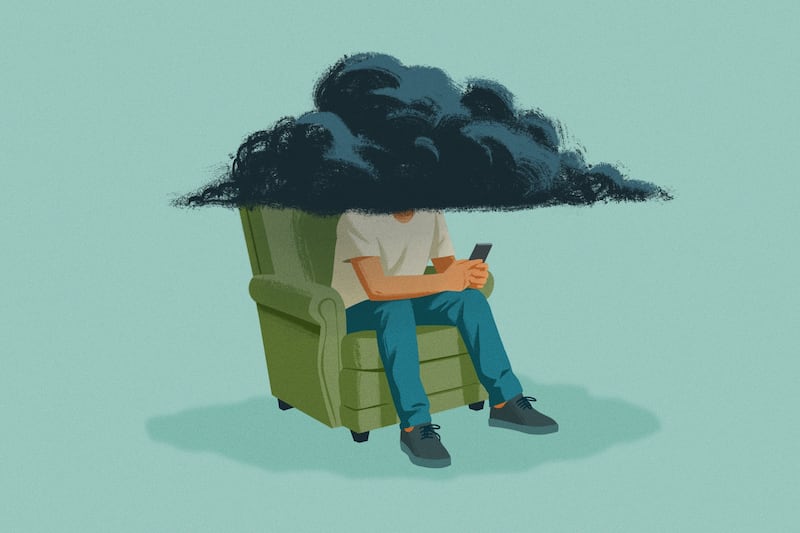

- Young men still aspire to traditional milestones — good jobs, marriage, fatherhood — contradicting the popular myth that they "just don't want to grow up."
- About half of young men no longer believe the American Dream is achievable for them.
- Electronic media use is extremely high — and emotionally costly.
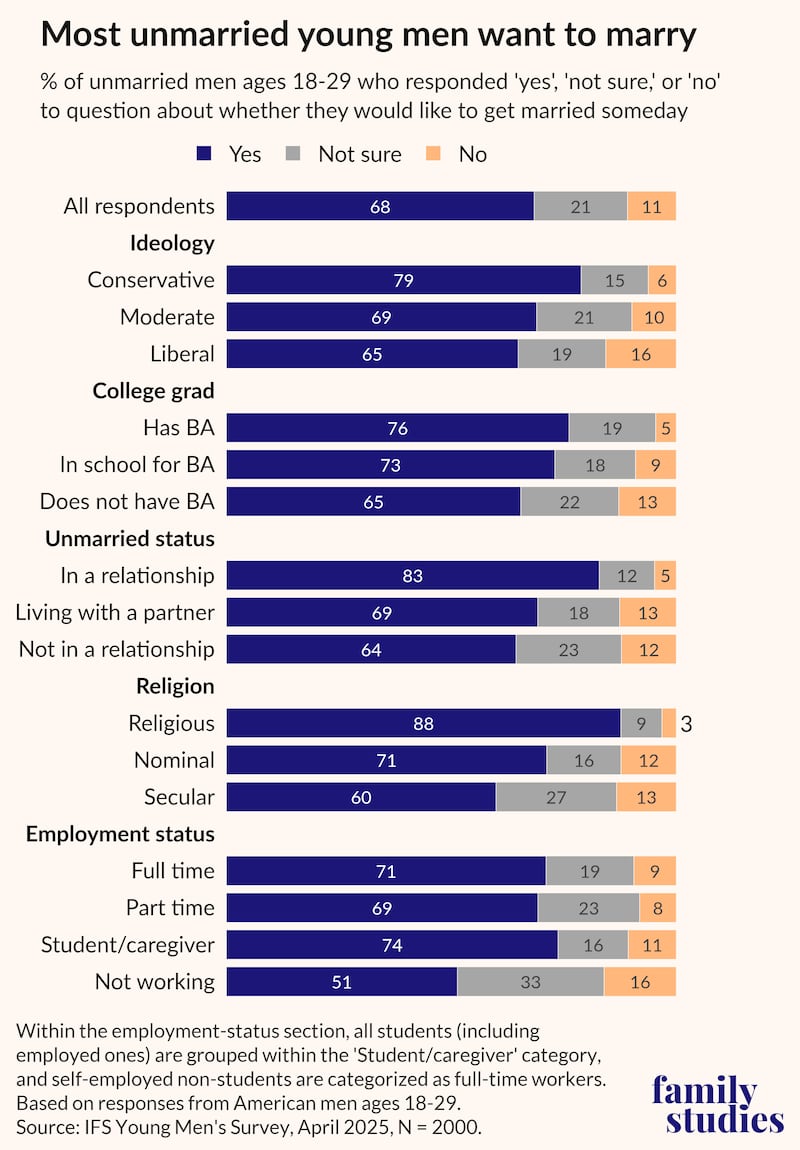
America’s young men often have traditional aspirations, including a real desire to be responsible, to be able to support themselves and others, to marry and become fathers.
But there’s a rub — in fact, several — according to the second report in the Institute for Family Studies’ “America’s Demoralized Men” project released Wednesday. They face barriers including inadequate income, limited educational opportunity and trouble finding a romantic partner. As a result, the report says many of them feel both frustrated and stressed. And the so-called American dream seems like just that: a dream.
A nationally representative survey of 2,000 men ages 18 to 29 revealed a sense of disconnect and inadequacy among more than half of young men. In smaller, but significant numbers, they also described loneliness, isolation and a lack of community much of the time.
“One big theme that stuck out was that many young men are just simply not happy with their situation despite the rumors they are succumbing to their ‘toxicity,” one of the report authors, Michael Toscano, who directs the institute’s Family First Technology Initiative, told Deseret News by email. “For instance, we find that huge numbers of men use social media almost constantly, as well as porn, online betting and video games, but at least in the case of porn and gambling, this deeply affects the mental health of young men.”
Toscano said the research found truths that buck some modern myths, including the notion that young men “just don’t want to grow up.” He and his colleagues consistently found the opposite to be true.
“Large majorities of young men still want to hold down a good job, be husbands and good fathers. But they find themselves unable to find a path to those goods. Moreover, they flee from their pain into the world of electronics where they use pornography, gambling, social media and video games to escape. But it’s not working. Our research shows that young men (crave) a different life. America needs to wake up to the problem and help them find it,” he said.
While some young U.S. men thrive, “some are struggling mightily,” per the report, which was written by Toscano, Joseph E. Davis, research professor of sociology and director of the Picturing the Human Project of the Institute for Advanced Studies in Culture at the University of Virginia, and Ken Burchfiel, a research fellow at the institute.
At the same time, about half of these young men no longer believe the American dream is possible for them, “no matter how hard I work.” And nearly three-fourths say that “who you know is more important than ability or hard work in getting ahead.”
But they have not quite given up. In what the authors deem remarkable, 84% say “having ambitious plans for the future describes them at least somewhat well.”
“We have striven to let men speak for themselves in this report and to not judge them for their very real shortcomings,” Toscano added in the email.
Barriers that hold men back
In part one of the two-part report, the researchers found that despite high hopes and good intentions, young men are struggling to reach their goals, as Deseret News reported in March.
The new report outlines many of the barriers that account for that: “A notable share of young men report having faced traumatic events in their lives. For example, 12% have ever been incarcerated, while 44% have a loved one who has gone to prison (28%), died of a drug overdose (18%), died by suicide (16%), or died by homicide (14%). The men with such experiences have higher rates of mental health struggles than those who do not, including with depression (49% vs. 27%), an anxiety disorder (44% vs. 25%), ADHD (36% vs. 19%), bipolar disorder (26% vs. 8%) and a learning disability (21% vs. 11%).”
Among other key findings, the authors report that:
- Slightly less than half of young men feel a steady emotional connection to others. While less than half say that they seldom or never feel lonely, isolated, unloved or unwanted, 55% say they are sometimes lonely, isolated (54%), and 32% say they feel loved or wanted only some of the time. Twenty percent say they never feel loved or wanted.
- For too many, friendships are rare. Nearly 1 in 10 of the young men reported that they have no close friends, while 1 in 3 said they have a close friend or two. The report says institutions like marriage, church and school are “the best predictor of having at least three friends,” while participation in sports teams, Scouts or other all-male groups also boosts that likelihood. Having at least one close friend is a hedge against loneliness. Of those with no close friends, 43% were lonely all or most of the time, while 27% were lonely some of the time. Conversely, of those with six or more close friends, 18% were lonely all or most of the time and 26% were lonely some of the time. But 56% were not lonely often or were never lonely.
- Social, civil and religious participation is low. The survey found nearly 6 in 10 of the young men questioned participate in at least one community activity, but just 3 in 10 volunteer and even fewer are members of a faith-based group, social club, adult sports league or similar activity. The odds of flourishing increase for young men who are in a religious group, are students, are married with kids and who have completed trade school.
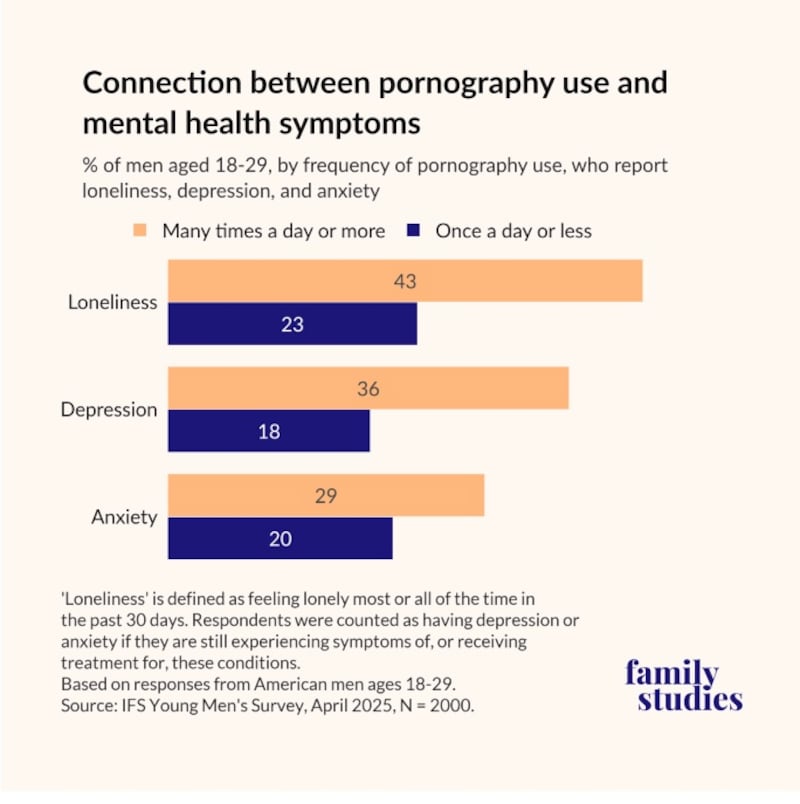
- Electronic media use is very high, with lots of gambling — including 23% who do so daily — and gaming. The survey found 44% play video games several times a day and pornography consumption is widespread at 42%. Those using porn daily, per the report, “include married men (21%) and regular religious service attenders (24%).”
- Online gambling and pornography carry significant emotional repercussions, including loneliness, depression, anxiety and more, according to the report.
People you can count on
Most of the respondents do have some social support available all or most of the time. More than two-thirds have someone they enjoy spending time with, while 64% have someone who will listen when there’s something the young man needs to talk about. A very similar 63% usually have someone with whom they can engage in a fun activity, while 62% usually have someone who can provide advice about a personal issue.
The report asks who is providing this support, then answers that given the similarity of the numbers, the respondents are probably thinking of the same one or two people for all of them — folks who are a stable presence for them.
The report notes that married men “tend to enjoy more social support than their unmarried counterparts. Along with close friends, spouses (who may or may not be thought of as close friends) play a very important support role.”
Again, there is a similar benefit to all-male groups, like sports teams in school.
A changing world
The report notes that the world is getting “formless” as “the social fabric itself has thinned.” There are fewer prescribed roles, there now exists “a more open and indeterminate field of options and choices” that includes “less guidance from shared beliefs, customs, rules or forms of life.”
Still, some things have held true, like the value of college, trade school or apprenticeships which help young men fare better financially over time, including opening doors to stable employment, friendships, relationships, family life, community and more, per the report.
Some can’t access that educational track, however, for a lot of reasons ranging from inadequate finances to learning disabilities and other responsibilities. Sometimes it’s a plain lack of belief in oneself. Consequently, per the report, young men who are not on that educational pathway “often step into a void after high school, bouncing around entry-level jobs, and may only discover a vocation, such as a trade, much later.”
Amid many challenges, the report notes that “a large majority of men (73%) believe that in recent decades it has become harder to know what it is to be a man.”
For role models, by a wide margin they say it is their mothers and then fathers. But as the report concludes, “Never have young people been asked to shoulder such burdens of autonomous self-making. That some can thrive in this fluid, entrepreneurial environment does not mean everyone can or should be expected to.”
YouGov conducted the Institute for Family Studies Gen-Z survey on men April 7-15, 2026. They were matched to a sampling frame that considered gender, age, race, education and region to make the survey nationally representative. They note that lesbian, gay, bisexual and transgender adults were included but were not analyzed separately.