

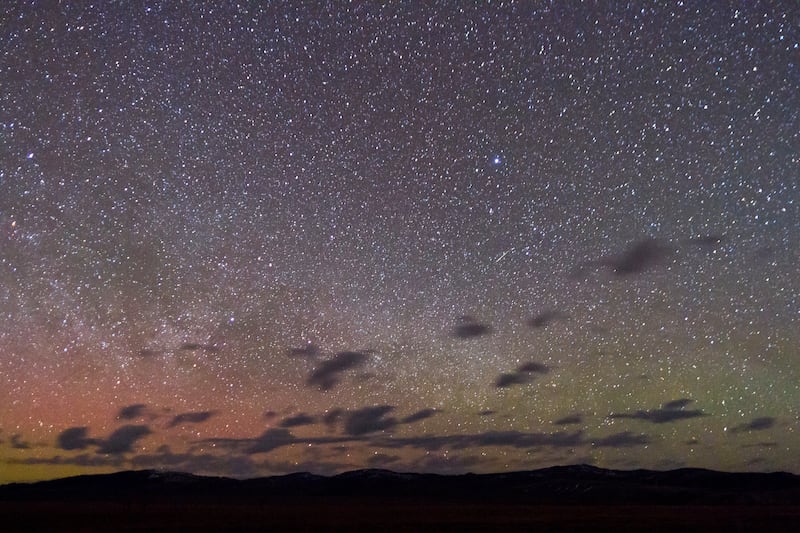

One of the oldest known meteor showers reaches its peak this week. The Lyrid meteor shower has been observed for around 2,700 years, according to NASA. Records from 687 B.C. show that Chinese observers were the first to document the event.
While the Lyrids are not as fast or as powerful as the Perseids in August, they are known for being bright and quick. Although the shower typically produces 10 to 20 meteors per hour, it can sometimes produce outbursts of up to 100 meteors every hour.
The shower has been active since April 14 and will continue to be until April 30.
In 2026, the peak occurs the night of April 21 and into the early morning of April 22, according to the American Meteor Society.
How to watch
The Lyrids are best viewed in the Northern Hemisphere between moonset and dawn. Because light pollution is one of the biggest obstacles to a clear view of the shower, the best time to watch is after midnight once the moon has set.
To get the best view, escape the city lights and look up. The radiant — the point in the sky where the meteors appear — is located near the star Vega within the constellation Lyra. Vega is the brightest star in the constellation and the fifth brightest in the night sky. The constellation is shaped like a joined rhombus and triangle, named for the harp-like lyre played by the Greek mythological musician Orpheus.
While the meteors appear to come from the constellation in the East, experts recommend just looking up into the sky instead of East to catch brighter, longer streaks of light, according The Times.
NASA recommends skygazers give their eyes 30 minutes in the dark to adapt. This year, the American Meteor Society highlighted that the light from the moon will be minimal, even before midnight, because the moon is in a waxing crescent phase, according to the American Meteor Society.
Origins of the Lyrids
The Lyrids are actually debris from Comet Thatcher, which was discovered on April 5, 1861. While the comet has not been seen since and it won’t be back for roughly another 250 years, its trail of debris crashes into Earth’s orbit every April, according to The Times.
When the debris hits and burns up in Earth’s atmosphere, it creates the “shooting stars” visible from the ground, according to NASA. These bright streaks of light aren’t just for those on Earth, astronauts aboard the International Space Station can see them too.