

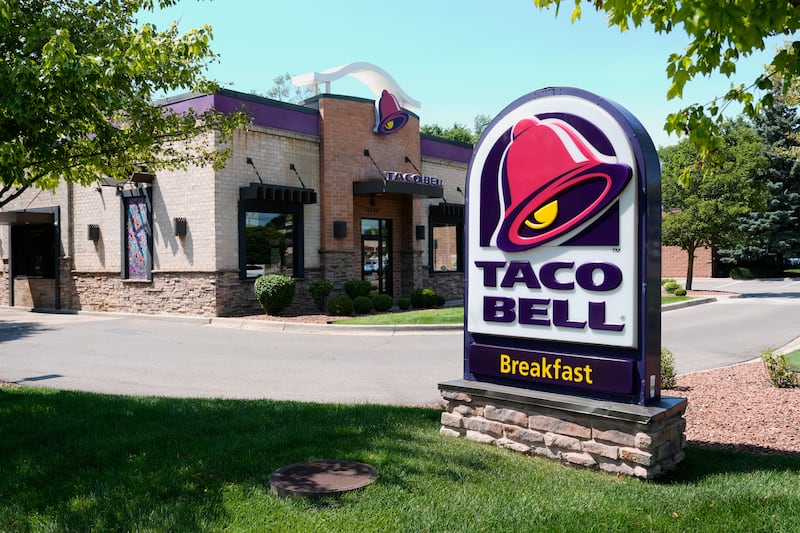

- The CDC and FDA say do not eat shredded iceberg lettuce at Taco Bell locations in Indiana, Kentucky, Michigan, Ohio, and West Virginia.
- Taco Bell has committed to removing the lettuce from its nationwide supply chain and is encouraging other restaurants to act.
- The FDA said an earlier test of lettuce produced a false positive.
Editor’s note: This story has been updated to indicate the allegation the illness came from Taylor Farms lettuce was a false-positive.
In an investigation that’s still open, the Centers for Disease Control and Prevention and the U.S. Food and Drug Administration say that Cyclospora parasite infections in five states have been linked to shredded iceberg lettuce from Mexico that was supplied to Taco Bell and possibly other food vendors.
“Do not eat shredded iceberg lettuce from Taco Bell locations in Indiana, Kentucky, Michigan, Ohio and West Virginia,” the notice posted by the CDC reads as the investigation continues.
It adds that the “CDC is also investigating other outbreaks and illnesses of cyclosporiasis nationally that are unrelated to this outbreak.”
A notice posted by the FDA said more states could be added to the five listed. And it said that “not all Taco Bell locations in these states received implicated product.”
Cyclosporiasis is the infection caused by the microscopic parasite Cyclospora. It is most often linked to fresh produce that has been irrigated with water contaminated by feces. Cyclosporiasis can cause violent diarrhea and vomiting, among other symptoms.
CDC reported 1,644 cases have been linked to contaminated lettuce and said more than 90 people have been hospitalized in the Midwest outbreak, but there have not been any deaths.
Nationwide since May, close to 7,000 cases have been confirmed or are being investigated and at least 141 people have been hospitalized, per the CDC. Cases are typically seen between May and August.
The public health giant said it is working with the supplier to “determine if contaminated shredded iceberg lettuce went to other places.”
Neither the CDC nor the FDA have named the supplier, but an earlier version of this story cited multiple media outlets including The New York Times, The Washington Post and The Wall Street Journal who were told Taylor Farms supplied the lettuce, each basing their reports on unnamed federal sources.
The FDA has said the test yielded a false positive. In a statement released July 20, Taylor Farms said the FDA had apologized. And it noted that “to be clear, at this moment, FDA has not identified a single positive product test result for Cyclospora.”
The company’s statement continued, “Acting on initial information provided by health officials, in an abundance of caution, we completed a voluntary recall of iceberg lettuce from central Mexico. Recalled product was limited to iceberg lettuce grown and processed in central Mexico.”
Taylor Farms is one of the world’s largest fresh vegetable producers, with facilities across North America and Western Europe.
Investigations nationwide
CNN quoted public health officials on the scope of investigations nationally, noting “multiple investigations underway, some tied to the large outbreak in the Midwest, some involving single states and some involving cases not yet tied to any cluster.”
“The investigation remains active, and additional states, restaurants, retailers or products may be identified as more information becomes available,” Emily Hilliard, a spokesperson for the Health and Human Services Department, told The Washington Post.
Roughly 4,300 of the cases are in Michigan and it was the Michigan state health department that first pinpointed lettuce as the potential source of the contamination, based on its investigation.
According to USA Today, “Public health officials in Michigan analyzed food exposures from 190 of the cases who reported eating at Taco Bell and shared these findings with the CDC,” noting that nine out of 10 of those reported that they’d eaten iceberg lettuce.
The statement from Taco Bell suggested other restaurants might also need to take action.
“While no official advisory has been issued, we believe public health is a shared responsibility among restaurants, their suppliers, and authorities, and we are proud to have consistently acted quickly and proactively to protect our guests,” read the company statement. “Taco Bell has taken precautionary action, and we encourage all relevant restaurants, retailers, and foodservice operators to do the same.”
Bad for business
Business Insider noted Friday that Taco Bell was not the only “lettuce-heavy” restaurant taking a hit from the cyclosporiasis outbreak.
“Early data from location intelligence firm Placer.ai shows that U.S. foot traffic at some of these chains began to decline in the second half of the week as reports of the diarrhea-causing parasite spread."
The Washington Post said the International Fresh Produce Association was critical of how the investigation is being done.
“Everything pointing to produce is based on recollections of patients, and even those recollections — based on what we hear — explain, at most, only half of the current cases,” Max Teplitski, the association’s chief science officer, told the Post.
“We need to be candid about the limits of the data being used here,” he added. “A parasite with a notoriously complex life cycle, Cyclospora can be hard to detect in the environment, and some of the methods for its detection have performed inconsistently.”
The WSJ article called Taco Bell “one of the standout fast-food chains in a challenging time for restaurants, posting strong quarterly sales for several years.” But it said “third-party data shows that people connecting their recent meals at the chain to their illness is starting to hurt the company’s sales.”
Per the FDA, “If you purchased or received food items with shredded iceberg lettuce served at Taco Bell at one of these locations, carefully clean and sanitize any surfaces or containers that it touched.”