



- The Red Cross declared a national blood supply crisis for the second time in its 145-year history.
- Donations fell to a four-year summer low and type O blood is dangerously scarce.
- Blood cannot be manufactured, so hospitals depend entirely on volunteer donors.
For only the second time in its history, the American Red Cross has declared a national blood supply crisis, with warning of serious potential consequences in a season rife with injuries and illnesses that require blood.
The Red Cross supplies about 40% of the nation’s blood to more than 2,500 hospitals and transfusion centers, including nearly 45 hospitals across Utah. Nationwide, the Red Cross must collect about 13,000 blood donations and 3,000 platelet donations every day to meet patient needs.
Blood donations are at a four-year summer low — and summers are always tricky. The Red Cross is the nation’s largest single provider of blood products. And it monitors the nation’s blood supply on a daily basis.
While the Red Cross is sounding the alarm through media announcements, it’s a national challenge affecting blood centers and thus hospitals nationwide. The challenges are hitting both urban and rural centers.

Jess Gomez, an Intermountain Health spokesman, notes that every 2 seconds, someone in the U.S. needs blood. And there’s a reason summer is known as trauma season. “As more people travel, drive, swim, bike and spend time outdoors, especially here in Utah, our hospitals see an increase in serious injuries requiring lifesaving blood transfusions,” he said.
Or, as Deborah Jordan, a spokesperson for ARUP Blood Services, describes it, “Summer means more car crashes. Someone’s riding an ATV for the first time. Someone’s going horseback riding. A hiker has fallen.... Summer months, because they’re so active, we need more blood products for transfusions. It’s not the same necessarily in all states, but for Utah winter is also the same because we have so many winter sports.”
ARUP Blood Services provides blood to University of Utah Hospital and the Huntsman Cancer Hospital. It’s a smaller but also vital network. And sometimes ARUP and the Red Cross end up helping each other out when one needs blood it doesn’t have on hand, said Jordan.

When supplies are so low, they may end up purchasing through an outside broker. “And if every state is short, every state is short,” Jordan said. “It makes it more difficult for us to purchase at the time of an emergency. More difficult for everybody.”
As demand rises, blood donations tend to fall. “Vacations, busy schedules and disrupted routines are the main causes,” Gomez said.
The need for blood is huge. Keith Paul, American Red Cross regional communications director for Utah and Nevada, said that last year his organization collected 138,000 units and benefited from more than 4,200 in-state blood drives.

The Red Cross said the blood emergency was declared after the national blood supply dropped nearly 25% in one month. With blood donations and scheduled appointments down “sharply,” the gap between blood supply and demand became considerable — and extremely worrisome.
An announcement from the American Red Cross said that “despite thousands of people answering the call to give, blood donations are not keeping pace with hospital demand — which is up during the summer trauma season. Extreme heat, poor air quality and widespread foodborne illnesses are contributing to lower donor turnout this summer, further straining the nation’s blood supply."
An inadequate blood supply has no work-around. “When a trauma patient arrives in the emergency room, there is no substitute for donated blood. It can’t be manufactured. It can’t be ordered overnight. It must already be here — waiting because someone chose to donate," Gomez said.
Per the Red Cross, “Just three more donors at each blood drive this summer can end this crisis and stabilize the blood supply.”
“At this point in the summer season, we’re asking anyone who can donate blood to do so. We would like our inventory to be higher,” Gomez said. “We are always in need of O-negative blood and O-positive red blood cells, but especially now in the middle of trauma season we welcome all donors.”
Extending a helping arm

Benjamin Donner, executive director of the American Red Cross Central and Southern Utah Chapter, was already involved with the organization and proud of its mission, and he’s been a blood donor since age 16. But in 2019, the need to bolster the blood supply became an almost-evangelical, visceral mission.
He had a medical emergency that could have killed him. He was bleeding internally, though he didn’t know it, when he arrived at Lone Peak Hospital’s emergency room in Draper. As healthcare providers rushed to stabilize him, he heard his son, then 11, ask if his dad was going to die.
“Without skipping a beat, the doctor said, ‘He’s going to be okay. We have the blood he needs and we are going to get him squared away,” Donner recalls. He said the calm that came over his entire family was palpable and he had a “full-circle moment” where his blood donations and his occupation hit him hard as being very important. How scary would that have been to need blood in the hospital and find they didn’t have it? he said. “It was the only time in my entire life I was not sure I would wake up the next day.”
The message is out there. But he said more people need to answer the call.
Tuesday, Kylie Rae Lee and her pal Joanna Campbell were at American Red Cross Blood Services donating blood. It was a first for Lee, an emergency medical technician, who heard about the need through work. Campbell had donated before in college and was happy to be invited along.
Lee told Deseret News she had been planning on donating blood and had even gotten her blood typed. The announced dire need for the very blood running through her veins — O-positive — was a do-it-now nudge. She and Campbell both were surprised by how fast and easy the process was.
“An hour of your day, total,” said Campbell.
Lee said she’d like to see more ambulances carry blood products, but doubts that can happen if there isn’t even enough to supply hospitals.
All about your blood
Jordan said that every donation has the potential to save three people. Typically, a blood donation is made into three products: Red blood cell concentrates are packed cells used to treat severe anemia or blood loss from trauma. Fresh frozen plasma is the liquid portion containing clotting factors that are used to reverse bleeding or replace volume. And cryoprecipitate is a frozen plasma product that’s rich in specific clotting factors.
Additionally, Jordan described a “Whole Blood Titan” program, where blood is not broken down, but remains whole. That’s the product that medical helicopters use and fly to the scene of a trauma, “giving a patient the whole blood instead of three different products during the rapid transport to the hospital.”
Most people don’t know much about blood.
Red blood cells, which carry oxygen throughout the body, have protein markers called antigens on their surface that determine a person’s blood type. Most fall into one of four categories: A, B, AB and O. If you have an A antigen, you have blood type A, for instance. Those with B are type B. Those with AB blood have both types and those with O have no antigens.
Plasma has an opposite antibody, so A blood has anti-type B antibodies. AB has no antibodies and becomes the universal plasma donor. Type O has both. AB is also the universal red blood cell recipient, while O negative is the universal red blood cell donor.
The Rh factor determines if blood is positive or negative. Although many Rh antigens may live on the red cell’s surface, D’s the one that matters for typing. If you have the D antigen, your blood is positive — true of 85% of Americans. The others have “negative” blood.
O-positive is the most common blood type and it’s also a match for anyone with A-positive, B-positive or AB-positive blood. But Jordan said it’s also needed because “that’s the most amount of patients that come through the hospital. So sometimes people think like, I’m O-positive, everybody’s O-positive, they don’t need me. But the flip side is, most of the patients who come through are O-positive.”
Blood banks want all types of blood, because patients in need have different blood types, per Jordan.
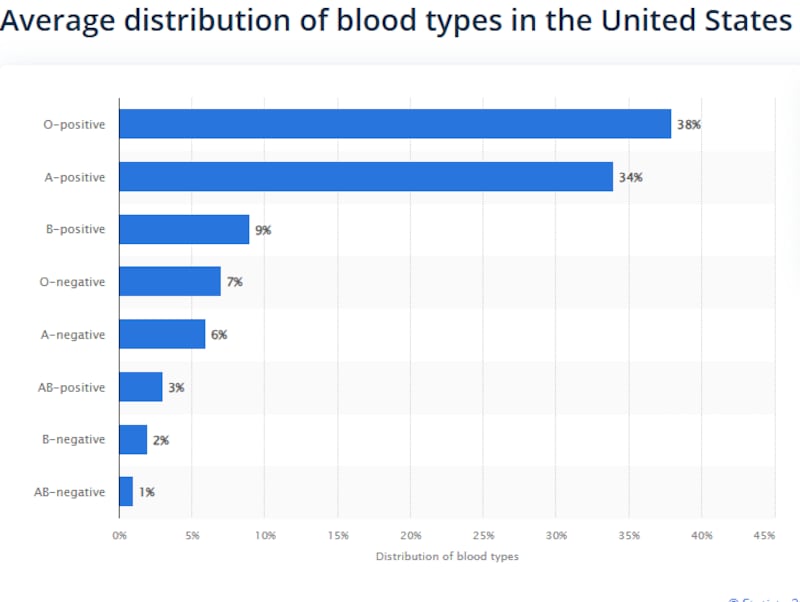
The American Red Cross noted that “type O blood accounts for about 60% of Red Cross blood distributions because it is essential for both everyday patient care and medical emergencies. Type O positive — the most commonly transfused blood type — can be safely given to about 80% of patients, while type O negative remains the universal blood type relied upon when every second counts."
When hospitals have plenty of A, B and AB blood products, they can give patients blood that matches their blood type and preserve type O blood for “life-threatening emergencies,” when there isn’t even time to type blood.
Each type of blood product has a specific shelf life, as well, so there’s a constant need for fresh donations. Platelets, for instance, only last five days, so they’re urgently needed on a regular basis.
How to donate
Level one trauma centers like Intermountain Medical Center and University Hospital also get patients with severe medical needs from all over the region, not just Utah, which also increases the demand.
Hospitals go through all of the blood very quickly. Jordan said they rely heavily on high school blood drives, but that’s another summer twist: Those aren’t happening because most schools are out on summer break. Jordan said blood banks like back-to-school.
The first national blood supply declaration by the organization was in 2022 and since then, the group has strengthened partnerships, so that about 65% of anticipated hospital blood needs are scheduled in advance, providing greater predictability for both the volume of blood products needed and where they are needed most. This enhanced coordination has helped improve the efficiency and resilience of the blood supply while ensuring careful stewardship of precious type O blood products."
Book an appointment to give blood now by using the Blood Donor App, visiting RedCrossBlood.org or calling 1-800-RED CROSS (1-800-733-2767).
To donate in Utah through ARUP, book your appointment through the Donor Portal or call 801-584-5272.