

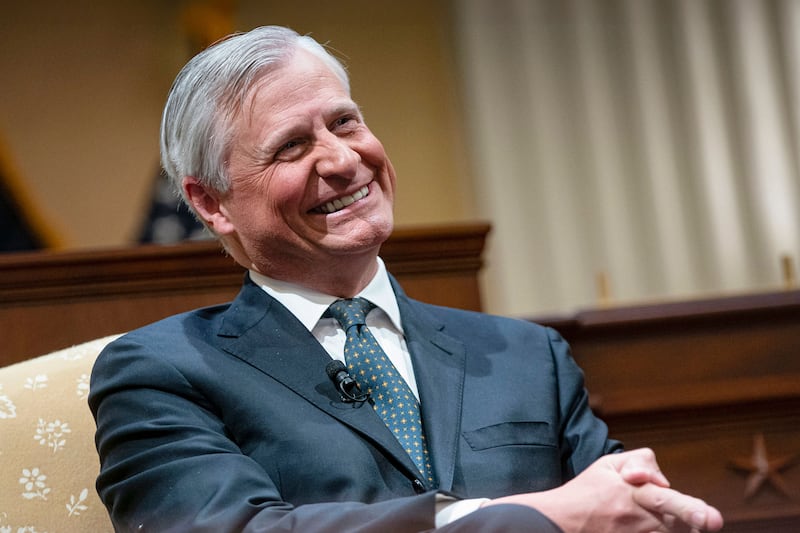


Jon Meacham is known for his insightful analysis of American political and social history. The author of more than a dozen books, including a Pulitzer Prize-winning biography of Andrew Jackson, he can’t resist comparing today’s political environment with those of the past. And he sees the partisanship that has played out over the past decade as uniquely troubling.
“I think we’re in an accelerating tragic cycle where we are getting more polarized because of the means of polarization and there’s no incentive to break out of it. So I think that’s why this is different,” he told Deseret Magazine contributing editor McKay Coppins.
The pair have known each other since Coppins started his first job in journalism at Newsweek, where Meacham was editor nearly two decades ago. The distinguished historian is currently the Carolyn T. and Robert M. Rogers Chair in the American Presidency at Vanderbilt University and co-chairs the Vanderbilt Project on Unity & Democracy.
In their conversation, edited for length and clarity, Meacham talks about his latest book, “American Struggle: Democracy, Dissent, and the Pursuit of a More Perfect Union,” in which he uses a collection of consequential speeches, letters and essays to illustrate the nation’s ongoing quest for a more perfect union, an endeavor some reviewers say is vital as America approaches its 250th anniversary.
McKay Coppins: My entire career in political journalism — starting in that summer when I walked through the door of your offices and you were running this big, important weekly magazine — has been kind of defined by two separate but interconnected trends. On the one hand, politics is meaner, coarser, more dysfunctional and more toxic, while at the same time, interest in politics has grown and gotten more intense. For a lot of reporters like me, that’s actually been advantageous in the sense that more people are reading our political coverage, more people are subscribing to our podcasts and our magazines, and buying our books. But it also corresponds with a kind of deepening pessimism about America, to the point where as America celebrates its 250th birthday, there’s talk of civil war or secession and America entering the late stages of empire. I’m curious, as a historian, what do you attribute that pessimism to?
Even at our finest hours, we were barely OK. Then all we have to be right now is
barely OK. And that’s not to minimize what that takes to recover.
Jon Meacham: I think it’s almost entirely driven by economics, and I use that in the broadest sense. It’s not just the bottom line. It’s not just people’s assets and capacity to create prosperity, but how they feel about the prospects for continuing to live in a prosperous world. You did not have this conversation about late-stage democracy during the Bicentennial in 1976. And if you think about it, you probably should have. We had just come through Vietnam; we had just come through Watergate. So you had the ingredients. We headed into a stagflationary era; within the next four years, we would have gas lines, we would have the Iranian hostage crisis — it’s always Iran. And so that period should have been one of profound public despair. All those things are largely true today. There’s an anxiety about globalization; there’s an anxiety about the cultural centrality of folks who look like me; there’s a lack of trust.
Here’s the difference: I think the media environment — and I mean it in the broadest sense — has become so polarized that there’s not enough of an opportunity to have the Tocquevillian clash of interests in which we’re able to hear the other side in such a way that we might be able to move a little closer to the other side. And so, I think we’re in an accelerating tragic cycle where we are polarized, we get more polarized because of the means of polarization, and there’s no incentive to break out of it. So I think that’s why this is different.
Coppins: You’re saying you hope that people don’t read your most recent book and come away thinking, “Ah, we’ve all been through this before, everything will be fine, we’ve been through worse. Look at 1968. Look at the Civil War.” But you’re saying that the book should illuminate something about American democracy and the American project?
Meacham: How closely fought this has been. But for a couple of battles, you’re looking at a different outcome in the middle of the 19th century. But for Abraham Lincoln saying he wasn’t going to take the Crittenden Compromise to avert the Civil War. But when does slavery ultimately end? Maybe not until the 20th century. It was that close.
America First in 1940–41, which was such a strong movement that we didn’t declare war on Nazi Germany until five days after Pearl Harbor when they declared war on us. I mean, the greatest thing America ever did, arguably, was fight the Second World War. And nobody seems to remember that we were genuinely dragged into it almost a week after being attacked at Pearl Harbor. But it does say that even at our finest hours, we were barely OK, then all we have to be right now is barely OK. And that’s not to minimize what that takes.
The fundamental risk of the era is that we no longer argue about the means of politics; we argue about the purpose. And when that happens, you are moving to kind of an adjacent supra-constitutional moment. Because the Constitution, arguably, isn’t really working particularly well right now. So here’s the question: Are there enough people who are willing to vote against their immediate partisan inclinations and what they see as their immediate interests to preserve an arena of contention or not?
We have to embrace the capacity that someone with whom I fundamentally disagree, if they win an election, they are allowed to exercise the attendant power and authority that comes from that.
Coppins: For a long time, and coming out of my conversations with Mitt Romney, which spanned a couple of years, I was actually pretty convinced that the ideological transmogrification of the modern Republican Party was permanent. That said, the one thing that makes me second-guess myself is that the obvious flexibility of Republican politicians that’s been on display in the last 10 years suggests that there is possibly hope for a new leader with a completely different brand of Republicanism, that he comes to power, or she comes to power, and steers them in a totally different direction. What do you think?
Meacham: I hadn’t quite heard it that way. That’s fascinating. If the party is in fact Silly Putty, does it depend on whose hands it’s in? And I would say yes because if you look at the 48 months between Mitt Romney being the nominee to Donald Trump, if something can happen in 48 months, you’re right, it can happen the other way. Partly because — and this is an imprecise — 35 percent of the country’s always kind of a hardcore nationalist, very right of center force. I use that number because it’s the number that still approved of Joe McCarthy after McCarthy fell from power, and basically what Dwight Eisenhower and his successors were trying to do was keep it at 35 percent. What happened was the 35 percent took over and got the 15 percent for all sorts of reasons, and they prevailed. What you’re arguing is that the 15 percent are the ones who might follow a more moderate person. And I think you’re right. Who would that be? Who are the candidates?
Coppins: That’s the problem, right? Most likely, it’s somebody who’s not really that much on our radar right now. I do think it has to be a positive, proactive message. And maybe we are ready as a country for a more optimistic Republicanism similar to Bush and Reagan. We’d have to see something like that.
You mentioned Mitt Romney. One of the first things that he showed me when I started interviewing him for my biography was this Rand McNally map that he keeps on the wall of his Senate office, that basically traces 4,000 years of human history throughout the civilizations according to the rise and fall of global superpowers. And the thing that always stood out to him was that all of human civilization — with very few exceptions — has been dominated by emperors, kings, kaisers, tyrants of one kind or another. And democracy is this incredibly rare thing in human history. It’s fragile, it’s complicated, it takes constant hard work to preserve. And I wonder if as a historian you think there is something uniquely difficult about preserving the American project?
Meacham: I absolutely do, and it’s not just as a historian and biographer, but also as a Christian. This is a counterintuitive enterprise because a democracy is about giving as well as taking. And I believe the default position starts in the second chapter of Genesis, which is that we would rather take than give. There was a piece of fruit, we were told not to take it, we took it, mayhem ensued, right? So democracy requires an effort of moral will that is incredibly difficult to sustain. Either being a strongman or signing up with a strongman is an easier way to negotiate life’s complexities than to live with ambiguity. We have to embrace the capacity that someone with whom I fundamentally disagree, if they win an election, they are allowed to exercise the attendant power and authority that comes from that. That’s really hard and requires us to love our neighbor. There’s a reason both the author of Leviticus and Jesus had to command people to do it. It’s because no one was doing it. Or at least not enough people were.
We’re talking in a period where King Charles has just been in the United States. He gave, I think, a really interesting speech to Congress, in which he said very obvious things about the Western liberal tradition that in many ways begins with English Common Law and Magna Carta, so almost a thousand years. And the fact that it struck people as notable tells you that this is a season, to bring this full circle, a season where it’s harder than it has been to give as well as to take. And part of it requires the creation of a climate in which that’s encouraged and not discouraged. And a singular legacy of the incumbent president of the United States is that he has made harshness and taking (rather than giving) fashionable, and has prioritized those things over kindness and giving.
Coppins: Are you optimistic America makes it to another — forget 250 years — another 100 years?
Meacham: Somebody asked me the other day, “What’s my birthday wish for America?” and it’s that we have a 251st.
Coppins: That’s bleak.
The media environment has become so polarized that there’s not enough of an opportunity to hear the other side in a way that we might be able to move a little closer to the other side.
Meacham: I don’t really think that, but at the same time, I wouldn’t have thought we would be having this conversation, right? I mean, if we had planned this a decade ago, we would have thought, “You know what, in 2026, we’re probably going to be discussing the literary antecedents of the Declaration of Independence.” We would not be talking about — and I don’t want to be too personal here, but we are dealing in my family with friends who have run afoul of ICE — a kind of darkness-at-noon situation where there’s no charge against someone, but they are in a cage in a different state. If I took time to tell you this story, you would think I was talking about a totalitarian state.
And it shouldn’t take a personal connection to an outrage for us to stand up for common law and common decency, but it often does. Empathy is the oxygen of democracy. And so, I am optimistic and hopeful to the extent that I believe in the human capacity to lend a hand as well as clench a fist.
Coppins: There’s obviously a lot in the world happening that is anxiety-inducing, that makes people angry — it can be very stressful to follow the news or to comment on the news as you and I both do. What are you doing lately that is keeping you sane, keeping you grounded?
Meacham: For a long time, I have read the morning and evening prayers using the 1928 Book of Common Prayer of the Episcopal Church. It’s a small service, it takes about four minutes probably. I probably shouldn’t admit that, I probably should be thinking more and praying more than that, but I read the word. I do it in the morning and I do it at night. Even if my mind is 100 miles away, I have to say the words out loud. I read it out loud and there’s something about that. Here’s what I close the day with, attributed to John Henry Newman: “O Lord, support us all the day long until the shadows lengthen and the evening comes, and the fever of life is over, and the busy world is hushed, and our work is done. Then in thy mercy, grant us a safe lodging, and a holy rest, and peace at the last.” You do that every night and you can keep marching.
This story appears in the July/August 2026 issue of Deseret Magazine under the headline “Echoes of history.” Learn more about how to subscribe.