

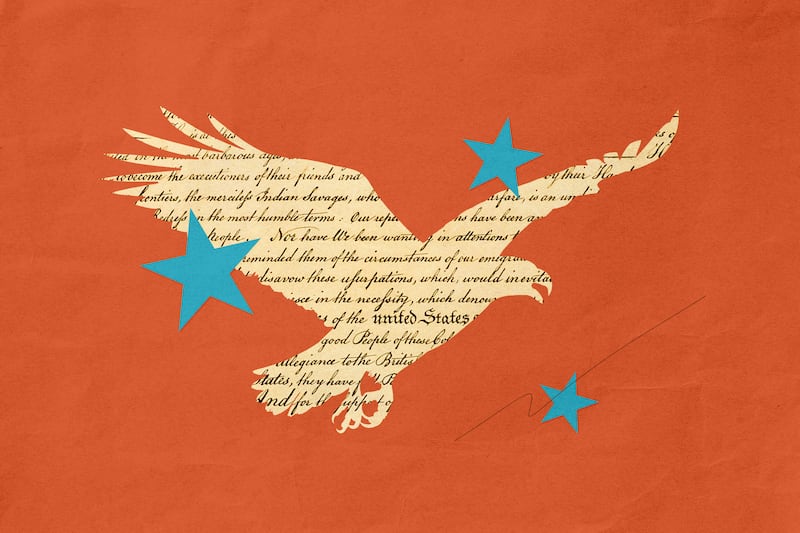

Could a milestone be more deserving of celebration and commemoration than the 250th anniversary of the Declaration of Independence?
First, the values and principles animating the American Revolution — radical in their time — enabled the freedom and prosperity that have persisted for generations ever since. Today’s Americans are the greatest beneficiaries of the forces of progress and flourishing unleashed by the founding generation.
But second, the events of 1776 redound far beyond the United States, for the declaration has inspired nearly every subsequent human movement for liberty — and against tyranny.
Indeed, the impact of Thomas Jefferson’s words contradicts the man himself. It was in his letter to Edward Carrington in 1788 that he famously observed, “the natural course of things is for liberty to yield, and government to gain ground.”
Many freedom-loving Americans, surveying the scale and power of today’s government, treat Jefferson’s warning as axiomatic. And that may be true. But in the two centuries-plus since he said it, it’s been wrong.
By nearly any measure, the world is freer today than it was in Jefferson’s time. Government is far larger than at any time in our history. But consider the tremendous progress of America in liberty and equal rights for nearly every minority group since 1788. I’d sooner argue that since the American founding, the natural course of things has been for government to yield and liberty to gain ground.
But even with an awareness and appreciation for the sweep of history over the past 250 years and its upward march of freedom and prosperity for Americans, one can’t help but feel a sense of concern as we mark the declaration’s milestone. Are we at an inflection point where Jefferson’s warning is proved out? And recall Benjamin Franklin’s famous admonition as the curtain came down on the Constitutional Convention.
“Well, Doctor, what have we got?” asked Elizabeth Willing Powel.
“A republic … if you can keep it.”
We have kept it so far. And we’ve done so through periods of incredible stress, including bitter partisan battles, economic and social upheaval, and even a great Civil War. But the amount of stress we’re placing on it today makes Franklin’s question relevant in our own age. We’re simply asking too much of our republic when, as citizens, we ask too much of our government.
As the writer George Will has remarked on today’s intense polarization, “one reason the temperature of the nation’s discourse is high is that the stakes are high.” Government intervention and power now pervade nearly every aspect of our lives.
Americans used to look toward family and community for support when dealing with the inevitable rough patches of life. But increasingly, our first call is to the state to “do something” when we face such challenges. And the political class is all too happy to indulge, evidenced by federal spending that grows inexorably higher — and less sustainable — as the years pass.
With the scope and power of federal policymaking exceeding anything the founding generation could have imagined, it’s undermining their splendid constitutional architecture: the very thing that has engineered our current age of freedom and prosperity. And while the bending of that architecture is not new, it’s accelerating and being pushed to new boundaries.
So as we commemorate a revolution that was largely fought over the rule of law and executive power, it’s ironic that two of the most concerning trends in today’s America are the deterioration of the rule of law and an accumulation by both parties of breathtaking presidential power that is increasingly being wielded in unconstitutional and extralegal ways.
And could there be any clearer call that our efforts to “keep” the republic are at risk than bearing witness to 2020’s attempts to disrupt the peaceful transition of government that has been a hallmark of these 250 years?
Let’s do more than commemorate and celebrate the 250th. Let’s ask our government to do less for us, so that we can again feel the sense of empowerment and meaning that comes from doing more for ourselves.
Let’s insist that government live within its means, so that the power of our economy to generate prosperity for all is not derailed.
Finally, let’s renew our commitment to meet Franklin’s challenge, and keep the republic that will protect the lives, liberty and economic well-being of the future generations that follow us for the next 250 years.
This story appears in the July/August 2026 issue of Deseret Magazine. Learn more about how to subscribe.