


A new pencil is a new beginning. For me, that goes back to the start. Before memory. Before language. Before I knew what words were, much less that they could become a life.
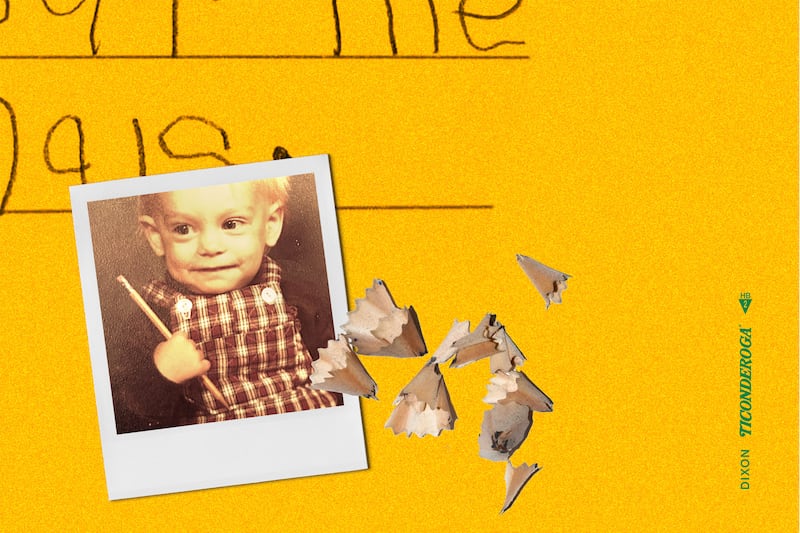
In a box of old family photographs, there is a studio portrait my mother arranged. I am a toddler in plaid overalls, grinning into the camera, my hair so blonde it’s nearly white, clutching a yellow wooden pencil as though someone had entrusted me with a tiny wand. My eyes are bright with a delight I cannot explain. Looking back now, it seems less like a photograph and more like a prophecy.
For as long as I can remember, a pencil has been the instrument of where I start. There is the faint sweetness of cedar released by a fresh sharpening, the whisper of graphite finding paper, the soft drag across a blank page that sounds, somehow, like possibility itself.
A sharpened pencil does not demand perfection. It asks only that you begin. Every to-do list, every interview I do as a journalist, every first sentence starts with that invitation.
I prefer the Ticonderoga. A box of them sits on my desk. Others wait, freshly sharpened, in a ceramic cup I got on a reporting trip to China. Six flat sides. School-bus yellow. The lacquer has a richness to it, like the finish on a fine piece of furniture. The name Ticonderoga stamped in a metallic Kelly green. It shimmers when I rotate it between my fingers.
I like how it feels in my hand. A Ticonderoga has weight to it. Not much, but enough.
The cedar is firm. The graphite holds its point. The eraser doesn’t crumble into pink confetti after a few mistakes. It embodies a simple philosophy I admire more with every passing year. If a thing is worth making, it is worth making well.
I suppose I favor the pencil because of something I often forget: that mistakes are not failures but part of the design. Pens insist on certainty. But a pencil arrives with its own forgiveness attached.
The pink eraser is not an afterthought; it is part of the architecture. We are meant to cross things out. We are expected to change our minds. The page becomes more interesting for the evidence of our revisions. For the smudges left by the eraser.
Perhaps that’s why, despite all the glowing screens that have followed me through adulthood, I still reach for a wooden pencil when something matters. Before I interview a stranger on a reporting trip. Before I outline a magazine story. Before I try to understand my own thoughts.
There is something grounding about its weight, something reassuring about knowing it will slowly disappear with use. Unlike the battery-powered tools that surround us, a pencil fulfills its purpose by becoming smaller.
Its usefulness is measured by what it gives away.
I sometimes think about that little boy in the photograph, smiling at an object he could not yet use. Neither of us knew then that the pencil would become less a tool than a companion, following me from spelling tests to newspaper notebooks, from college lectures to magazine deadlines, from childhood curiosity into a career built one sentence at a time.
I have owned thousands of pencils. None of them lasted very long. Yet together they have quietly sketched the outline of an entire life.
This story appears in the September 2026 issue of Deseret Magazine under the headline “My write or die.” Learn more about how to subscribe.