

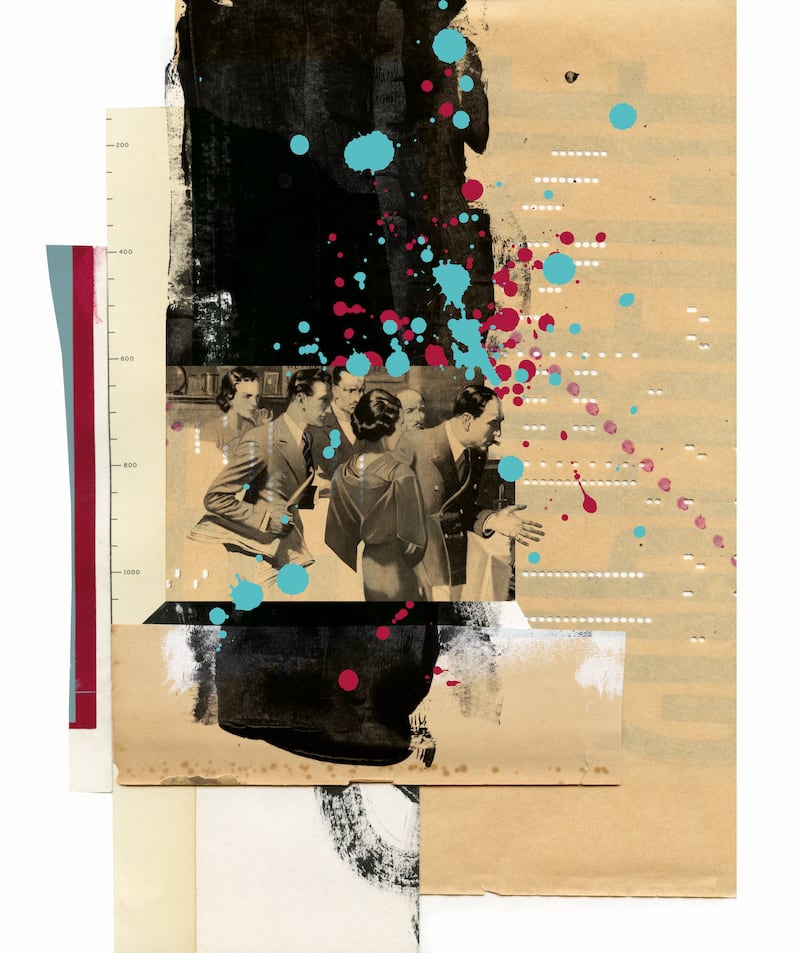

Five minutes into the bidding, the price kept climbing, a million dollars at a time. Inside Christie’s saleroom at Rockefeller Center in midtown Manhattan, Global President Alex Rotter stood on the side balcony, one hand hiding his mouth as he relayed bids from a client on the phone. Across the aisle, auctioneer Adrien Meyer locked eyes with a front-row bidder, later identified as Swiss dealer Iwan Wirth, reading his cues to keep the bidding going. Paddles sank as three of the five original contenders dropped out.
On this Monday evening in May, the eighth lot up for grabs was Jackson Pollock’s “Number 7A, 1948” — a dizzying canvas of oil and enamel, black drizzles streaked with red splotches, almost 11 feet long. Its previous owner, publishing magnate Samuel Irving “S.I.” Newhouse Jr., died in 2017. “Last chance at $153 million,” Meyer called, his voice edged with disbelief. “No regrets at 153 with Alex Rotter’s telephone.”
A few seats away from Rotter, Christie’s senior specialist Ana Maria Celis, dressed in black with a pale green feathered pompom pinned to her dress, raised her hand while holding her own phone to her ear. Another remote player was entering the game.
“One hundred fifty-four million in a new place,” Meyer announced, drawing an audible gasp from the room. The bidding continued: from Rotter’s client at $155 million to Celis’ at $156 million and back to Rotter’s with the final bid of $157 million.
When the hammer fell, applause erupted as Rotter smiled, still speaking to the anonymous buyer who had just secured a coveted masterpiece for $181.2 million with fees — the fourth-highest price ever paid at auction, part of a billion-dollar evening.
The next morning, the art world buzzed with speculation. Who bought the Pollock? A foreign royal? A Silicon Valley billionaire? A longtime collector who had never appeared in the headlines?
The sale represented more than a record-breaking price. S.I. Newhouse was a renowned patron of the arts, a collector who served on the board of New York’s Museum of Modern Art for three decades. Now, a painting once displayed in his Manhattan home had moved into unknown hands. It was a sign of changing times in the art world, from an age when prominent collectors embraced public recognition to a time when many of the world’s wealthiest buyers value privacy instead.
Researchers have coined the term “wealth shame” to describe why some affluent people are more cautious with their image.
Discretion has not diminished their influence. Private collectors still shape the art world, supporting living artists, driving up auction prices and shaping museum collections through loans, gifts and bequests.
But their domain is less concentrated now, with major collections dotting the map from Manhattan to Los Angeles — including the Mountain West, where a growing class of supporters has also embraced anonymity. Why are so many of today’s art collectors choosing to stay out of the spotlight, and how do they do it?
A new class of collectors
Art collecting has always balanced competing impulses: private ownership and public display. Collections have signaled political power or personal taste, revealing not only what people valued but how they wanted to be seen.
In ancient Rome, generals filled their villas with treasures taken from conquered lands. During the Renaissance, families like the Medicis commissioned chapels, frescoes and sculptures that proclaimed both their wealth and their standing within the Catholic Church.
That changed with the evolution of the art market. Dealers in the 17th century Dutch Republic learned that protecting identities helped to preserve negotiations and keep rival bidders at bay. When James Christie opened his London auction house in 1766, the catalog for its inaugural sale identified the consigner only as a “noble personage (deceas’d).”
Christie understood that auctions thrived on spectacle, but transactions depended on privacy. Anonymity also shielded the often-embarrassing circumstances that brought works to market: death, divorce and debt.
In the late 19th century, America’s industrial boom spawned a new class of celebrity collectors. Some, like Isabella Stewart Gardner, Peggy Guggenheim, Henry Clay Frick and Elizabeth Harwood turned private collections into public institutions, laying the groundwork for modern museums. Others prized discretion.
J. Pierpont Morgan filled his homes with old masters, creating private museums for friends and associates, yet he also gifted works anonymously as president of the Metropolitan Museum of Art. He believed “a gentleman should never advertise his benefactions,” according to biographer Frederick Lewis Allen.
Similarly, Andrew Mellon kept his purchase of 21 paintings from the Soviet sale of the Hermitage Museum in the 1930s secret, until he made them the foundation of the National Gallery of Art, a building he financed but declined to name after himself.
Today’s collectors represent a broader spectrum of society. Entrepreneurs, investors, tech executives and family offices view art as both a passion and an investment.
Evan Beard, who built Bank of America’s art advisory and finance group before launching Beard & Co., says some clients approach collecting like scholars, studying a single artist or movement. Others use art to diversify their investment portfolios, support tax planning through museum loans, or transfer wealth across generations. Increasingly, they all want to control how that wealth is perceived.
“There’s a group of people in many countries that would prefer to not land on the Forbes 400 list,” Beard says. “If word gets out that you’re buying Matisse and Monet in Liechtenstein, that is a signifier that you are wealthy.”
Anonymity has become a shield against public judgment, social media, competitors and even security threats. In recent decades, public attitudes toward extreme wealth have hardened amid widening global inequality. Displays of luxury that once drew admiration now invite scrutiny or resentment.
Researchers have coined the term “wealth shame” to describe why some affluent people are more cautious with their image, emphasizing philanthropy and keeping their spending private. Art buyers often act through advisers, LLCs or trusts, and U.S. disclosure rules don’t require auction houses to reveal their identities.
Not that they’re hiding anything illicit; they’re simply trying to stay out of tomorrow’s headlines.
Private sales now account for 19% of revenue at auction houses, though the practice is centuries old. Christie’s executed its first landmark private sale in 1779, transferring 204 paintings from former British Prime Minister Robert Walpole’s collection to Catherine the Great of Russia.
Delighted, the Russian empress wrote to a friend: “Your humble servant has already got her claws on them and will no more let them go than a cat would a mouse.”
Shielded from scrutiny
On the morning of Dec. 15, 2022, a shipping crew found the padlock cut on its van outside a hotel in Boulder, Colorado. Five paintings worth about $400,000 were gone.
Among them were two paintings bound for a couple in Englewood, Colorado: an abstract bullfight scene by Elaine de Kooning, the Expressionist artist known for her portrait of John F. Kennedy, and a bucolic landscape by Jane Freilicher, a key figure of the mid-century New York School. Two months earlier, the couple’s adviser, Colleen Fanning, had traveled to the Frieze art fair in London to inspect the works before finalizing the purchase.
For Fanning, the theft posed a dilemma. Keeping it quiet could increase the chances that the paintings would resurface on the market. Going public would expose her clients, but could also open more investigative leads. After some persuasion, the couple agreed to publicize the theft, while withholding their names.
The story ran nationally, in outlets from Forbes and The Art Newspaper to Smithsonian Magazine. Less than a month later, a tip led police to a hotel room in nearby Lakewood, where all five paintings were recovered.
“I try to be the protector,” Fanning says.

That has become a central function of the modern art adviser. She opened her practice in 2008, after previously overseeing public art at the Denver International Airport, stepping into one of the art world’s least visible but most influential positions.
Advisers help collectors to find works, negotiate purchases and navigate a market built on relationships and trust. Some clients ask Fanning to tell the story behind some newly acquired painting to guests at a dinner party, but others want complete confidentiality: no photographs of art in their homes, no public mention and no trace of ownership. Whether she’s bidding at auction on their behalf, arranging museum loans or negotiating private sales, Fanning preserves those boundaries.
“In the art world, there are so many people who will sabotage what you’re working on,” she says. “A lot of us just keep our mouths shut and we don’t really talk about much.”
Here, information is currency. Knowing who owns a particular work, or who is trying to buy one, can fuel speculation, influence prices, and make or break negotiations.
At fairs like Art Basel and Frieze, galleries often share prices only with select collectors and advisers, leaving others to guess. That culture extends beyond the sales floor. New York-based adviser Wendy Cromwell encourages clients to develop direct relationships with galleries and artists whenever possible. But when they lend works to museums, she recommends anonymity.
“There’s a lot of invasive behavior in the art world,” Cromwell says. “A lot of art dealers will buy a book in a museum show and see who the lenders are just to know who owns what, and then solicit business that way.”
A name on a museum wall can incur donation requests, invitations to serve on boards and heightened attention on one’s business ventures or personal affiliations. Museums must also navigate the perception of relationships with controversial donors.
In recent years, the Metropolitan Museum of Art and the Louvre both removed the Sackler name from galleries after protests over the role that their company, Purdue Pharma, played in the opioid crisis.
Museums rely more than ever on private collectors for financial support and art loans that make exhibitions possible. The American Alliance of Museums advises them to evaluate anonymous gifts on a case-by-case basis, warning against situations that “conceal a conflict of interest, real or perceived.” Yet collectors often serve simultaneously as donors, trustees and lenders to those same museums, so it can be difficult to separate their roles.
Some collectors have responded by creating museums of their own. At The Broad in Los Angeles and the Rubell Museum in Miami, billionaires share their collections with the public while retaining control over how the works are displayed and preserved — and, by extension, how their own legacies are shaped.
Others, like the Tia Collection in Santa Fe, are more discreet. Established in 2007 by a collector of Southwestern art, its holdings have grown to more than 5,000 works, often loaned to museums around the world. The collection’s subtle namesake — the founder’s daughter, 25-year-old Tia Tanna — recently became its associate director. Her father has remained out of view.
“He has always wanted the focus to be on the art and the artists,” former Tia curator Laura Finlay Smith said on the “Art Dealer Diaries” podcast in 2020. “It’s not a vanity project for him.”
Anonymity out West
Before joining Christie’s American Art department, Tylee Abbott spent his summers on a ranch in Montana. Raised in a Quaker family in Philadelphia, he developed an early affinity for Western art.
His ancestor, William Tylee Ranney, was a 19th century painter who produced some 150 works on the Revolutionary War, western migration and frontier life. Abbott’s family also supported institutions like the Buffalo Bill Center of the West in Cody, Wyoming, which mounted a retrospective of Ranney’s work in 2006, though they never attached their names to their philanthropy. “They were the opposite of ostentatious,” Abbott says.
Today he oversees some of Christie’s largest Western art sales, including this year’s record-breaking auction of oil billionaire William Koch’s collection. Once a regional niche, Western art has become one of the fastest-growing segments of the market, driven by wealth in California and Arizona, and collectors with second homes in resort enclaves like Aspen, Jackson Hole and Park City.
In this region, wealth has long been associated with land, hard work and independence, values that shape how people think about success, generosity and patronage.
“Around here there is the biblical injunction that you don’t have to share your name or fame with the world.”
Throughout the West, traditions of anonymous giving have been influenced by the teachings of The Church of Jesus Christ of Latter-day Saints, where charitable acts done without expectation of public recognition are seen as expressions of humility. “Around here there is the biblical injunction that you don’t have to share your name or your fame with the world,” says Rita Wright, former director of Utah’s Springville Museum of Art.
Few events capture collecting in the region like the Coeur d’Alene Art Auction in Reno, Nevada. Every summer, collectors compete for works by celebrated artists such as Charles M. Russell, Thomas Moran, Frank Tenney Johnson and members of the Taos Society of Artists.
Compared to Christie’s, there are fewer tailored suits, fewer reporters and many more cowboy boots. But the dynamics are familiar — collectors bidding on coveted works at sometimes extraordinary prices, while deciding whether anyone will ever know their names.
Mike Overby, who has led the auction for decades, calls it “the most fun and lively auction you’ll ever attend.” Online and phone bidding have expanded since the pandemic, but the live event still draws roughly 500 collectors from across the United States and abroad, giving it the feel of a family reunion. Overby says collectors of Western art are rarely motivated by profit and renown.
“Maybe in New York, when people are buying a Picasso, they want the whole world to know that they were the buyers of it,” Overby says. “With our people, they tend to be a little more conservative. They’re buying the art because they really want it.”
At noon on July 25, Overby took the stage of a Reno resort ballroom wearing sneakers and a lavender tie. With a Western twang, he greeted bidders by name and moved through over 300 lots with the ease of an old hand.
Many works sold for only a few thousand dollars. Others climbed into six and seven figures. By the end of the afternoon, the auction had set a record $17 million in sales, including a $968,000 bronze cast of Frederic Remington’s “The Broncho Buster” and John Clymer’s “The Trader,” a snowy landscape depicting fur traders encountering a Native tribe. With fees, the painting sold for $1.1 million to an anonymous phone bidder.
The buyer’s identity never became public, and unlike the frenzy that followed the sale of Pollock’s “Number 7A,” few people spent the next day trying to unmask the collector. The painting had found a new home, and that was news enough.
This story appears in the October 2026 issue of Deseret Magazine under the headline “Anonymous Buyers.” Learn more about how to subscribe.