

Today, the label “do-nothing Congress” is most often associated with a metaphor popularized by President Harry S. Truman during the 1948 presidential campaign. Looking back through the lens of history, it seems far more applicable today than it did then.
During the summer and fall of 1948, when his chances of reelection looked bleak, Truman directly appealed to the American people by giving campaign speeches from the rear platform of the Ferdinand Magellan, “the only private railroad ever fitted out for the exclusive use of the President,” per David McCullough. Over 33 days, his famous whistlestop campaign took him nearly 22,000 miles on “a cross-country trip to California, a six-day sprint through the Midwest, and a ten-day run through the large population centers of the Northeast.” Often before huge crowds, Truman relentlessly attacked the Republican-controlled “80th do-nothing Congress,” and explained “to average Americans why the policies of the Democrats benefitted them.”
Despite the fact that the 80th Congress passed 906 public laws in two years, the nickname “do-nothing Congress” stuck. They “did nothing” on Truman’s domestic agenda, but the Republicans did approve two significant actions relating to the presidency — the 22nd Amendment, limiting the tenure of future presidents to two terms, and the Presidential Succession Act of 1947, which changed the order of succession in the event of the death of a president. They also passed the Marshall Plan, which provided significant economic aid to help rebuild Western Europe after World War II; the Greek-Turkish Aid Act; the National Security Act of 1947; the Taft-Hartley Labor-Management Act; the U.S. Information and Educational Exchange Act; the Displaced Persons Act of 1948; and the Federal Water Pollution Control Act of 1948.
Contrast those notable accomplishments with the work of the current Congress, which has passed fewer than 150 laws. Just days from now, the 118th Congress will be gaveled into history. It will leave behind the distinction of being the least productive Congress since just prior to the Civil War.
A legitimate question is whether a comparison of the number of bills passed into law over time is the best way to measure productivity. During the past several decades, the size and scope of legislation have changed dramatically, as Congress has often bundled several bills from disparate policy areas in one massive omnibus bill instead of voting on them individually, as was done earlier. As George Washington University political scientist Sarah Binder has observed, “‘omnibus legislating’ (packing numerous small measures into a single mammoth bill) complicates comparing the number of laws enacted over time. And simple counts treat all laws the same even though some measures target narrow matters, while others temporarily fund the entire federal government.”
Obviously, this context is crucial for understanding whether Congress is doing an effective lawmaking job, but irrespective of how you measure the accomplishments of the 118th Congress, it has been historically unproductive. Not since the 35th Congress (March 4, 1857-March 3, 1859) have fewer than 150 bills been approved each two-year biennium.
While the average number of bills passed is significantly lower for the last two decades, the 118th Congress is still grossly unproductive by comparison with the 10 previous Congresses (2003-2022), which averaged 388 public bills signed into law. More recently, the 116th Congress (2019-2020), a Republican-controlled Senate and Democratic-held House, reached agreement on 344 measures. That number changed little in the 117th Congress (2021-2022), when the Democrats controlled both chambers of Congress and the White House, and 362 public bills were signed into law. Several of those laws contained multiple bills, a vast portion of which required bipartisan support to move through the Senate.
What in the past two years has transpired on Capitol Hill that prompted such a difference between the current Congress and its two most immediate predecessors? A vast majority of the bills approved by the 118th Congress are noncontroversial bills that passed either by unanimous consent or with minimal opposition. Even when the two chambers brokered deals, several of the laws passed were just short-term extensions, allowing members of Congress to delay the tough job of compromise on big-picture legislation. Except for legislation necessary to avoid a government shutdown or a default on the country’s debt, but only after struggling to reach a consensus, the 118th Congress passed little significant legislation.
Left unfinished is important bipartisan legislation on immigration policy and border security, railway safety, the farm bill and taxes. Reforms to bedrock programs like Medicare and Social Security are desperately needed but still remain no closer to getting passed. A majority of the bills approved have not been controversial, and 28% of those measures named or renamed federal buildings (such as post offices and Veterans Affairs clinics), or provided for the minting of commemorative coins and Congressional Gold Medals.
Clearly, growing differences both within and between the parties have made it increasingly more challenging to find issues on which both sides are willing to seriously consider. Even when they have worked hard to try and reach a compromise, as a trio of bipartisan senators did after spending months negotiating a deal on immigration, the lack of backing by their leadership undoubtedly made them understandably far less motivated to try again.
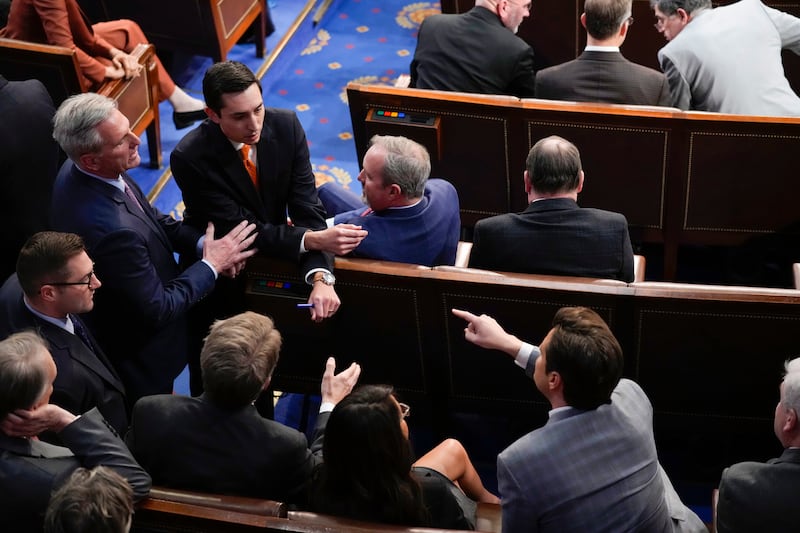
Also, twice in nine months during the first session, the turbulent bickering among House Republicans over who should lead the GOP’s razor-thin majority as speaker prompted 15 rounds of voting over several days and nights in January 2023, and three weeks of chaos after the House voted to remove Speaker Kevin McCarthy. The latter action paralyzed the chamber in October 2023 as Republicans went back and forth over his successor.
Despite a spurt that saw the current Congress approve more than 43% of its enactments since September, there is little time left to finish enough other initiatives to avoid a historic unproductive ending.