



The oldest human governance system is the clan, usually revolving around descent from a common male ancestor. Before there were kingdoms, there were clans. Before there were empires, there were clans. And before there were nation-states, there were clans. And when empires or nation-states weaken and fall, clan governance surges into the vacuum to prevent complete anarchy.
Interestingly, a return to clan governance is currently making the rounds as a possible way to resolve the Israeli-Palestinian conflict. Before there was the Palestinian Liberation Organization (PLO), before the Palestinian Authority (PA), and before Hamas, there was governance by local clans and their leaders, or sheikhs.
Not surprisingly, the clans were subordinated for decades by the more general, more modern Palestinian activist groups. It was these groups that were recognized and empowered through the Oslo Peace Accords of 1993 — it was Yasir Arafat who was the signatory on the Accords for the Palestinians. The aim of the Accords was a two-state solution, and as a result Israel began to turn over governance functions to the Palestinian Authority.
But the past 30-plus years have not been kind to the Accords. One nail in the coffin was the election of Hamas as leadership of the Gaza Strip in 2006; given that the PA and Hamas detested each other, governance splintered. And, of course, the Oct. 7 massacre of 2023 was the final nail for Oslo’s demise. While Hamas has largely been neutralized by Israeli strikes, the question of how Palestinians and Israelis are to live together remains up in the air.

Trump would like to see Gazans vacate the Strip and be paid to move elsewhere. Others still argue for one-state or two-state solutions. But recently, an old proposal has resurfaced and is getting a second look: return power to the clans. “Palestine” would thus become more like the United Arab Emirates than a unified nation-state.
In the UAE, different areas are ruled by seven different clans, and the state is a federation of these subnational units. By hereditary right, the two strongest clans hold the presidency and the prime ministership of the federation. Each emirate autonomously oversees the governance of its territory; each, for example, has its own police force that coordinates through the federal interior ministry.
How would this apply in Palestinian lands? The sheikhs of Hebron, one of the largest cities in the West Bank, propose to establish the Emirate of Hebron and to live in peace with Israel by signing the Abraham Accords negotiated by Trump in his first administration.
In return for no longer being ruled by the Palestinian Authority, the new emirate would recognize Israel and punish harshly any of the emirate’s subjects who plan or perpetrate terror. A guest worker program and joint economic zone with Israel would be part of the package.
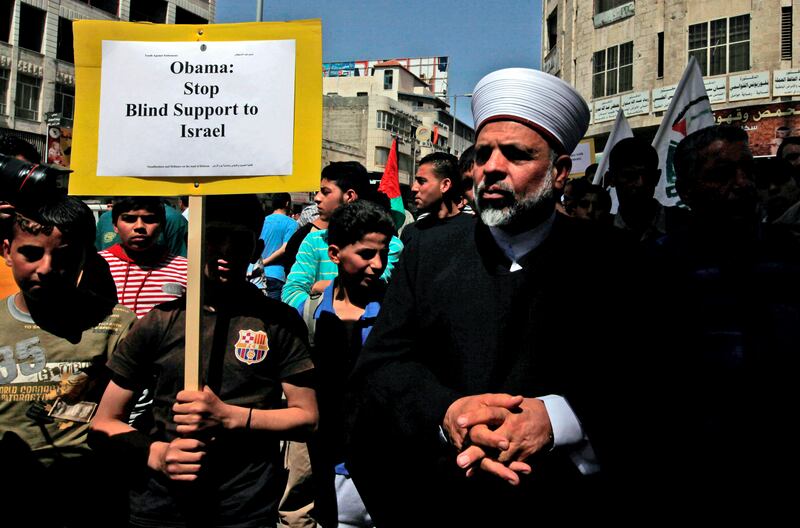
Of the Hebron-area sheikhs, 21 have signed on to the proposal being shepherded by Shaikh Jaabari of the most powerful clan, which collectively claims the allegiance of about 80% of the residents of the Hebron area. While the PLO, the PA and Hamas united the governed under the banner of hatred of Israel, ensuring endless conflict, the clans existed long before the modern state of Israel was formed in 1948. Their legitimacy derives not from their stance vis a vis Israel, but rather from the ancient claim of blood identity.
While I applaud any out-of-the-box thinking on Israel and Palestine, and believe the emirati model should be given its fair hearing, as someone who has written scholarly works on clan governance, I have my doubts. After all, it is instructive to remember that some of the Oct. 7 Israeli hostages, living and dead, were not in the hands of Hamas at all, but in the hands of Gazan clans, who also roared across the border on that fateful day. Why would we assume Palestinian clans would be less hateful toward Israel? Or less corrupt than the PA?

Furthermore, while clan politics may be more or less peaceful now in the Gulf States, it was not so when they were establishing which clan would have predominant say over the others. Much blood was spilt as these hierarchies were put into place, as any history of Saudi Arabia will reveal. This was echoed when Mohammed bin Salman (or MBS, as he is known) came to power in 2017, and there was a huge purge of clan rivals. If the Emirate of Hebron has 21-plus clans, each of which will have armed men as security forces, why would we assume these would not turn on each other? Or turn on Israel as a point of leverage in inter-clan rivalries?
In addition, because clan governance is anything but democratic, my own research shows that clan-based societies are typically very restrictive of women. This is because it is very difficult to maintain a clear bloodline identity with appropriate socialization of the young without the compliance of women. Because the clan depends on this contribution of women, their lives are, generally speaking, tightly controlled. But the subordination of women does not lead to a peaceful society, but a conflictual one.

It should give one pause that the Israeli Defense Forces and the Shin Bet (Israeli intelligence) are none too keen on the proposal. One retired Israeli general posed the right question: “How do you deal with dozens of different families, each of them armed, each under its own control?” It would be akin to the cutting of a hydra’s head; the end state of violence and terror may be worse than before.
It is high time for creative thinking on the Israeli-Palestinian conflict. A model based on the emirates of the Gulf States is a creative idea with real potential. But it has as much potential for bad as it has for good.