

In this country, it would seem like free speech is a cherished value, at least until someone uses it in a way we don’t like.
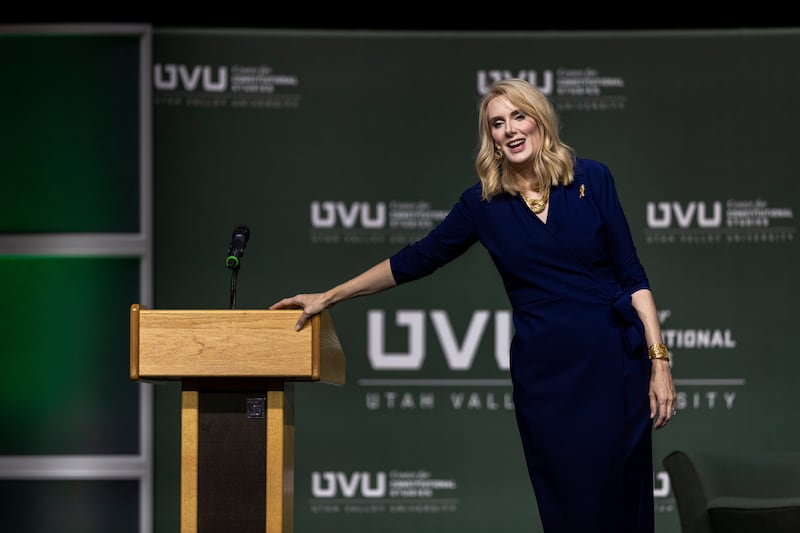
Utah Valley University’s invitation to Sharon McMahon as its commencement speaker has prompted a wave of objections from conservative student groups and political figures. They feel the comments she made in the aftermath of the assassination of Charlie Kirk were insensitive, even offensive, and therefore disqualifying. She should not, they conclude, be invited to speak at this commencement. For the record, McMahon maintains that what happened to Kirk was horrendous, should have never happened, but that Kirk’s rhetoric could be, at times, harmful.
Fair enough. People are allowed to find her comments distasteful. They’re allowed to say she struck the wrong tone, at the wrong moment, in the wrong way.
What’s more interesting is what came next: The university has now announced, due to “increased safety concerns,” that there will be no speaker at UVU’s commencement. Problem solved, one could suppose.
Out of all of this mess, this is the part that many find to be most troubling: The same political movement that has spent years warning us about the dangers of “cancel culture,” lamenting the silencing of controversial voices and insisting that universities must remain open marketplaces of ideas, demanded that this commencement speaker be stopped.
Listen, no one’s First Amendment rights are being violated here. McMahon is free to speak; her critics are free to object. That’s all as it should be. But conservatives have long argued that institutions — especially universities — should resist the urge to deplatform speakers simply because their views provoke backlash. Apparently, that principle is much easier to defend when it’s your side being shouted down. When the discomfort runs the other direction, the commitment suddenly becomes … more flexible.
We start hearing that this situation is different. This isn’t about suppressing ideas, it’s about respect, it’s about timing. It’s about sensitivity to a grieving campus community. All of which may be true — and all of which are, coincidentally, the same kinds of arguments conservatives have spent years dismissing when they come from the left. It turns out “context matters” is a far more appealing concept when it’s your context.
Let me be clear, this is not a situation unique to conservatives, at all. Progressives have their own well-documented history of deciding that certain speakers are simply too harmful, too offensive or too controversial to be given a platform. The inconsistency is bipartisan; the selective outrage is practically a national pastime. And that’s precisely why moments like this are worth noticing.
If free speech is going to mean anything beyond a rhetorical prop, it has to survive contact with the speech we dislike. Not just the mildly irritating kind, but the genuinely uncomfortable kind — the kind that makes us wince, or bristle, or wish someone had chosen a different speaker altogether.
Supreme Court Justice John Roberts once said, “Speech is powerful. It can stir people to action, move them to tears of both joy and sorrow, and … inflict great pain. … We cannot react to that pain by punishing the speaker.”
We do not need a more curated public square, where invitations are extended and revoked based less on principle and more on who happens to be offended this week. We need more respect and thoughtfulness, and to be built on the same foundations as our founding documents.
We might try trusting these graduates to exercise the tolerance required to live peaceably in the world.
A commencement address is not an endorsement of every opinion a speaker has ever held, it is not a canonization ceremony. It is, at most, an opportunity to hear from someone with a particular perspective — one that graduates are entirely free to accept, reject or ignore. This is real life. We might try trusting these graduates to exercise the tolerance required to live peaceably in the world.
Or, we can continue this exhausting cycle: We can defend free speech when it’s convenient for us, when we like what we hear, or we can qualify it when it’s not, throw tantrums to get it turned off, and eventually, act surprised when no one takes the principle seriously anymore.
If nothing else, the debate over Sharon McMahon has clarified one thing for me: We don’t actually want free speech, we want agreeable speech.
And those are not the same thing.