

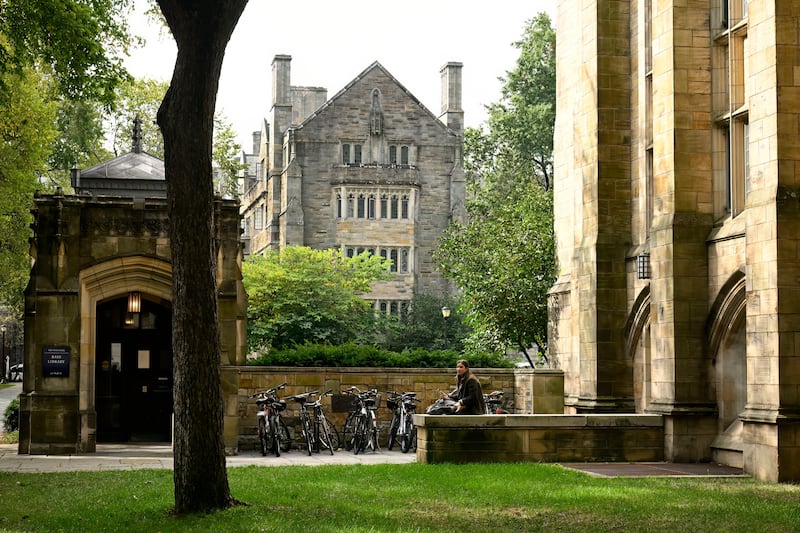
Yale University deserves credit for taking the first step to come face-to-face with the problems facing higher education in the United States by releasing an honest and candid report.
The key to change, however, lies in its ability to take the next step and the ones after that.
As critics have noted, Yale’s recently released report by an internal Committee on Trust in Higher Education was authored largely by the same people responsible for making the school’s campus a place where left-leaning ideology has made free speech and honest inquiry little more than theoretical concepts.
Still, the report offers much reason for optimism. Because of Yale’s elite status in the Pantheon of American institutions of higher learning, any changes it makes in the right direction are likely to set reforms in motion at other institutions as well.
That includes Utah’s higher education system, although the University of Utah has worked closely with state leaders in recent years in a good-faith effort to enact changes. These include initiatives to reallocate costs to programs that are in demand and that lead to high wages.
The Yale report is remarkable in its honest confrontation with higher education’s current problems, from its growing lack of trust among the American public to runaway costs, grade inflation and the lack of free speech on campus for ideas that do not conform to perceptions of accepted dogma.
“Tenured faculty have some of the strongest protections, but even some tenured faculty feel pressure to stay silent or refrain from saying what they really think,” the report said. “Faculty at all levels worry that the wrong book on a syllabus or the wrong idea expressed on social media may damage their careers or get them fired.”
It also addresses pressure from government authorities, noting that faculty have been dismissed for speaking in opposition to federal or state initiatives.
Such ideological pressures, whether internal or external, run afoul of the concept of free inquiry and the honest pursuit of truth.
The report estimates that Democratic faculty outnumber Republicans 36 to 1 across the arts, sciences, the law school, and the school of management at Yale.
Such ideological pressures, whether internal or external, run afoul of the concept of free inquiry and the honest pursuit of truth. They also have not been kept secret.
The report notes that public trust in higher education has dropped faster than it has in other institutions. Ten years ago, it said, 57% of Americans had either “a great deal” or “quite a lot” of confidence in colleges and universities. That number fell to 36% by 2024, and although it has since improved a bit, 70% of Americans still believe it’s headed in the wrong direction.
As with any good report, this one doesn’t just outline problems, it suggests 20 ways to make things better.
“We recommend that Yale undertake a multi-pronged series of initiatives and experiments, with the goal of enhancing open and critical debate on campus,” reads one.
“We recommend that the university embrace a standard of candor: It should only use criteria for admission that it is willing to describe publicly and defend openly,” says another. Admission preferences for certain groups of people should be reduced.
Another recommendation asserts, “We recommend that Yale affirmatively support a classroom environment conducive to full presence, focus, and interaction. That begins with a device-free policy — no phones, laptops, or tablets — as the default in classroom settings.”
The school’s hardest sell may be to its own students. A report in the Yale Daily News said not long after Yale President Maurie McInnis shared the report, some students were wondering “whether it sufficiently dealt with the pressures faced by undergraduates.”
While many faculty members were quoted as being pleased and optimistic about the undertaking, Mór Szepesi, the president of the Yale Political Union, said the report does not address the fact that “a lot of the censorship that happens happens because students try to police one another.”
Fair enough. A report like this cannot be expected to change overnight the prevailing culture at many American universities. However, it does represent a strong first step in recognizing the problems and urging progress, and that should not be underestimated.
Universities play a critical role in examining new ideas and researching innovative solutions to problems. A healthy system of higher education is a sign of a healthy and prosperous nation. Each school should convene a similar group to candidly confront its own version of concerns and propose its own solutions.